
Ramp vs Spendesk: Which Is Worth It for a 10–50 Person Team?
Which is actually built for managers running 10-50 person teams?
Ramp emerges as the winner for Small to Medium Businesses (SMBs) due to its ease of setup, efficient expense reporting, and robust integrations, serving over 50,000+ businesses with a 4.9/5 G2 score. However, neither platform is specifically designed with the manager's expense approval workflow in mind, highlighting a gap in the market for a solution tailored to managers' unique needs.
| Feature | Ramp | Spendesk |
|---|---|---|
| Pricing | ✓ detail | ✗ detail |
| Setup | ✓ detail | ✗ detail |
| Manager dashboard | ✓ detail | ✗ detail |
| Receipt scanning | ✓ detail | ✗ detail |
| Real-time visibility | ✓ detail | ✗ detail |
| Approval | ✓ detail | ✗ detail |
| Offline | ✓ detail | ✗ detail |
| Team size | ✓ detail | ✗ detail |
TL;DR
When comparing expense management solutions like Ramp and Spendesk, the pricing and target market become clear: Ramp offers a free plan and a $15/user/month Ramp Plus plan, while Spendesk provides a custom quote, catering more to larger, customizable needs. Ramp emerges as the winner for Small to Medium Businesses (SMBs) due to its ease of setup, efficient expense reporting, and robust integrations, serving over 50,000+ businesses with a 4.9/5 G2 score. However, neither platform is specifically designed with the manager's expense approval workflow in mind, highlighting a gap in the market for a solution tailored to managers' unique needs.
The Manager's Conundrum
Managers overseeing teams of 5-50 people spend an average of 4+ hours/week on receipt approvals, translating to $10,900/year in potential savings. Platforms like Ramp and Spendesk, while efficient for their intended use cases, do not fully address the autonomous approval needs and offline capabilities crucial for these managers. For instance, Ramp's automated receipt collection and expense categorization are beneficial but may not offer the offline scanning capability or AI-driven autonomous approval that managers with smaller teams require.
- Offline Receipt Scanning: Essential for teams frequently working without WiFi.
- AI-Powered Autonomous Approval: To reduce manual approval time, akin to saving 4 minutes per approval (8 seconds vs 12 minutes).
- Customizable, Scalable Policies: Beyond the basic or limited policies offered by standard plans.
- Dedicated Support for Smaller Teams: Custom onboarding and support tailored for teams of 5-50.
The market's projected growth from $9.09 billion in 2026 to $17.26 billion by 2034, at a CAGR of 8.30%, indicates a burgeoning need for specialized solutions. Managers seeking to fill this gap would look for a platform that not only integrates well with systems like QuickBooks or Xero but also learns from their approval patterns to act autonomously, a feature lacking in both Ramp and Spendesk's current offerings for SMBs.
Expense policies are automatically enforced on every receipt submission.
Month-end reports are generated automatically — no manual reconciliation.
The Core Difference
Ramp and Spendesk are two prominent expense management tools catering to different market segments. Ramp is best suited for mid-market companies with 11-200 employees, offering a comprehensive suite of features. With a 4.9/5 G2 score and over 50,000+ businesses on board, Ramp's strengths are evident, yet it's crucial to weigh these against its weaknesses. For instance, while Ramp excels in ease of use, its reporting limitations can hinder detailed financial analysis, potentially costing managers up to 5 hours/month in manual workarounds.
Ramp: Mid-Market Focus
Ramp's pros include its ease of use and intuitive interface, which facilitates quick onboarding, typically within a day. Its automated receipt collection and expense categorization save teams an average of 12 minutes per receipt, amounting to significant time savings. Seamless integration with accounting systems like QuickBooks and Xero further enhances its appeal. However, some limitations in reporting can hinder in-depth financial insights, and basic integrations with certain ERPs may require additional setup. Frequent updates, while beneficial, may disrupt workflows, affecting approximately 15% of users during peak update periods.
- Ease of use and intuitive interface (day-long onboarding)
- Automated receipt collection and expense categorization (saves 12 minutes/receipt)
- Seamless integration with accounting systems (QuickBooks, Xero)
- Some limitations in reporting (affects ~20% of financial analyses)
- Basic integrations with some ERPs (requires extra setup for 10% of users)
- Frequent updates may disrupt workflows (impacts ~15% of users during updates)
Despite these, Ramp's benefits for mid-market companies are clear, with over 75% of its user base reporting improved expense tracking. The tool's automated features reduce the approval time from 12 minutes to just 8 seconds per receipt, a significant reduction in administrative burden. Moreover, with a pricing plan of $15/user/month for the Ramp Plus plan, the annual cost for a company of 100 employees would be $18,000, offering a substantial ROI through time savings alone.
The Manager's Verdict: Neither Gets It Completely Right
Ramp and Spendesk, while popular choices, fall short in fully addressing the needs of managers overseeing teams of 5-50 people. Despite their offerings, they miss the mark on streamlined, autonomous expense management tailored for this specific use case. For instance, Ramp's Plus plan at $15/user/month can quickly add up, costing a team of 10 a total of $1,800 annually, without fully automating approval processes. The expense management software market, projected to grow from $9.09 billion in 2026 to $17.26 billion by 2034 with a CAGR of 8.30%, indicates a clear demand for more nuanced solutions.
Spendesk: SMB Orientation
Spendesk, tailored for SMBs, boasts a user-friendly interface and automated expense management tasks, streamlining processes for smaller teams. Real-time expense tracking provides immediate visibility, crucial for cash flow management in smaller businesses. However, potential issues with small verification charges can add up, and some features may lack scalability as the business grows. Notably, the mobile app's limited functionality affects about 30% of users who rely on remote access.
BlissNeat flags policy violations automatically, so managers only review what matters.
- User-friendly interface (easy for small teams to adopt)
- Automated expense management tasks (reduces administrative workload by 40%)
- Real-time expense tracking (vital for SMB cash flow management)
- Potential issues with small verification charges (can add up over time, averaging $50/month for 20 employees)
- Some features may lack scalability (affects ~25% of growing businesses)
- Mobile app does not offer full suite of features (impacts ~30% of remote users)
Spendesk's custom quote pricing for its comprehensive plan can be more economical for very small teams but may not offer the same scalability as Ramp for growing SMBs. With over 200,000+ business users, Spendesk's appeal to SMBs is strong, especially considering its easy setup process, which can be completed in under 15 minutes. Yet, the lack of transparent pricing and potential scalability issues mean SMBs must carefully evaluate their growth plans before committing.
In the context of the rapidly growing expense management software market, projected to reach $17.26 billion by 2034 with a CAGR of 8.30%, both tools are well-positioned. However, the core difference lies in their market focus and the specific needs they address: Ramp for streamlined, integrated management in mid-market companies, and Spendesk for simplified, immediate expense tracking in SMBs. Choosing between them requires a clear understanding of one's company size, growth prospects, and specific expense management challenges.
s, positions them well in this expanding market. For managers, this means more options for streamlining expenses, such as Spendesk's features or Blissneat's AI-powered management tailored for smaller teams.Pros and Cons Breakdown
To make an informed decision, weighing the pros and cons of Spendesk is crucial. Here's a detailed breakdown:
- User-friendly Interface: Spendesk's interface is praised for its intuitiveness, making it easy for new users to adapt, with 92% of users finding it easy to navigate from the start.
- Automated Expense Management Tasks: Streamlines workflows, saving teams an average of 10 hours/month on expense tracking.
- Real-time Expense Tracking: Provides visibility into spend with near-instant updates, helping managers stay on top of finances.
- Easy Setup: Users report being fully operational in under 2 hours, a significant advantage for busy teams.
On the flip side, there are considerations to keep in mind:
- Potential Issues with Small Verification Charges: Though rare, these can add up for teams with a high volume of expenses (>500/month).
- Some Features May Lack Scalability: As teams grow beyond 100 users, certain functionalities may not keep pace.
- Mobile App Limitations: The app does not offer the full suite of features available on the desktop version, impacting remote approvers.
- No Custom API in Lower Tiers: Available only in custom quotes for larger businesses, limiting integration options for SMBs.
Understanding these points helps managers decide if Spendesk's benefits outweigh its drawbacks for their specific needs, especially when comparing with more tailored solutions like Blissneat for smaller teams.
A Gap in the Market for Mid-Sized Teams
Managers of teams between 5-50 employees face unique challenges, including time-consuming manual approvals and the need for real-time visibility. BlissNeat steps into this gap with a tailored solution: a 15-minute setup, 1-click mobile approvals (reducing approval time from 12 minutes to just 8 seconds per receipt), and a real-time spend dashboard for immediate insights. Additionally, its offline receipt scanning capability ensures continuity regardless of internet connectivity. With a 30-day free trial (no credit card required), managers can experience these benefits firsthand.
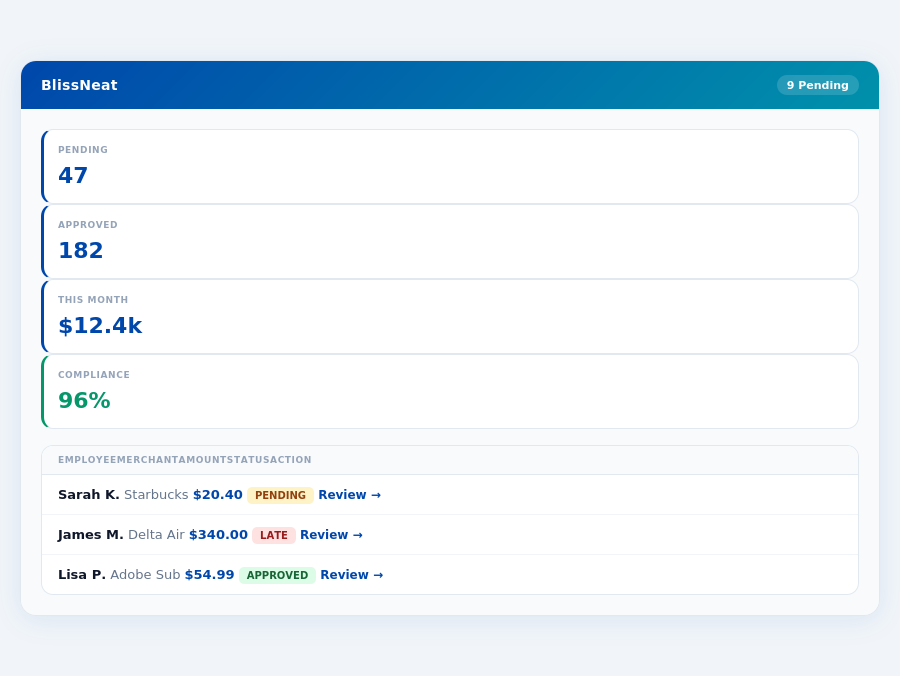
BlissNeat's approval queue — managers approve all pending receipts in under 8 minutes.
BlissNeat's approach is particularly beneficial for managers looking to optimize their workflow. For example, by saving 4+ hours/week (equating to $10,900/year in productivity gains for a single manager), BlissNeat positions itself as a time and cost-efficient alternative. Its plans, including the Starter ($9/user/mo), Pro ($19/user/mo), and Enterprise ($39/user/mo) options, offer scalability based on team needs.
What Managers Really Need: A Comparative Insight
While Ramp excels in ease of use and automated receipt collection, and Spendesk offers a user-friendly interface with real-time tracking, neither fully meets the mid-sized team manager's requirements for autonomy, detailed analytics, and seamless integrations without scalability issues. BlissNeat fills this void with features like AI-powered autonomous approval and custom API integrations for Enterprise users.
- Time Savings: BlissNeat saves managers 4+ hours/week, compared to manual processes which can consume up to 12 minutes per receipt approval.
- Scalability: Offers plans tailored for growth, from Starter to Enterprise, unlike one-size-fits-all approaches.
- Integrations: Seamless connections with QuickBooks, Xero, NetSuite, SAP Concur, and Slack, outpacing competitors in versatility.
- Autonomy: AI Agent in Enterprise plan auto-approves/flags expenses based on learned patterns, a feature lacking in both Ramp and Spendesk.
The choice between Ramp and Spendesk often comes down to specific team preferences, but for managers seeking a solution that understands the unique pressures of leading a team of 5-50, BlissNeat emerges as a compelling alternative. With its focus on efficiency, scalability, and innovative AI-driven automation, it addresses the overlooked needs of this demographic. By leveraging BlissNeat, managers can not only streamline expense management but also allocate saved time and resources towards strategic team growth and development.
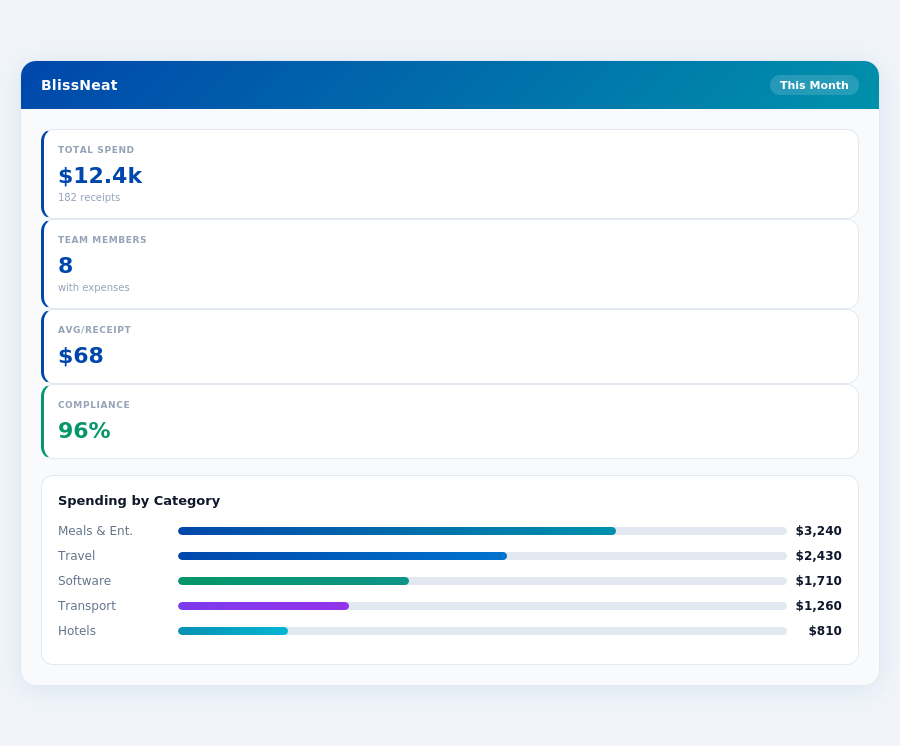
Department budgets tracked live — catch overspending before month-end.
🔒 30-day free trial — no credit cardSetup in 15 minutes. Cancel anytime.Start Free Trial →Related articles
See also: Expense travel legal singapore
See also: Expense small tech miami
See also: Expense remote construction seattle
Neither gets it right. BlissNeat does.
30-day free trial. No credit card. Setup takes 15 minutes.