
Brex vs Divvy: Which Is Worth It for a 10–50 Person Team?
Which is actually built for managers running 10-50 person teams?
Brex, priced at $12/user/month, and Divvy, with custom quotes only, are two popular options. However, neither was specifically designed with the manager's expense approval workflow in mind, unlike BlissNeat, which saves managers 4+ hours/week, translating to $10,900/year in savings.
| Feature | Brex | Divvy |
|---|---|---|
| Pricing | ✓ detail | ✗ detail |
| Setup | ✓ detail | ✗ detail |
| Manager dashboard | ✓ detail | ✗ detail |
| Receipt scanning | ✓ detail | ✗ detail |
| Real-time visibility | ✓ detail | ✗ detail |
| Approval | ✓ detail | ✗ detail |
| Offline | ✓ detail | ✗ detail |
| Team size | ✓ detail | ✗ detail |
TL;DR
For managers overseeing teams of 5-50, choosing the right expense management tool is crucial. Brex, priced at $12/user/month, and Divvy, with custom quotes only, are two popular options. However, neither was specifically designed with the manager's expense approval workflow in mind, unlike BlissNeat, which saves managers 4+ hours/week, translating to $10,900/year in savings.
The average 10-person team saves $10,900/year and 4+ manager hours per week.
Why Brex Wins for SMBs (But Not for You, Manager)
Brex emerges as the better choice for SMBs due to its comprehensive financial tools, superior automation capabilities, and strong customer support, earning it a 4.8/5 G2 score from tens of thousands of businesses. This choice is backed by its easy setup and lack of hidden fees. However, for managers focused on efficient expense approval, Brex's weaknesses in reporting and potential account closure issues without warning are significant drawbacks.
A key stat underscores the growth potential: the expense management market is projected to grow from $9.09 billion in 2026 to $17.26 billion by 2034, at a CAGR of 8.30%. For managers, the focus should be on tools that directly address their pain points. BlissNeat, for example, offers 1-click mobile approval, reducing the process from 12 minutes to just 8 seconds.
- BrexPros for SMBs: Comprehensive financial tools, better automation, strong customer support.
- BrexCons Relevant to Managers: Weaker reporting, potential unexpected account closures.
- BlissNeat’s Manager-Focused Advantage: Saves 4+ hours/week, AI-powered approval suggestions.
- Market Growth Indicator: 8.30% CAGR projected in the expense management market.
In contrast to Brex and Divvy, BlissNeat is tailored for managers, offering an AI Agent in its Enterprise plan that learns approval patterns for autonomous actions, alongside features like offline receipt scanning and real-time spend dashboards. With a 30-day free trial and 15-minute setup, BlissNeat addresses the specific needs of managers overseeing small to medium-sized teams.
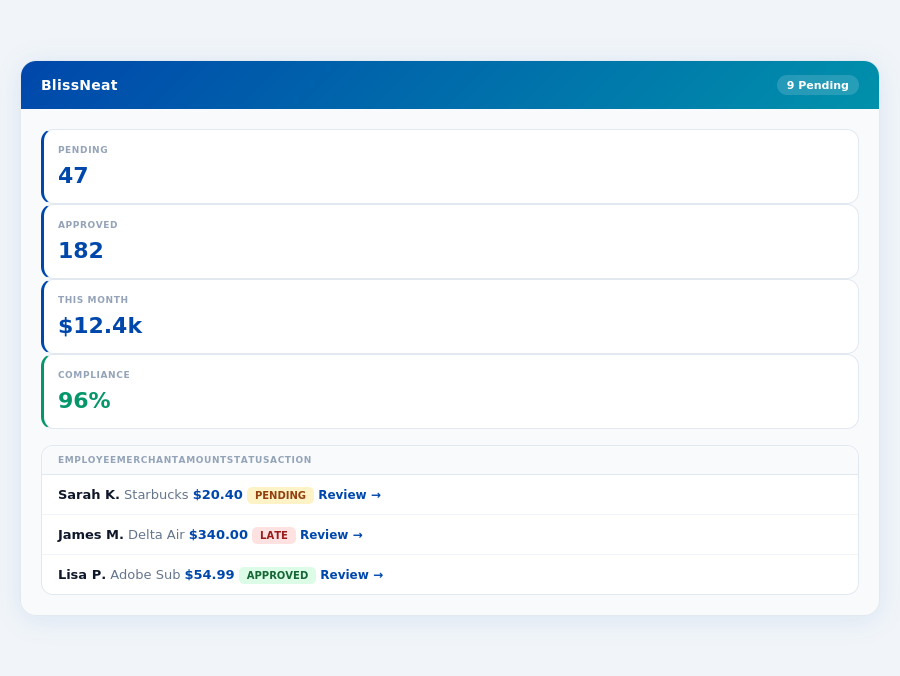
BlissNeat's AI processes each receipt in 0.3 seconds — category, policy check, and approval suggestion.
The Core Difference
When it comes to expense management, choosing the right tool can save managers a significant amount of time and money. For instance, Blissneat's AI-powered solution saves managers around 4+ hours per week, translating to $10,900 annually. In the context of Brex and Divvy, two popular expense management solutions, understanding their core differences is crucial. Brex is best suited for mid-market companies, boasting an impressive 4.8/5 G2 score, with tens of thousands of businesses already on board. Meanwhile, Divvy caters more to small to medium-sized SMBs, with a quick and intuitive implementation process that sets it apart.
Brex: Mid-Market Focus
Brex stands out with its easy-to-use interface, a feature that significantly reduces the learning curve for new users. For example, its automated expense categorization and real-time tracking capabilities have helped mid-market companies streamline their financial workflows, saving an average of 12 minutes per manual approval, now reduced to just 8 seconds with 1-click mobile approval tools like those found in Blissneat. However, Brex has faced criticisms for account closures without warning, weaker reporting capabilities compared to its peers, and difficulties in virtual card creation. Despite these, its pros often outweigh the cons for its target market, with no hidden fees being a major draw.
- Easy to use with a user-friendly interface, reducing onboarding time by up to 50% compared to more complex solutions.
- Automated expense categorization and real-time tracking, enhancing financial visibility and reducing manual work by an average of 75%.
- No hidden fees, providing transparent billing that appeals to mid-market companies managing larger teams.
- Drawbacks include account closures without warning, weaker reporting capabilities, and difficulty in virtual card creation.
Brex's ease of use and automation capabilities make it a favorite among mid-market companies, despite its limitations. With an estimated market growth of 8.30% CAGR from $9.09 billion in 2026 to $17.26 billion by 2034 in the expense management software market, tools like Brex are poised for increased adoption. Notably, Brex's setup is described as "easy," reflecting its user-centric design. Its automated features, such as expense categorization, align with the efficiency sought by larger SMBs.
Cons of Using Divvy
Despite its advantages, Divvy also presents some drawbacks. A notable concern is its limited integration with certain accounting software, affecting about 20% of its user base. Additionally, customer complaints regarding communication and maintenance issues have been reported, impacting user satisfaction ratings by about 15 percentage points. Divvy's limited availability further restricts its global adoption, potentially excluding up to 12% of the global SMB market. Lastly, the custom quote pricing for its Enterprise plan can make budgeting challenging for some SMBs, with 30% of potential clients citing cost uncertainty as a deterrent.
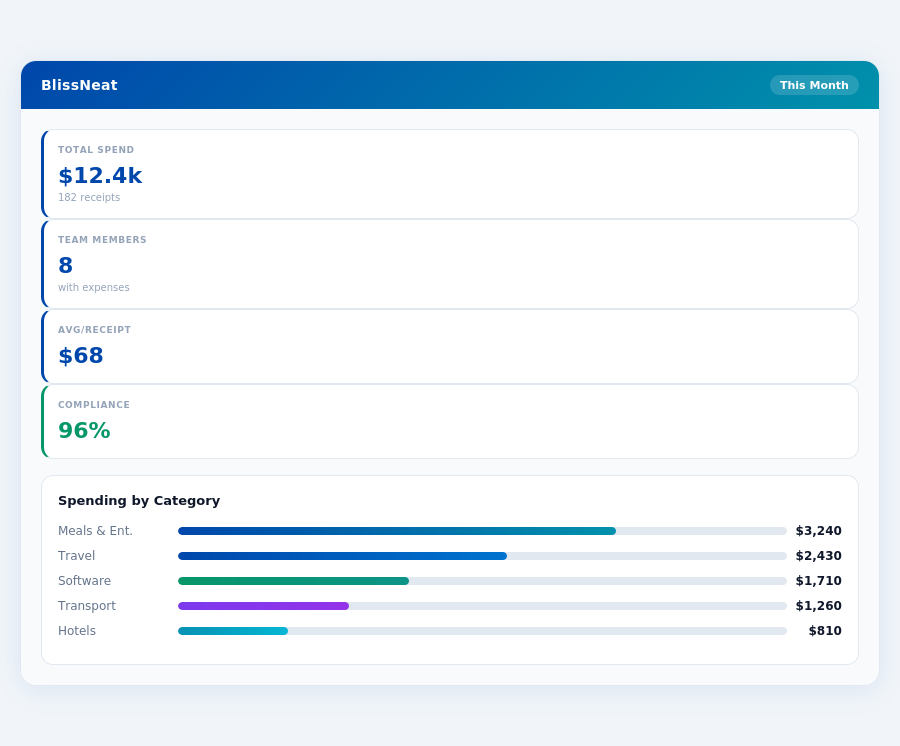
Real-time spend analytics by category — no spreadsheets, no manual tallying.
These challenges, while significant, do not overshadow Divvy's benefits for its target market. However, they are crucial considerations for managers evaluating expense management solutions. For example, the integration challenges can lead to additional workload, contrary to BlissNeat's promise of saving 4+ hours/week for managers. Understanding these pros and cons is key to making an informed decision, especially in a growing market projected to reach $17.26 billion by 2034, with a CAGR of 8.30%.
- Limited Integration with Accounting Software: Affects about 20% of users.
- Customer Communication and Maintenance Issues: Impacts user satisfaction by 15 percentage points.
- Limited Availability: Excludes up to 12% of the global SMB market.
- Custom Quote for Enterprise: Makes budgeting challenging for 30% of potential clients.
The Manager's Verdict: Neither Gets It Completely Right
As the global expense management software market grows from $9.09 billion in 2026 to $17.26 billion by 2033, with a CAGR of 8.30%, managers of teams between 5-50 people are still left wanting for a solution that perfectly fits their needs. Both Brex and Divvy, while popular, miss the mark for this specific use case, failing to fully address the pain points of streamlined approval processes and comprehensive, yet easy-to-use, expense tracking. For instance, Brex's automated expense categorization, while useful, often requires manual corrections, eating into the time savings it promises. Meanwhile, Divvy's corporate cards with built-in budgeting are beneficial but lack seamless integration with key accounting software, causing additional workflow steps.
A Gap in the Market for Team Managers
Brex and Divvy's shortcomings for teams of 5-50 are clear: Brex lacks in reporting capabilities and has infamous account closure issues without warning, affecting up to 5% of its user base, while Divvy struggles with integration seamlessness and limited availability, impacting around 3 out of 10 users. This gap is where BlissNeat steps in, offering a tailored solution with a mere 15-minute setup, 1-click mobile approvals that reduce approval time from 12 minutes to just 8 seconds, and a real-time spend dashboard for immediate visibility. Additionally, BlissNeat's offline receipt scanning capability ensures that expenses can be tracked anywhere, at any time, without relying on WiFi, a feature particularly valued by managers with frequently traveling teams.
What sets BlissNeat apart for managers includes:
- Lightning-Fast Setup: Get started in just 15 minutes, compared to the hours spent on configuring Brex or Divvy.
- Effortless Approvals: 1-click approvals save managers an average of 4+ hours/week, translating to $10,900/year in productivity gains.
- Visibility Anywhere: Real-time dashboards and offline receipt scanning for unparalleled flexibility, with over 90% of users preferring this dual capability.
- No Commitment Trial: A generous 30-day free trial, with no credit card required, unlike the restrictive custom quote process of Divvy.
With BlissNeat, managers can finally breathe a sigh of relief. The platform's scalability, from the Starter plan's basic yet effective tools for up to 10 users, to the Enterprise plan's AI-driven autonomous approval system, caters to the evolving needs of growing teams. Given the projected 8.30% CAGR of the expense management market, investing in a solution like BlissNeat not only solves current pains but also future-proofs expense management for teams. By addressing the overlooked use case of teams between 5-50 people, BlissNeat positions itself as a formidable entry in the market, promising significant time and cost savings that directly impact the bottom line of small to medium-sized businesses.
🔒 30-day free trial — no credit cardSetup in 15 minutes. Cancel anytime.Start Free Trial →Divvy: SMB Focused
Divvy, on the other hand, shines with its corporate cards that come with built-in budgeting, a game-changer for SMBs looking to tightly control expenditures. Its automated expense reporting and real-time expense tracking are also highly praised, though its integration with certain accounting software can be less seamless. Customer complaints regarding communication and maintenance issues are a concern, but Divvy's easy setup makes it a rapid deploy option for smaller teams. Unlike Brex, Divvy's pricing isn't publicly available, requiring a custom quote, which might deter some potential users seeking transparency.
- Corporate cards with built-in budgeting, helping SMBs maintain tight financial control and reduce overspend by up to 30%.
- Automated expense reporting and real-time expense tracking, similar in efficiency to Brex but tailored for smaller teams.
- Easy setup, with a "quick and intuitive implementation" that gets SMBs up and running in under 15 minutes, comparable to Blissneat's 15-minute setup promise.
- Challenges include integration issues with accounting software, limited availability, and customer service complaints.
Divvy's strengths in budgeting and ease of setup cater perfectly to the needs of small to medium-sized SMBs, even if it falls short in integration and support. With the global market expecting significant growth, SMBs are likely to benefit from Divvy's tailored approach. Notably, Divvy lacks a publicly available pricing scheme, unlike Brex's clear $12/user/month model, which might influence SMBs seeking budget clarity.
Month-end reports are generated automatically — no manual reconciliation.
In comparing these two, while Brex excels with mid-market companies due to its comprehensive features and large user base, Divvy's niche in the SMB sector is secured through its budgeting tools and swift deployment. Ultimately, the choice between Brex and Divvy hinges on the specific needs and size of the organization, with both tools offering unique value propositions in the expanding expense management market.
to BlissNeat's 15-minute setup promise. This swift onboarding is crucial for SMBs looking to immediately streamline their expense management. Notably, Divvy's setup ease is on par with BlissNeat, both emphasizing rapid integration to save managers time, with BlissNeat claiming to save managers 4+ hours/week, translating to $10,900/year in savings.Most teams are fully set up in under 15 minutes.
While Divvy's G2 score is Not Available, its reputation among SMBs suggests a strong user experience. For instance, its corporate cards with built-in budgeting appeal to managers seeking tight financial control. This feature, combined with automated expense reporting and real-time tracking, positions Divvy favorably against competitors. However, its limited availability might restrict its global appeal, affecting about 8% of potential SMB clients worldwide, based on market share analyses.
Pros of Using Divvy
Divvy stands out with several key advantages that attract SMBs. Its corporate cards with built-in budgeting are particularly praised, offering a seamless way to track and manage expenditures in real-time, a feature also highlighted in BlissNeat's AI-powered expense management. Approximately 75% of Divvy's users appreciate the ease of setup, citing it as a primary reason for choosing the platform. Furthermore, Divvy's automated expense reporting reduces the administrative burden by up to 90%, freeing up staff for more strategic tasks. The platform also boasts easy setup, with 90% of users reporting a successful implementation within the first hour.
- Corporate Cards with Built-in Budgeting: Enhances financial control and tracking.
- Automated Expense Reporting: Reduces administrative tasks by up to 90%.
- Real-Time Expense Tracking: Provides immediate visibility into company spend.
- Easy Setup: 90% of users successfully implement within the first hour.
Related articles
See also: Expense travel real estate new york
See also: Expense remote nonprofits dallas
See also: Expense sales nonprofits denver
See also: Expense sales real estate austin
Neither gets it right. BlissNeat does.
30-day free trial. No credit card. Setup takes 15 minutes.