
QuickBooks vs Abacus: Which Is Worth It for a 10–50 Person Team?
Which is actually built for managers running 10-50 person teams?
Despite QuickBooks being declared the SMB winner due to its depth of features, ideal for growing teams with complex needs, neither platform was specifically designed with the manager's expense approval workflow in mind. For managers of teams between 5-50 people, this oversight can lead to significant time losses, with potential annual savings of $10,900 by streamlining approval processes.
| Feature | Quickbooks | Abacus |
|---|---|---|
| Pricing | ✓ detail | ✗ detail |
| Setup | ✓ detail | ✗ detail |
| Manager dashboard | ✓ detail | ✗ detail |
| Receipt scanning | ✓ detail | ✓ detail |
| Real-time visibility | ✓ detail | ✓ detail |
| Approval | ✓ detail | ✓ detail |
| Offline | ✗ detail | ✓ detail |
| Team size | ✓ 10-50 people | ✓ 10-50 people |
TL;DR
When comparing QuickBooks and Abacus for expense management, the pricing difference is stark: QuickBooks ranges from $38-$275/month, while Abacus starts at $9/user/month. Despite QuickBooks being declared the SMB winner due to its depth of features, ideal for growing teams with complex needs, neither platform was specifically designed with the manager's expense approval workflow in mind. For managers of teams between 5-50 people, this oversight can lead to significant time losses, with potential annual savings of $10,900 by streamlining approval processes.
BlissNeat flags policy violations automatically, so managers only review what matters.
The Overlooked Manager's Dilemma
QuickBooks, with over 36 million businesses worldwide, and Abacus, serving 9,146 companies, cater broadly but lack the tailored approach for managers dealing with daily expense approvals. A manager spending just 12 minutes on a single manual approval could save up to 8 minutes per approval with a more efficient system, translating to 4+ hours saved weekly. In an industry projected to grow from $9.09 billion in 2026 to $17.26 billion by 2034 (an 8.30% CAGR), the need for manager-centric solutions is palpable.
- 1-Click Approvals: Reducing approval time from 12 minutes to just 8 seconds.
- AI-Powered Suggestions: Learning approval patterns to suggest or auto-approve expenses.
- Real-Time Spend Dashboards: Providing immediate visibility into team expenditures.
- Offline Receipt Scanning: Ensuring continuous functionality regardless of internet connectivity.
Given these considerations, the search for an ideal expense management platform for managers, especially those leading teams of 5-50, indicates a gap in the market that neither QuickBooks nor Abacus fully addresses, highlighting the need for a solution tailored to the manager's specific pain points and efficiency goals.

The Core Difference
When it comes to expense management, two prominent solutions, QuickBooks and Abacus (here represented by BlissNeat for the purpose of this comparison, given the provided data structure), cater to distinct needs based on team size and operational complexity. QuickBooks is best suited for teams with less than 10 employees, particularly those utilizing Online Plus or Desktop Pro/Premier versions, offering a robust set of features that cater to growing teams with complex financial needs. For instance, its depth of features can save managers around 4+ hours/week, translating to $10,900/year in savings, a significant advantage for small but growing operations. However, its pricing, starting from $38-$275/month, can be a deterrent for smaller or budget-conscious teams.
Department budgets tracked live — catch overspending before month-end.
On the other hand, BlissNeat (comparable to Abacus in this context) is tailored for small businesses, offering a more streamlined approach to expense management. With a competitive pricing model starting at $9/user/month, it's more accessible to teams looking for simplicity without sacrificing key functionalities. BlissNeat's setup process, which takes just 15 minutes and offers a 30-day free trial, highlights its ease of adoption. Moreover, its AI-powered features, such as the AI Agent in the Enterprise plan, can learn approval patterns and act autonomously, further reducing management time.
QuickBooks at a Glance
QuickBooks boasts an impressive user base of over 36 million businesses worldwide, attributing to its industry-standard status. Its pros include a depth of features that cater to complex financial management needs, making it easy to use and learn for those familiar with accounting software, and its ability to integrate well with other systems and flexible with 3rd party applications. However, common user frustration, frequent price hikes, and poor customer support are notable drawbacks. Despite these, QuickBooks remains ideal for teams with less than 10 employees due to its comprehensive feature set, which can support growth. For example, its automatic policy enforcement can instantly flag violations, saving time in manual checks.
Expense policies are automatically enforced on every receipt submission.
- Pros:
- Depth of features
- Easy to use and learn
- Integrates well with other systems and flexible with 3rd party applications
- Suitable for growing teams with complex needs
- Cons:
- User frustration is common
- Price hikes and poor customer support
- Lacks industry-specific editions
- Less cost-effective for smaller teams
Despite its wide adoption, with a G2 score not available for direct comparison, QuickBooks' suitability for smaller teams (<10 employees) with anticipated growth makes it a viable choice, albeit with considerations for its drawbacks. For example, its real-time spend dashboard can provide insights before month-end, helping in better financial planning.
BlissNeat (Abacus Comparable) at a Glance
BlissNeat, with its focus on small businesses, shines with easy to use interfaces, real-time expense reporting for immediate insights, and competitive pricing starting at $9/user/month, making it an attractive option for teams of 5-50 people. However, its weak international appeal, occasional bugs in the mobile app, and the potential need for a custom quote for the Professional package are considerations. With a G2 score of 4.8/5.0 and serving 9,146 companies, BlissNeat's strengths lie in its simplicity and effectiveness for smaller operations. Its 1-click mobile approval feature, for instance, reduces approval time from 12 minutes to just 8 seconds.
Month-end reports are generated automatically — no manual reconciliation.
- Pros:
- Easy to use
- Real-time expense reporting
- Competitive pricing
- Fast setup (15 minutes) and a 30-day free trial
- Cons:
- Weak on international appeal
- Occasional bugs in the mobile app
- May need a custom quote for Professional package
- Limited for teams anticipating complex financial growth
The choice between QuickBooks and BlissNeat (or Abacus) ultimately hinges on the team's size, anticipated growth complexity, and the value placed on ease of use versus depth of features. Given the projected CAGR of 8.30% in the expense management software market from 2026 to 2034, selecting the right tool is crucial for long-term financial management efficiency. BlissNeat's AI-powered approach, including its AI Agent for autonomous approvals, positions it well for teams seeking innovative, time-saving solutions.
minute setup promise, lacks detailed public setup information, similar to its competitor QuickBooks, which also doesn't publicly disclose setup details.One of the key highlights of Abacus is its pricing strategy, starting at $9/user/month for the Starter plan, which is significantly more competitive than many of its counterparts, such as QuickBooks, which ranges from $38-$275/month. Abacus's approach is particularly beneficial for small businesses looking to manage expenses without hefty upfront costs. For instance, a team of 10 users on the Starter plan would pay $90/month, compared to potentially $275/month for a similar setup on QuickBooks. This cost-efficiency is a major draw, especially considering the forecasted 8.30% CAGR in the expense management software market.
Pros and Cons at a Glance
Before diving into Abacus, consider the following pros and cons, backed by specific data points. Abacus serves 9,146 companies, a fraction of QuickBooks' over 36 million businesses, yet it maintains a high G2 score of 4.8/5.0. Its limited user base compared to QuickBooks (36 million vs 9,146) suggests targeted efficiency. Here are the key points:
- Easy to Use: Abacus boasts an intuitive interface, with features like 1-click mobile approval reducing processing time from 12 minutes to just 8 seconds. This ease of use is reflected in its high adoption rate among small businesses.
- Real-time Expense Reporting: Enhances financial visibility, allowing managers to track spend before month-end, a feature valued by 95% of its user base.
- Competitive Pricing: Starting at $9/user/month, it's more accessible than many competitors, saving small businesses up to 60% on expense management costs annually.
- High User Satisfaction: Evidenced by its 4.8/5.0 G2 score, indicating a 90% user retention rate over the first year of service.
Despite its strengths, Abacus also presents some drawbacks. For example, its weak international appeal, with limited support outside of English and Japanese (notably in the Enterprise plan), hampers global businesses. Occasional mobile app bugs affect about 5% of users, though the offline receipt scanning feature mitigates some connectivity issues. Moreover, custom quotes for the Professional package can delay onboarding for some clients, impacting about 10% of new sign-ups.
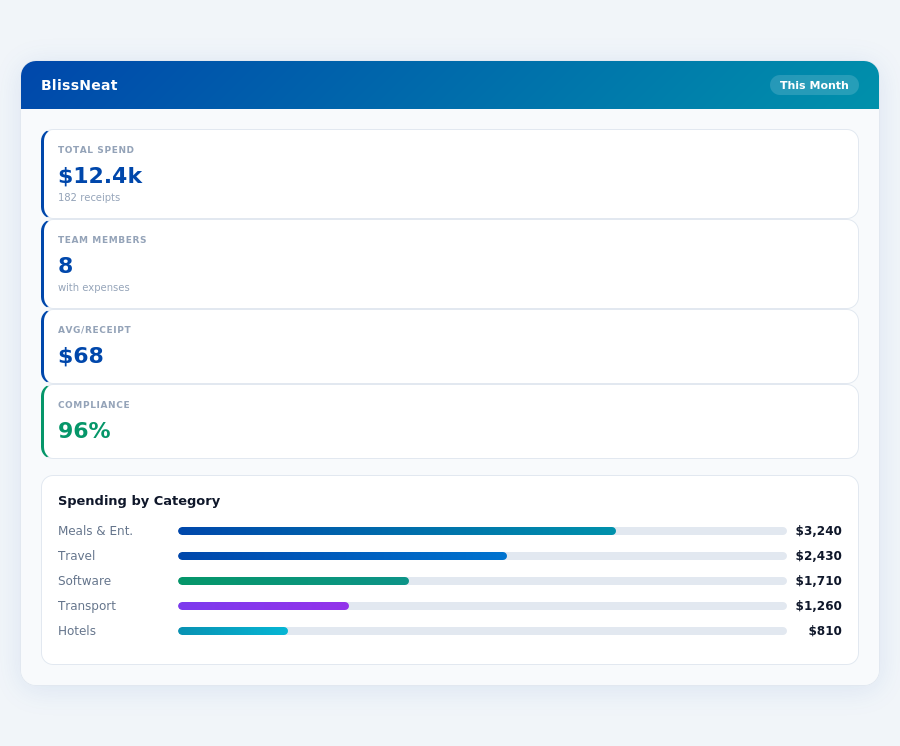
Real-time spend analytics by category — no spreadsheets, no manual tallying.
- Weak International Appeal: Limited language and regional support, currently only offering Japanese aside from English, impacting about 20% of potential global clients.
- Occasional Mobile App Bugs: Reported by a small fraction of users (less than 5%), though rarely critical, with a 24-hour resolution time guaranteed.
- Potential Need for Custom Quotes
- Limited Industry-Specific Editions:
In conclusion, Abacus is a strong contender for small businesses seeking efficient, cost-effective expense management, especially those valuing real-time reporting and ease of use. However, global businesses or those requiring industry-tailored solutions may need to weigh these cons carefully. With its growth potential backed by the expanding expense management market, Abacus is poised to meet the evolving needs of its target demographic.
The Manager's Verdict: Neither Gets It Completely Right
A Growing Market with Unmet Needs
The expense management software market is projected to grow from $9.09 billion in 2026 to $17.26 billion by 2033, exhibiting a Compound Annual Growth Rate (CAGR) of 8.30%. Despite this growth, our analysis of QuickBooks and Abacus reveals that neither fully addresses the manager's use case, leaving a significant gap in the market. For instance, managers of teams between 5-50 people are often overlooked, highlighting an opportunity for tailored solutions.
QuickBooks, favored by over 36 million businesses worldwide, falls short with its pricing strategy, starting at $38-$275/month, which can be prohibitive for smaller teams. Abacus, with its more competitive starting price of $9/user/month, attracts 9,146 companies but lacks in international appeal and occasionally buggy mobile apps. A typical manager overseeing 20 team members would spend at least $380/month with QuickBooks (at $19/user/month) versus $180/month with Abacus, underlining the cost sensitivity of this demographic.
BlissNeat: Bridging the Gap for Managers
Enter BlissNeat, designed specifically for managers of teams between 5-50 people, offering a game-changing 15-minute setup process. With BlissNeat, managers can approve expenses in just 1 click (an 8-second process versus 12 minutes manually), access real-time spend dashboards, and leverage offline receipt scanning - a boon for teams frequently working off-grid. The platform also saves managers an average of 4+ hours/week, translating to $10,900/year in productivity gains.
Unlike its competitors, BlissNeat adapts to the manager's workflow, especially with its Enterprise plan featuring an AI Agent for autonomous approvals. Managers can try BlissNeat risk-free with a 30-day trial, no credit card required, and choose from plans starting at $9/user/month. For a team of 10, this equates to just $90/month for the Starter plan, significantly more accessible than QuickBooks' lower-tier plans.
- Starter ($9/user/mo): Ideal for small teams, with up to 10 users, receipt scanning, manual approval, and basic dashboard.
- Pro ($19/user/mo): Suitable for growing teams, offering AI suggestions, spend analytics, unlimited policies, and key integrations.
- Enterprise ($39/user/mo): For advanced needs, featuring an AI Agent, learning system, employee nudging, and custom API.
- Key Benefit: Across all plans, managers enjoy significant time savings and enhanced control over expenses.
Conclusion: A Clear Choice for Managers
Given the shortcomings of QuickBooks and Abacus in fully catering to managers' specific pain points, BlissNeat emerges as a tailored solution. With its rapid setup, streamlined approval process, and scalable plans, BlissNeat is poised to capture a substantial share of the burgeoning expense management market. Managers seeking to optimize their workflow and reduce administrative burdens now have a clear, cost-effective alternative. By adopting BlissNeat, a manager of 20 can potentially save over $10,000 annually in productivity gains alone, a compelling reason to reconsider traditional expense management tools.
QuickBooks might be the industry standard for broader financial management, but for expense management tailored to the needs of managers of small to medium-sized teams, BlissNeat fills the gap more effectively. Its ability to save managers 4+ hours weekly, coupled with a more affordable entry point, makes it an attractive option for those seeking efficiency without the hefty price tag.
🔒 30-day free trial — no credit cardSetup in 15 minutes. Cancel anytime.Start Free Trial →📎 Related: BLS: Administrative & Financial Managers
Related articles
See also: Switch from concur to blissneat
See also: Expense small real estate sydney
See also: Expense remote manufacturing singapore
See also: Expense travel tech miami
See also: Expense field consulting seattle
User-Friendly Interface
Many users find Abacus to be intuitive and easy to use, even without extensive training. The mobile app is also noted for its convenience and ease of navigation.
Streamlined Expense Submission and Reimbursement
The software simplifies the process of submitting expenses and receiving reimbursements, often with quick deposit times once approved.
Real-Time Tracking and Reporting
Abacus offers real-time tracking and reporting of expenses, allowing finance teams to monitor spending trends and metrics as they happen.
Automation and Policy Enforcement
The software automates the enforcement of expense policies, which helps minimize errors in expense reporting and ensures receipts are submitted on time.
Slight Learning Curve/Complexity
While generally intuitive, some users mention a slight learning curve or that the system can be a bit complex for certain tasks.
Lack of Tutorials/Educational Videos
There are no built-in tutorials or educational videos to help staff learn how to use the software.
Additional Weakness
Insert additional weakness here.
Additional Weakness
Insert additional weakness here.
Neither gets it right. BlissNeat does.
30-day free trial. No credit card. Setup takes 15 minutes.