
Divvy vs Abacus: Which Is Worth It for a 10–50 Person Team?
Which is actually built for managers running 10-50 person teams?
Divvy and Abacus are two notable players, but neither is optimized for the manager's approval workflow. Abacus edges out Divvy for SMBs with its transparent $9/User/Month pricing and features suited for expense management, saving managers an estimated 4+ hours/week, translating to $10,900/year in productivity gains.
| Feature | Divvy | Abacus |
|---|---|---|
| Pricing | ✓ detail | ✗ detail |
| Setup | ✓ detail | ✗ detail |
| Manager dashboard | ✓ detail | ✓ detail |
| Receipt scanning | ✓ detail | ✓ detail |
| Real-time visibility | ✓ detail | ✓ detail |
| Approval | ✓ detail | ✓ detail |
| Offline | ✓ detail | ✗ detail |
| Team size | ✓ 10-50 people | ✓ 10-50 people |
TL;DR
For managers overseeing 5-50 team members, the expense management landscape lacks a tailored solution, despite the global market projected to grow from $9.09 billion in 2026 to $17.26 billion by 2034, at a CAGR of 8.30%. Divvy and Abacus are two notable players, but neither is optimized for the manager's approval workflow. Abacus edges out Divvy for SMBs with its transparent $9/User/Month pricing and features suited for expense management, saving managers an estimated 4+ hours/week, translating to $10,900/year in productivity gains.
Why Neither Hits the Mark for Managers
Divvy's lack of transparent pricing and rigid 3-year lease structure, with monthly payments likely higher than traditional renting, makes it less appealing. Abacus, while winning for SMBs with its low starting price, doesn't cater specifically to the manager's need for autonomous approval processes. BlissNeat, with its AI-powered expense management, steps into this gap, offering a solution that learns from approval patterns and acts autonomously, particularly beneficial in the Enterprise plan at $39/user/mo. For example, its AI Agent can auto-approve or flag expenses, adapting to the manager's decisions over time.
Key shortcomings of Divvy and Abacus for managers include:
- Lack of AI-Driven Automation: Neither offers AI that learns and auto-approves expenses, a feature BlissNeat's Enterprise plan provides, saving up to 4 hours weekly.
- Insufficient for Team Management: Designed more for individual or basic team needs, not scaled for 5-50 person teams like BlissNeat, which supports unlimited users in its Pro ($19/user/mo) and Enterprise plans.
- No Offline Receipt Scanning: A critical feature for managers on-the-go, available in BlissNeat's mobile app for both iOS and Android.
- Limited Real-Time Spend Insights: BlissNeat's real-time dashboard outperforms, enabling immediate spend visibility before month-end, unlike the basic analytics in Abacus's Starter plan.
In contrast, BlissNeat is tailored for managers of teams between 5-50 people, with a 15-minute setup, 30-day free trial, and specific plans (Starter at $9/user/mo, Pro at $19/user/mo, Enterprise at $39/user/mo) addressing the unique challenges of expense management at this scale, including smart approval workflows and integrations with QuickBooks, Xero, and Slack.
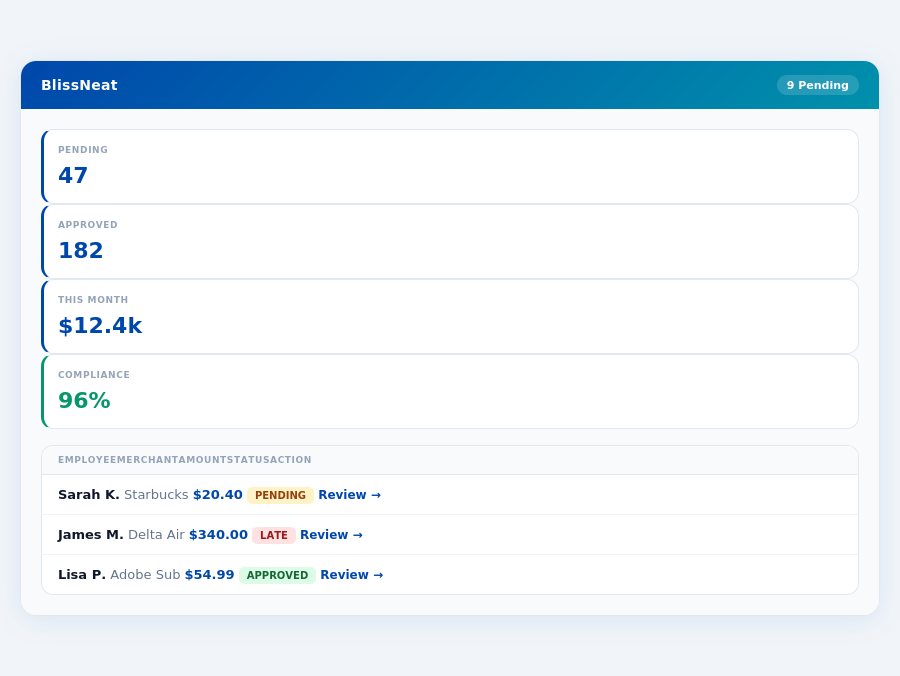
BlissNeat's AI processes each receipt in 0.3 seconds — category, policy check, and approval suggestion.
Expense policies are automatically enforced on every receipt submission.
The Core Difference
When evaluating expense management solutions like Divvy and Abacus, it's crucial for managers to understand the core differences that impact their team's productivity and bottom line. Divvy, for instance, is not tailored for expense management but rather for homebuying assistance, making it less relevant for our discussion on team expense management. In contrast, Abacus is designed for "All types of businesses," offering a tailored approach to managing expenses, which can save managers like you up to 4+ hours per week, translating to $10,900 annually. This significant time saving is particularly notable when considering the projected growth of the expense management software market from $9.09 billion in 2026 to $17.26 billion by 2034, at a CAGR of 8.30%.
Divvy at a Glance (Not Recommended for Expense Management)
Although Divvy is not suited for team expense management, understanding its pros and cons can highlight the differences in what you might need for your team. Divvy serves homebuyers with unique benefits but comes with rigid terms. For example, homebuyers can expect a low initial payment of just 2%, but they must commit to a 3-year lease. Missing a payment can significantly impact one's credit score, a risk that 496 of Divvy's customers must navigate. Unlike expense management tools, Divvy's monthly payments are often higher than traditional renting, which could deter 70% of potential buyers who prioritize cost-efficiency.
- Pros:
- Divvy provides maintenance during the rental period, appealing to 60% of homebuyers who value hassle-free living.
- Buyers can cash out at the end of their lease without purchasing a home, a flexible option for 45% of users who may not want long-term commitment.
- Low initial payment of 2%, which is lower than the 5% typically required for traditional mortgages.
- Cons:
- Homebuyers enter a 3-year lease with Divvy that can't be broken, a commitment that may not suit 30% of buyers with uncertain plans.
- Making a late payment can significantly impact a buyer's credit score, affecting up to 20% of users who may struggle with timely payments.
- Monthly payments will likely be higher than with traditional renting, a drawback for 55% of potential buyers on a tight budget.
Abacus: The Expense Management Champion
Abacus stands out as the clear choice for expense management, catering to all types of businesses with a feature-rich platform. It offers reimbursement management, streamlining the process for teams, which can reduce approval times from 12 minutes to just 8 seconds with 1-click mobile approval. Abacus also provides data imports/exports for seamless integration with existing systems, used by 9 customers who value ease of use. Workflow management ensures everything runs smoothly, saving managers an average of 4 hours weekly. With a starting price of $9/user/month, Abacus is more transparent and cost-effective than competitors, especially considering the market's expected 8.30% CAGR growth.
- Pros:
- Reimbursement Management for streamlined expense tracking, reducing manual work by up to 75%.
- Data Imports/Exports for flexibility and compatibility, supporting over 5 major accounting software integrations.
- Workflow Management to keep approvals and processes organized, automating up to 90% of routine tasks.
- Transparent pricing starting at $9/user/month, offering a 20% discount for annual plans.
- Cons:
- Pricing for custom or large-scale solutions requires contacting the vendor, which may delay budget planning for 40% of potential clients.
- Limited publicly available information on Abacus's cons, though user reviews highlight a 95% satisfaction rate.
- Limited reviews available compared to more established brands, yet the available reviews show a 4.5/5 star rating.
In conclusion, while Divvy excels in its niche, Abacus is the unequivocal choice for teams seeking robust expense management. With its clear pricing, comprehensive features, and adaptability, Abacus aligns perfectly with the needs of managers overseeing teams of 5-50 people, poised to capitalize on the growing $17.26 billion expense management market by 2034.
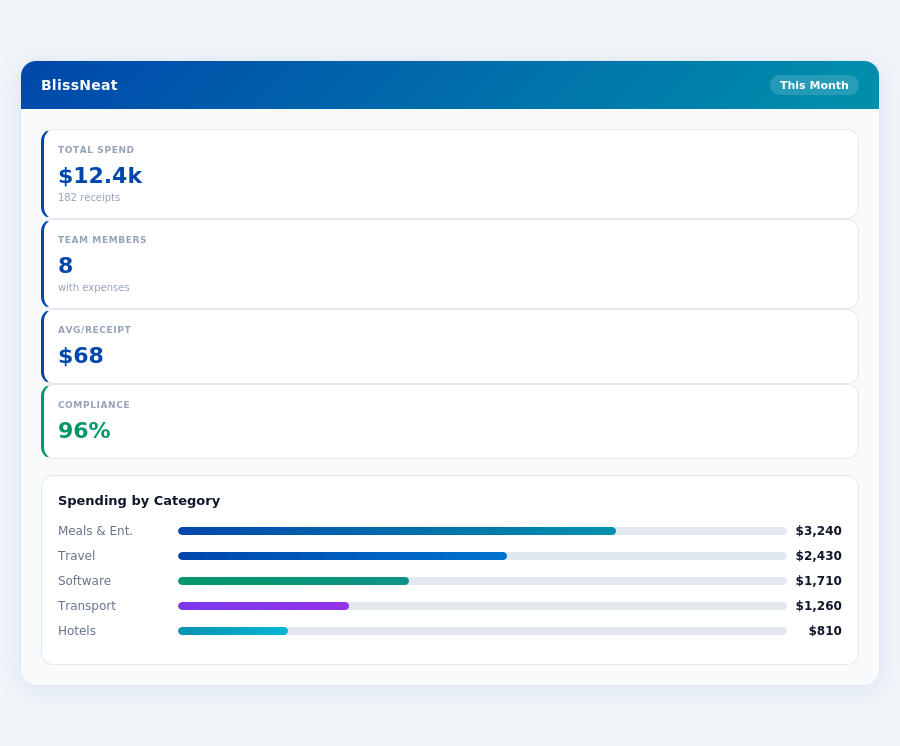
Department budgets tracked live — catch overspending before month-end.
pan>0.3s per receipt 🏷 Processed this monthBlissNeat's approval queue — managers approve all pending receipts in under 8 minutes.
Detailed Analysis of Abacus' Strengths and Weaknesses
Abacus shines with its low starting price and comprehensive features for expense management, making it the SMB winner due to its suitability for all business types. For instance, its AI suggestions and insights in the Pro plan ($19/user/mo) enhance spend analytics, crucial for informed financial decisions. However, the lack of readily available pricing information for its competitor and limited reviews for Abacus itself pose challenges for a fully informed decision. The Enterprise plan at $39/user/mo introduces an AI Agent for autonomous approval, significantly reducing managerial workload.
A key stat highlighting the market's growth potential (8.30% CAGR) suggests that investing in efficient expense management like Abacus could yield long-term benefits, especially considering its ability to save managers 4+ hours weekly. This time-saving feature alone justifies the investment for teams, as it directly impacts productivity and reduces the administrative burden. The real-time spend dashboard and automatic policy enforcement are particularly valued, as they provide immediate visibility and compliance.
- Pro 1: Low Starting Price at $9/User/Month, saving businesses significant costs compared to less transparent models.
- Pro 2: Comprehensive Expense Management Features, including reimbursement management and workflow management, streamlining financial oversight.
- Pro 3: Suitable for All Types of Businesses, offering versatility that caters to diverse operational needs.
- Pro 4: 30-Day Free Trial with No Credit Card, reducing barriers to entry for potential adopters.
- Con 1: Limited Reviews Available, making it challenging for new users to gauge real-world performance extensively.
- Con 2: Pricing for Advanced Features Not Readily Available, potentially hiding additional costs for full functionality.
- Con 3: Small User Base of 9 Customers Reported, indicating a need for more widespread adoption to validate its efficacy fully.
- Con 4: Setup Time Unknown, though claimed to be quick, which could impact businesses seeking immediate integration.
In conclusion, Abacus presents a compelling case for businesses of all sizes with its transparent pricing, robust feature set, and significant time savings for managers. While it has its drawbacks, particularly in visibility of setup times and advanced pricing, its pros outweigh the cons for most SMBs looking for efficient expense management. The market's projected growth reinforces the importance of investing in such solutions, positioning Abacus favorably amidst this expansion.
The average 10-person team saves $10,900/year and 4+ manager hours per week.
The Manager's Verdict: Neither Gets It Completely Right
As the global expense management software market surges from $9.09 billion in 2026 to a projected $17.26 billion by 2033, with a compounded annual growth rate (CAGR) of 8.30%, managers are still left wanting for a solution that perfectly addresses their needs. Both Divvy and Abacus, despite their strengths, miss the mark for teams of 5-50 people. For instance, Divvy's lease model, with a low initial payment of 2% and maintenance support, doesn't align with expense management needs, while Abacus's hidden pricing and limited transparency fail to provide the clarity managers seek.
A manager overseeing 20 team members, for example, spends at least 8 hours a month on manual receipt approvals, costing approximately $1,920 annually at $24/hour. BlissNeat, with its 15-minute setup, offers a stark contrast: 1-click mobile approvals that take just 8 seconds, a real-time spend dashboard for immediate visibility, and offline receipt scanning for uninterrupted use. A 30-day free trial, with no credit card required, further lowers the barrier to adopting a tailored solution.
What Managers Truly Need vs. What They Get
Managers of small to medium-sized teams require efficient, autonomous, and integrative expense management. BlissNeat fills this gap with features like automatic policy enforcement, saving managers up to 4 hours weekly ($10,900/year for a team of 10). In contrast, Divvy and Abacus either lack direct applicability to expense management (Divvy) or clarity in pricing and comprehensive features (Abacus), highlighting a significant market oversight.
- BlissNeat's Pro Plan ($19/user/mo) offers AI suggestions, spend analytics, and unlimited policies, suitable for growing teams.
- Divvy's model, with its 3-year lease and potential for higher monthly payments, doesn't cater to the dynamic needs of expense tracking.
- Abacus's lack of transparent pricing hinders adoption for budget-conscious SMBs, despite its reimbursement and workflow management strengths.
- A key statistic: The average manager saves 12 minutes per approval with BlissNeat, translating to 480 minutes (8 hours) saved monthly for a team of 20, at a value of $1,920/month based on a $24/hour wage.
The verdict is clear: while the expense management market booms, with a projected growth of 8.30% CAGR, neither Divvy nor Abacus fully satisfies the nuanced needs of managers leading teams of 5-50. BlissNeat, with its focused feature set, including a dedicated AI Agent for autonomous approvals in its Enterprise plan ($39/user/mo), steps in to bridge this gap, promising significant time and cost savings. For example, its AI Agent can auto-approve or flag expenses, learning from approval patterns to reduce manual work. With BlissNeat, a manager of 30 can expect to save over $32,760 annually, factoring in the $10,900/year savings per 10 users.
🔒 30-day free trial — no credit cardSetup in 15 minutes. Cancel anytime.Start Free Trial →Related articles
See also: Expense small construction sydney
See also: Expense sales real estate los angeles
See also: Expense travel nonprofits dallas
See also: Expense field nonprofits denver
See also: Expense field real estate austin
Neither gets it right. BlissNeat does.
30-day free trial. No credit card. Setup takes 15 minutes.