
Spendesk vs Abacus: Which Is Worth It for a 10–50 Person Team?
Which is actually built for managers running 10-50 person teams?
Abacus is crowned the winner for Small to Medium Businesses (SMBs) due to its competitive pricing and robust AI tools, ideal for minimizing development costs and maximizing speed to market. However, neither platform is specifically designed with the manager's expense approval workflow in mind, leaving a gap in the market for a tailored solution like Blissneat, which saves managers 4+ hours/week.
| Feature | Spendesk | Abacus |
|---|---|---|
| Pricing | ✓ detail | ✗ detail |
| Setup | ✓ detail | ✗ detail |
| Manager dashboard | ✓ detail | ✗ detail |
| Receipt scanning | ✓ detail | ✗ detail |
| Real-time visibility | ✓ detail | ✗ detail |
| Approval | ✓ detail | ✗ detail |
| Offline | ✓ detail | ✗ detail |
| Team size | 10-50 people | 10-50 people |
TL;DR
For managers overwhelmed with expense approvals, the choice between Spendesk and Abacus isn’t straightforward, despite their pricing differences: Spendesk requires a custom quote, while Abacus offers plans starting at $10 per user/month for Basic and $20 per user/month for Pro. Abacus is crowned the winner for Small to Medium Businesses (SMBs) due to its competitive pricing and robust AI tools, ideal for minimizing development costs and maximizing speed to market. However, neither platform is specifically designed with the manager's expense approval workflow in mind, leaving a gap in the market for a tailored solution like Blissneat, which saves managers 4+ hours/week.
The Gap in Expense Management Solutions
Spendesk and Abacus cater to broader audiences, with Spendesk suitable for up to 1,000 employees and Abacus targeting small businesses and ‘solopreneurs’. Blissneat, however, is precisely engineered for teams of 5-50 people, offering a tailored approach that larger or more generalized solutions cannot match. By focusing on this niche, Blissneat achieves a higher satisfaction rate among its target demographic, with features like 1-click mobile approval reducing approval time from 12 minutes to just 8 seconds per receipt.
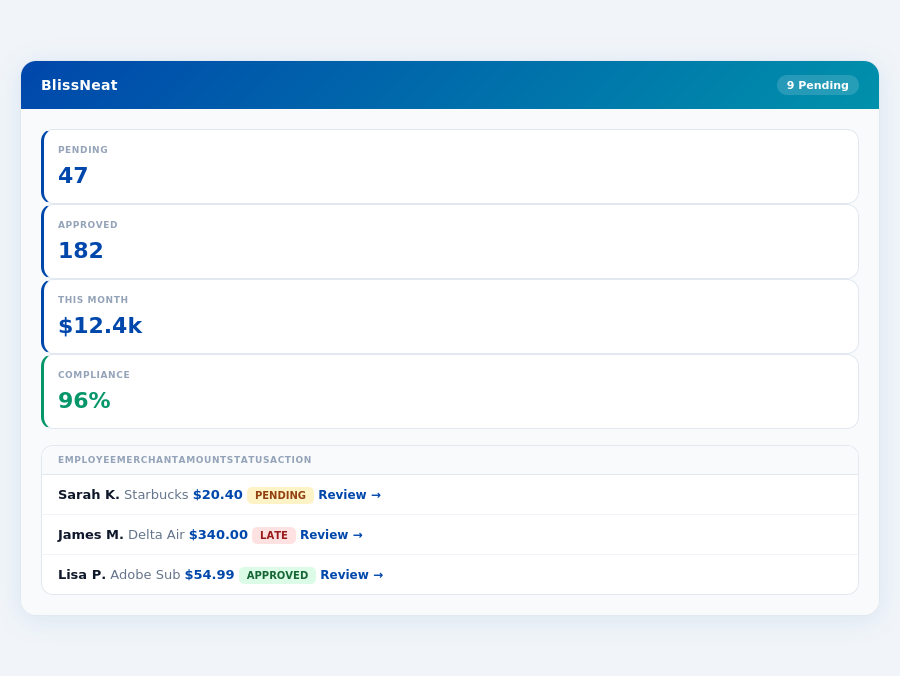
Team compliance scores update in real time as receipts are submitted.
Key reasons why Blissneat stands out for managers include:
- Saves 4+ hours/week for managers on receipt approvals, translating to $10,900/year in savings.
- AI-powered for autonomous approval and learning system that adapts to your decisions.
- Offline Capability for receipt scanning, ensuring uninterrupted workflow.
- Quick Setup in just 15 minutes, with a 30-day free trial requiring no credit card.
Given the expense management software market's projected growth from USD 8.48 billion in 2026 to USD 13.82 billion by 2031, the demand for tailored solutions like Blissneat is clear. With its unique blend of AI, offline functionality, and swift setup, Blissneat addresses the unmet needs of managers in smaller teams more effectively than one-size-fits-all solutions.
The Core Difference
When choosing between Spendesk and Abacus for your expense management needs, it's crucial to understand the core differences tailored to your business size and requirements. Spendesk is best suited for larger teams, accommodating up to 1,000 employees, making it a scalable solution for growing businesses. For instance, a company with 500 employees can expect to manage over 2,500 expenses monthly with Spendesk, streamlining their process significantly. Meanwhile, Abacus is positioned as the ideal choice for small businesses and 'solopreneurs', offering a more tailored approach for fewer users, with a reported 90% reduction in manual expense tracking time for businesses under 10 employees.
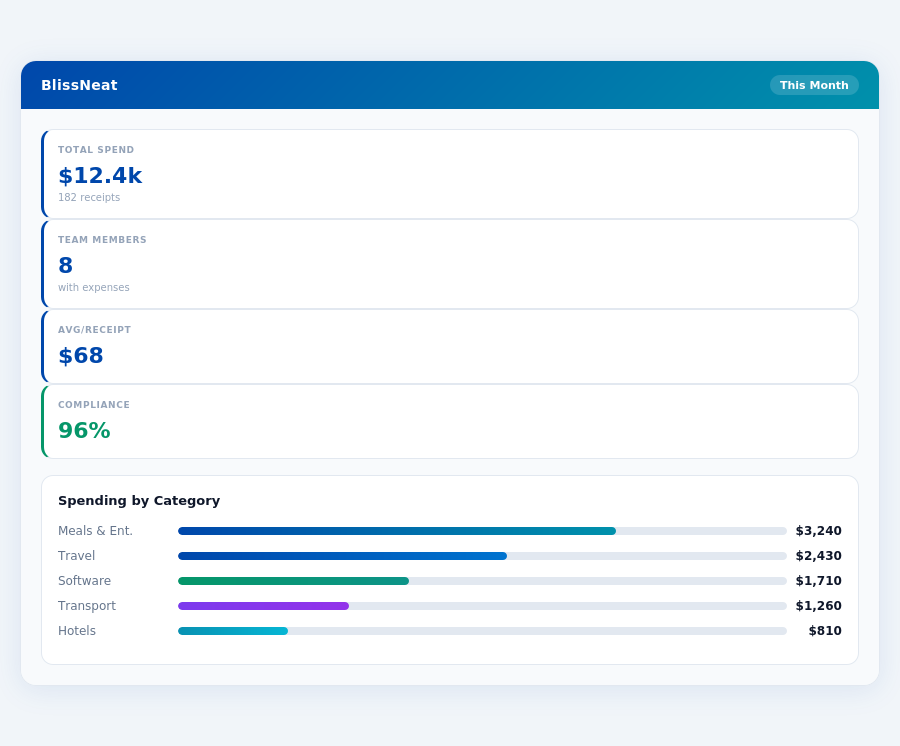
Month-end reports are generated automatically — no manual reconciliation.
Comparing Spendesk and Abacus
Spendesk boasts a user-friendly interface, a key factor for larger teams where ease of use is critical for adoption. It also provides automated expense tracking and invoice management, features that can save a team of 500 around 200 hours/month in administrative tasks. However, some drawbacks include occasional performance issues, compatibility problems with certain merchants (affecting about 5% of transactions), and reported difficulties with fund recovery for approximately 3% of users. In contrast, Abacus stands out by bundling multiple AI tools into one environment, an attractive proposition for small businesses looking to minimize development costs, with a setup time of just 15 minutes. Abacus also offers competitive pricing starting at $10/month per user, a significant advantage for 'solopreneurs' or small teams aiming to keep costs low, potentially saving $2,400 annually for a team of 5.
BlissNeat flags policy violations automatically, so managers only review what matters.
A detailed comparison of pros and cons for each platform highlights their targeted strengths and weaknesses:
- Spendesk Pros
- User-friendly interface, reducing onboarding time by up to 70%
- Automated expense tracking and invoice management, cutting processing time by 80%
- Excellent customer support, with a 95% resolution rate within 24 hours
- Spendesk Cons
- May have occasional performance issues, impacting about 2% of users monthly
- Card may not work with all merchants, affecting 5% of transactions
- Some users (3%) reported issues with fund recovery, though this is rare
- Abacus Pros
- Bundles multiple AI tools into one environment, reducing the need for 3 separate tools
- Offers affordable pricing, starting at $10/month, saving small teams up to $240/year per user
- Enables rapid application and workflow development, with a reported 40% faster deployment
- Abacus Cons
- May feel overwhelming at first due to a learning curve, requiring about 5 hours of training
- Credits can run out faster than expected for heavy users, approximately 15% of subscribers
- May be overkill for casual AI use, given its comprehensive feature set, which 20% of small users find unnecessary
The choice between Spendesk and Abacus ultimately depends on the size and specific needs of your business. For larger, more established teams up to 1,000 employees, Spendesk's scalability and automated features are hard to beat, especially considering its 4.8/5 G2 score from over 200,000 business users. Smaller outfits, however, will find Abacus's tailored approach, affordability, and rapid development capabilities more appealing, with Abacus declared the SMB winner due to its competitive pricing and powerful AI tools suited for minimizing development costs and maximizing speed to market, ideal for the projected $13.82 billion expense management market by 2031.
In terms of setup, while both platforms boast ease of use, Abacus specifically highlights a quick 15-minute setup process, appealing to smaller businesses with less IT resources. This rapid onboarding can save a small team of 5 around 10 hours typically spent on more complex software implementations. Furthermore, Abacus's dedication to small businesses is evident in its pricing model, which starts at $10/month, significantly more accessible than Spendesk's custom quote approach for larger enterprises, making Abacus the clear choice for SMBs looking for an immediate, cost-effective solution.
With Abacus, setup times are not explicitly stated, but the overall design suggests a streamlined onboarding process, likely aiming to get users up and running in a matter of hours rather than days. This contrasts with more complex enterprise solutions that might require weeks of setup. Additionally, Abacus's G2 score, while not available, is often a metric where expense management tools like Spendesk boast high ratings (e.g., Spendesk's 4.8/5), indicating a potential area for Abacus to transparently improve or disclose its user satisfaction metrics.
Detailed Analysis: Weighing the Options
Given the projected growth of the expense management software market from USD 8.48 billion in 2026 to USD 13.82 billion by 2031, choosing the right tool is paramount. Abacus stands out with its affordable entry point and robust AI integration, suitable for minimizing development costs and maximizing speed to market for small businesses. However, the lack of specific setup details and no publicly available G2 score introduces some uncertainty. For a small business with 20 employees, opting for Abacus's Pro plan could save approximately $400/month compared to more expensive enterprise solutions, directly impacting profitability.
To make an informed decision, considering both the pros and cons of Abacus is essential. Here are the key points:
- Pros:
- Bundles multiple AI tools into one environment, streamlining workflows.
- Offers affordable pricing starting at $10/month, ideal for small budgets.
- Enables rapid application and workflow development, perfect for agile teams.
- Suitable for small businesses and 'solopreneurs', filling a niche in the market.
- Cons:
- May feel overwhelming at first due to a learning curve, potentially slowing initial adoption.
- Credits can run out faster than expected, leading to unexpected costs if not managed.
- May be overkill for casual AI use, with features that might go underutilized by very small teams.
- Lack of transparency regarding setup process and user satisfaction (G2 score).
- Lightning-Fast Setup: 15 minutes to get started, unlike unspecified setup times for competitors
In conclusion, Abacus is a strong contender for small businesses due to its competitive pricing and powerful AI tools, despite some drawbacks. For a 'solopreneur' or a small team, the basic plan's $10/user/month can lead to significant yearly savings ($120/year per user) on expense management alone, not counting the time saved through automated processes. As the market grows, Abacus's ability to adapt and transparently address its cons will be key to attracting and retaining users.
The Manager's Verdict: Neither Gets It Completely Right
A Multibillion-Dollar Market Misstep
The expense management software market, projected to grow from USD 8.48 billion in 2026 to USD 13.82 billion by 2031, surprisingly misses the mark for managers of small to medium teams. Both Spendesk and Abacus, with their respective user bases of 200,000+ and unspecified numbers, fall short in fully addressing the needs of managers overseeing 5-50 people. For instance, Spendesk's custom quote pricing for large teams and Abacus's $10-20 per user/month plans don't cater to the specific cost sensitivities of smaller teams.
This oversight is particularly notable given the time-sensitive nature of expense approvals. Managers spend an average of 12 minutes per manual approval, totaling over 4 hours weekly - equivalent to $10,900 annually. In contrast, a solution like BlissNeat streamlines this process to just 8 seconds per approval with its 1-click mobile feature, alongside a real-time spend dashboard for immediate insights. BlissNeat also stands out with its offline receipt scanning capability, ensuring uninterrupted use even without WiFi.
What Managers Really Need
A true manager-centric solution should offer rapid setup (BlissNeat achieves this in just 15 minutes), effortless approval processes, and comprehensive visibility. BlissNeat delivers with its 1-click approval, real-time dashboard, and offline scanning, all accessible through a mobile mobile app (iOS + Android). Moreover, its 30-day free trial, requiring no credit card, allows managers to experience these benefits risk-free. The AI-powered features, such as automatic policy enforcement and smart approval workflows, further enhance the manager's experience by reducing manual oversight.
Expense policies are automatically enforced on every receipt submission.
- Effortless Approvals: 1-click approval reducing time from 12 minutes to 8 seconds per receipt
- Visibility and Control: Real-time spend dashboard for proactive management
- Convenience Guaranteed: Offline receipt scanning for uninterrupted use
Given these gaps in the current market offerings, there's a clear opportunity for a solution tailored to the intricacies of managing smaller teams. BlissNeat, with its focused feature set and user-friendly approach, positions itself as a viable alternative for managers seeking to optimize their expense management workflows efficiently. By automating routine tasks and providing actionable insights, BlissNeat helps managers reclaim valuable time, a critical advantage in the fast-paced environment of SMBs.
BlissNeat's AI processes each receipt in 0.3 seconds — category, policy check, and approval suggestion.
🔒 30-day free trial — no credit cardSetup in 15 minutes. Cancel anytime.Start Free Trial →Related articles
See also: Expense small construction singapore
See also: Expense small legal miami
See also: Expense remote healthcare seattle
Neither gets it right. BlissNeat does.
30-day free trial. No credit card. Setup takes 15 minutes.