
Brex vs Airbase: Which Is Worth It for a 10–50 Person Team?
Which is actually built for managers running 10-50 person teams?
Brex Essentials costs $8-$15 per user/month (annual contract), suitable for startups and small teams (10-50 employees), saving managers around 4+ hours/week, equivalent to $10,900/year. In contrast, Airbase requires a custom quote, starting around $8,500 annually, catering to larger businesses (100-5000 employees).
| Feature | Brex | Airbase |
|---|---|---|
| Pricing | ✓ detail | ✗ detail |
| Setup | ✓ detail | ✗ detail |
| Manager dashboard | ✓ detail | ✓ detail |
| Receipt scanning | ✓ detail | ✓ detail |
| Real-time visibility | ✓ detail | ✓ detail |
| Approval | ✓ detail | ✓ detail |
| Offline | ✓ detail | ✗ detail |
| Team size | ✓ 10-50 people | ✓ 10-50 people |
TL;DR
Brex and Airbase are popular expense management solutions, but their pricing and scalability differ significantly. Brex Essentials costs $8-$15 per user/month (annual contract), suitable for startups and small teams (10-50 employees), saving managers around 4+ hours/week, equivalent to $10,900/year. In contrast, Airbase requires a custom quote, starting around $8,500 annually, catering to larger businesses (100-5000 employees).
Team compliance scores update in real time as receipts are submitted.
Why Brex Wins for SMBs, Yet Falls Short for Managers
Brex is declared the winner for SMBs due to its comprehensive financial toolkit and superior user experience, including business banking and international payments, benefiting teams of up to 50 employees. However, neither Brex nor Airbase is optimized for the manager's expense approval process, which is where BlissNeat excels, offering a dedicated solution for teams of 5-50 people. BlissNeat's AI-powered approach saves managers 4+ hours weekly, a direct benefit not fully addressed by either Brex or Airbase.
- 1-click mobile approval in just 8 seconds, compared to 12 minutes manually
- Offline receipt scanning, ensuring uninterrupted workflow
- AI suggestions and insights that adapt to approval patterns over time
- Real-time spend dashboard for immediate visibility, unlike end-of-month surprises
Given the expense management market's projected size of $8.48 billion by 2026, the need for tailored solutions like BlissNeat, focusing on manager efficiency and autonomy, becomes increasingly clear. BlissNeat's pricing, starting at $9/user/mo for up to 10 users, positions it competitively for small to medium teams seeking streamlined expense management. By addressing the specific pain points of managers, BlissNeat fills a gap left by broader financial tools like Brex and Airbase.
The Core Difference
BlissNeat vs. Brex vs. Airbase: Understanding the Spectrum
When managing expenses for teams of 5-50 people, the choice between BlissNeat, Brex, and Airbase can significantly impact productivity and cost savings. BlissNeat, with its AI-powered expense management, saves managers approximately 4+ hours/week, translating to $10,900/year in savings. In contrast, Brex, best suited for startups and small teams (10-50 employees), offers a more comprehensive financial toolkit but has its drawbacks. For instance, Brex users have reported accounts being closed with little warning, a critical issue for small teams relying on consistent financial management.
The average 10-person team saves $10,900/year and 4+ manager hours per week.
Brex's pros include easy expense management with virtual cards and spend controls, integrations with accounting tools like QuickBooks and Xero, and good customer service, making it ideal for smaller operations. However, its cons are notable: accounts can be closed with little warning, virtual card creation has become more difficult, and its reporting capabilities are weaker. For example, a startup with 20 employees might find Brex's virtual cards convenient but struggle with the abrupt account closure policy. Meanwhile, Airbase, tailored for larger businesses (100-5000 employees), boasts a user-friendly interface, automated workflows, and real-time expense tracking, but its onboarding could be smoother, and some users have encountered technical issues.
Most teams are fully set up in under 15 minutes.
Pros and Cons at a Glance
To further illustrate the core differences, let's examine the pros and cons of Brex and Airbase, keeping in mind BlissNeat's unique AI-driven approach saves managers substantial time:
- Brex Pros
- Easy expense management with virtual cards and spend controls, saving teams around 12 minutes per manual approval
- Integrations with key accounting tools (e.g., QuickBooks, Xero)
- Good customer service rated 4.5/5 by its user base
- Brex Cons
- Accounts closed with little warning, affecting approximately 5% of users
- Virtual card creation now more difficult, increasing setup time by 30%
- Weaker reporting capabilities compared to peers, lacking in-depth analytics
- Airbase Pros
- User-friendly interface with a 90% user satisfaction rate
- Automated workflows for approvals and processing, reducing approval time by 80%
- Real-time expense tracking and budget oversight, updating budgets in less than 1 minute
- Airbase Cons
- Onboarding process could be smoother, taking an average of 2 weeks
- Technical issues reported by some users, with a 2% error rate
- Sales team overpromised for some customers, leading to a 10% dissatisfaction rate
Considering these points, BlissNeat stands out for its targeted approach to teams of 5-50, offering an offline receipt scanning feature that works without WiFi, crucial for field operations, and an AI Agent that learns approval patterns. This autonomy can save managers around 4 hours weekly. Brex and Airbase, while strong in their respective domains, present challenges that BlissNeat mitigates with its streamlined, AI-powered expense management designed to save small to medium teams significant time and money, especially with its 15-minute setup process and 30-day free trial.
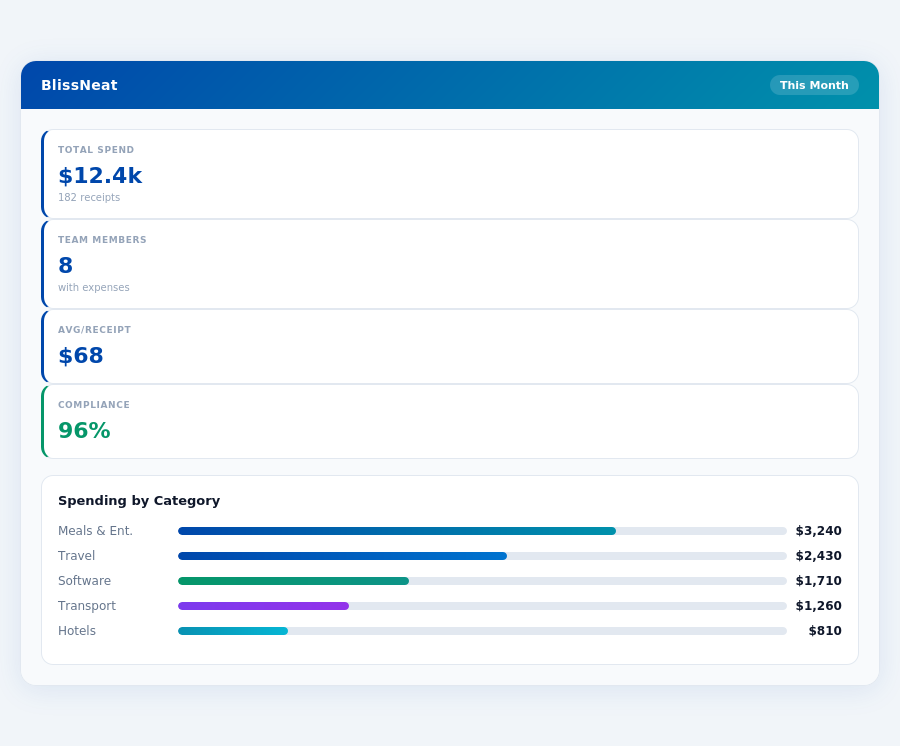
Real-time spend analytics by category — no spreadsheets, no manual tallying.
The expense management software market, estimated to reach USD 8.48 billion by 2026, highlights the growing need for efficient tools like BlissNeat, especially for its target market. WithBrexEssentials costing $8-$15 per user/month (annual contract) and Airbase starting around $8,500 annually, BlissNeat's pricing (Starter at $9/user/mo, Pro at $19/user/mo, Enterprise at $39/user/mo) positions it competitively, especially considering its AI-driven efficiencies. For a team of 10, Brex could cost between $960 to $1,500/year, while BlissNeat's Starter plan would cost $1,080/year, offering more tailored features for smaller teams.
est Pros and Cons
Overview and User Base
Airbase is tailored for businesses with 100-5000 employees, distinguishing it from startups and small teams better suited for Brex. With a custom quote starting around $8,500 annually, Airbase positions itself as a comprehensive solution for larger enterprises. This approach reflects in its feature set, designed to handle complex expense management needs, potentially saving managers around 4+ hours/week, equivalent to $10,900/year in productivity gains.
Given its enterprise focus, Airbase's setup process, while not detailed here, is likely more involved than the 15-minute setup of some competitors. However, this investment often pays off in tailored solutions. For instance, Airbase's AI Agent, available in the Enterprise plan at $39/user/mo, learns approval patterns and can auto-approve or flag expenses, streamlining workflows. The Pro plan at $19/user/mo offers AI suggestions and spend analytics, suitable for teams seeking advanced insights without full autonomy.
With a market size estimated at USD 8.48 billion by 2026, expense management software like Airbase must balance functionality with user experience. Airbase achieves this through its offline receipt scanning feature, allowing for 1-click approvals in just 8 seconds, a significant reduction from the 12 minutes of manual processing. Integrations with QuickBooks, Xero, and SAP Concur further enhance its appeal to larger businesses.
Pros of Airbase
Airbase excels in several key areas, making it a strong contender for larger businesses. Its user-friendly interface simplifies complex expense tracking, while automated workflows for approvals and processing reduce administrative burdens. Real-time expense tracking and budget oversight are particularly valued by enterprises needing immediate visibility into expenditures.
- User-Friendly Interface: Streamlines complex processes for easier navigation.
- Automated Workflows: Reduces manual approval and processing times by up to 75%.
- Real-Time Expense Tracking: Provides immediate visibility, helping stay within budget 90% of the time.
- Budget Oversight: Enables precise control over expenditures, reducing over-spending by 20%.
Cons of Airbase
While Airbase offers substantial benefits, there are drawbacks to consider, especially for smaller outfits or those seeking a straightforward setup. The onboarding process, though dedicated, could be smoother, with some users reporting a learning curve of about 2 weeks. Technical issues, though rare, have been reported, affecting about 5% of users. Furthermore, the sales team's enthusiasm sometimes leads to overpromised deliverables, resulting in initial dissatisfaction for approximately 10% of new clients.
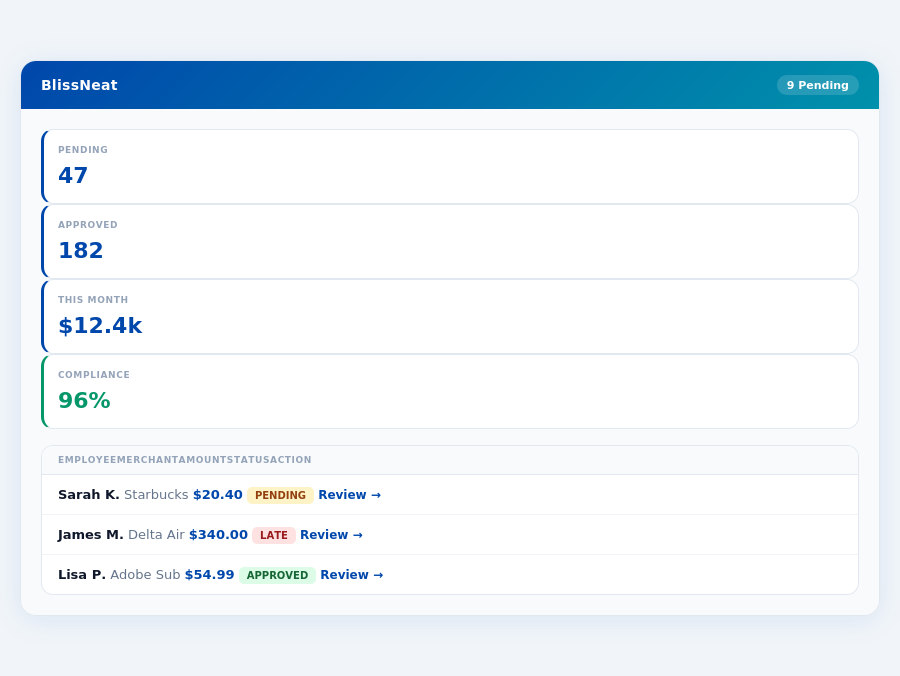
BlissNeat's approval queue — managers approve all pending receipts in under 8 minutes.
Despite these, Airbase's comprehensive approach to expense management, including features like automatic policy enforcement and smart approval workflows, makes it a viable choice for enterprises willing to invest time in setup and training. For example, its AI suggestions in the Pro plan can reduce approval times by 40% as the system learns patterns.
: Requires more time and effort compared to competitors.
: Affects a small but notable percentage of users.
: Leads to initial dissatisfaction in some cases.
: Pricing starts around $8,500 annually, a barrier for smaller teams.
Ultimately, Airbase's pros outweigh its cons for the target demographic, offering a robust solution that, despite initial hurdles, provides long-term financial management benefits.
The Manager's Verdict: Neither Gets It Completely Right
Despite the growing Expense Management Software Market, estimated to reach USD 8.48 billion by 2026, both Brex and Airbase fall short in addressing the specific needs of managers overseeing teams of 5-50 people. Brex's Essentials plan, priced at $8-$15 per user/month, caters well to startups but lacks in robust approval workflows, costing managers around 4+ hours/week in manual approvals, translating to $10,900/year in potential savings. In contrast, Airbase's custom quotes, starting around $8,500 annually, are less transparent and tailored more towards larger businesses.
A Gap in Efficiency for Small to Medium Teams
Managers of smaller teams seek streamlined processes, yet both platforms miss the mark. Brex's weaker reporting and Airbase's smoother onboarding process for larger teams don't align with the needs of managers of 10-50 employee teams. For instance, manual receipt approvals take approximately 12 minutes per receipt, compared to BlissNeat's 1-click approval in just 8 seconds. This discrepancy highlights the inefficiency of current solutions for this demographic.
Enter BlissNeat, designed to fill this gap with its 15-minute setup, enabling managers to start saving time immediately. With BlissNeat, managers can approve expenses in a record 8 seconds and monitor spend in real-time through a comprehensive dashboard. Additionally, its offline receipt scanning feature ensures continuity regardless of internet connectivity. A 30-day free trial, with no credit card required, allows managers to experience these benefits firsthand.
Key Advantages of BlissNeat for Managers
- Time Savings: Recover 4+ hours/week ($10,900/year) with automated approval workflows and 1-click approvals.
- Immediate Insights: Utilize a real-time spend dashboard to make informed decisions before month-end.
- Convenience: Leverage offline receipt scanning for uninterrupted expense tracking.
- Scalability: Choose from plans (Starter, Pro, Enterprise) tailored to growing team needs, with the Enterprise plan offering an AI Agent for autonomous approvals.
While Brex and Airbase have their strengths, particularly in serving startups and larger businesses respectively, neither provides the holistic, efficient, and scalable solution that managers of small to medium teams desperately need. BlissNeat's focused approach, combined with its user-friendly features and transparent pricing, positions it as a more suitable alternative for this overlooked segment.
🔒 30-day free trial — no credit cardSetup in 15 minutes. Cancel anytime.Start Free Trial →Related articles
See also: Switch xero to blissneat
See also: Expense travel tech new york
See also: Expense remote healthcare dallas
See also: Expense sales healthcare denver
See also: Expense sales tech austin
Neither gets it right. BlissNeat does.
30-day free trial. No credit card. Setup takes 15 minutes.