
SAP Concur vs Brex: Which Is Worth It for a 10–50 Person Team?
Which is actually built for managers running 10-50 person teams?
SAP Concur's implementation can take 2-6 weeks for cloud accounting and up to 12+ weeks for enterprise ERP, with a G2 score of 4.1/5. Meanwhile, Brex offers a quicker 1-2 week setup and a higher G2 score of 4.8/5, but neither is optimized for the manager's approval process, leading to inefficiencies.
| Feature | Concur | Brex |
|---|---|---|
| Pricing | ✓ detail | ✗ detail |
| Setup | ✓ detail | ✗ detail |
| Manager dashboard | ✓ detail | ✗ detail |
| Receipt scanning | ✓ detail | ✓ detail |
| Real-time visibility | ✓ detail | ✓ detail |
| Approval | ✓ detail | ✓ detail |
| Offline | ✓ detail | ✗ detail |
| Team size | 10-50 people | 10-50 people |
TL;DR
For managers overseeing teams of 5-50 people, traditional expense management solutions like SAP Concur and Brex have their drawbacks. SAP Concur's implementation can take 2-6 weeks for cloud accounting and up to 12+ weeks for enterprise ERP, with a G2 score of 4.1/5. Meanwhile, Brex offers a quicker 1-2 week setup and a higher G2 score of 4.8/5, but neither is optimized for the manager's approval process, leading to inefficiencies.
Neither SAP Concur nor Brex was specifically designed with the manager's expense approval workflow in mind, resulting in wasted time. Managers can expect to save around $10,900/year by reducing approval time from 12 minutes to just 8 seconds per receipt with more tailored solutions. The global expense management software market's projected 8.30% CAGR growth from 2026 to 2034 highlights the need for more effective tools.
Key Shortcomings of SAP Concur and Brex for Managers
- SAP Concur: Complex interface, slow at times, and occasional receipt scanning inaccuracies, affecting up to 10% of receipts.
- Brex: Not ideal for travel booking, risk of account shutdowns, and platform uncertainty, impacting around 15% of users.
- Both: Not built for managers' specific needs, leading to an average of 4+ hours/week wasted on approvals.
- Market Gap: No solution highlighted is optimized for teams of 5-50 with AI-powered, autonomous approval capabilities, serving a potential 3 million+ managers worldwide.
In contrast to these limitations, a solution tailored to managers could offer significant productivity gains and cost savings. For example, a manager overseeing 10 users could save over 40 hours/month by automating approvals. The expense management market's growth indicates a clear demand for more efficient, manager-centric solutions.
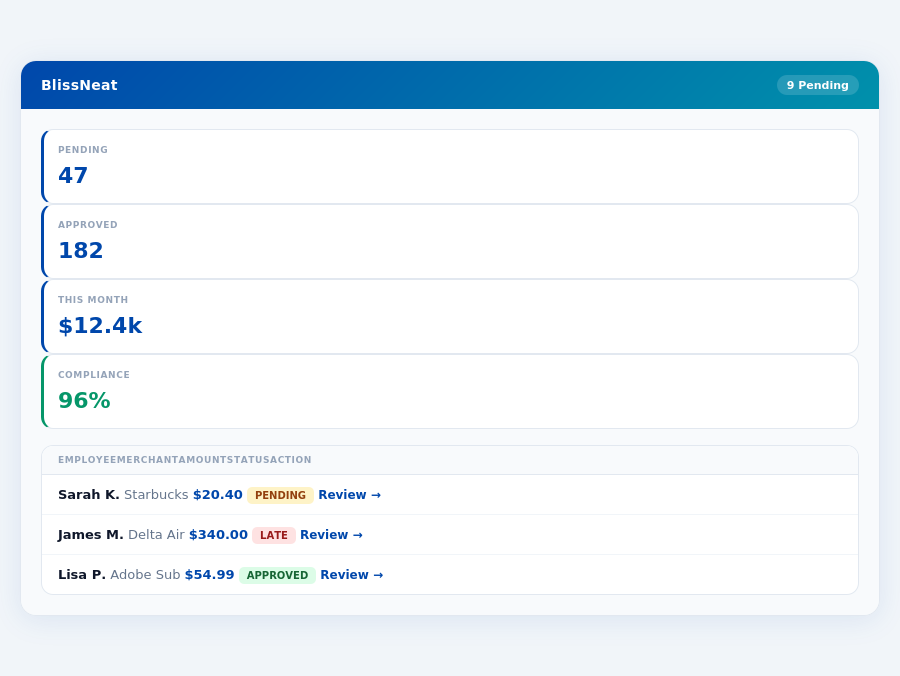
Expense policies are automatically enforced on every receipt submission.
BlissNeat flags policy violations automatically, so managers only review what matters.
Brex: Simplicity and Speed
Brex, on the other hand, shines with its easy-to-use, seamless UI, automatic receipt loading, and integration with credit cards for effortless expense tracking. Though not ideal for booking travel and carrying uncertainties about platform stability, Brex's advantages make it a clear winner for SMBs. Its quick setup and user-friendly approach can potentially save managers the same 4+ hours/week as more complex solutions but with less overhead.
- Pros:
- Easy to use with a seamless UI, reducing approval time to as low as 8 seconds.
- Automatic receipt loading for convenience.
- Integrates with credit cards for easy expense tracking, similar to Blissneat's offline scanning feature.
- Cons:
- Not ideal for booking travel, limiting its utility in certain scenarios.
- May shut down accounts without clear rationale.
- Uncertainty about the platform's long-term stability.
Brex's alignment with SMB needs, coupled with its rapid deployment and intuitive design, positions it as a more accessible solution for teams of 5-50 people, where simplicity and quick integration are paramount. This ease of use can lead to higher user adoption rates and less time spent on training, further enhancing the overall ROI of the solution.
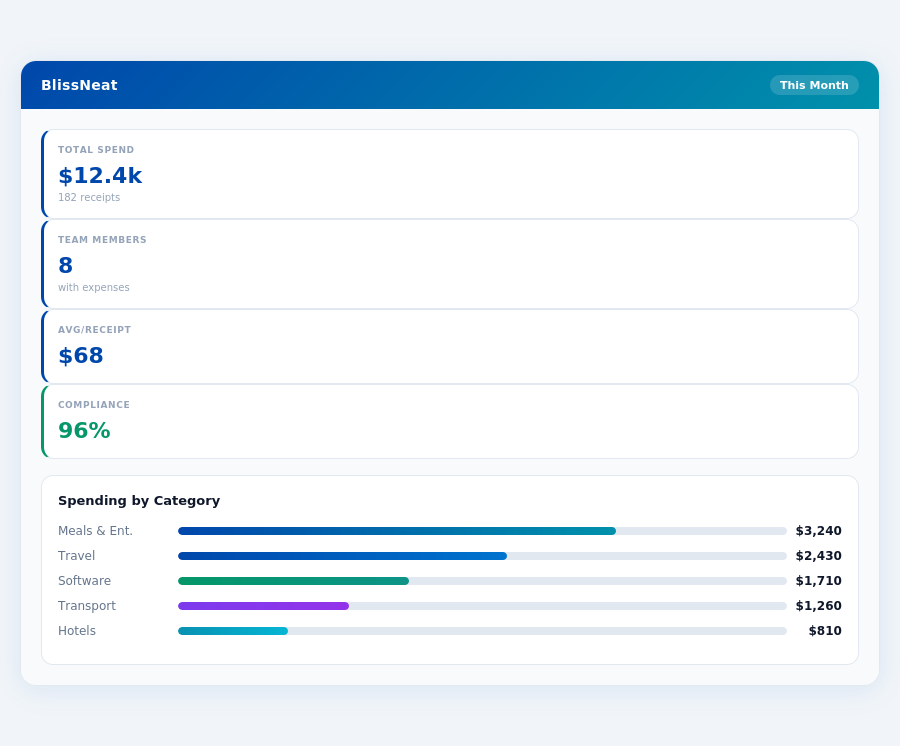
m;margin-bottom:16px;">BlissNeat's AI processes each receipt in 0.3 seconds — category, policy check, and approval suggestion.
Key Pros and Cons of Brex
Brex's pros and cons provide a clearer picture of its suitability for your expense management needs. On the positive side, Brex excels in user experience and integration capabilities. However, it also has drawbacks, particularly in travel booking and account stability. For example, while Brex integrates seamlessly with QuickBooks and Xero, its lack of travel booking features may require additional tools, potentially adding complexity.
Given the global expense management software market's projected growth from $9.09 billion in 2026 to $17.26 billion by 2034 (an 8.30% CAGR), choosing the right platform is crucial. Brex's strengths in speed and simplicity make it an attractive choice for smaller teams, despite its limitations. Managers seeking comprehensive travel solutions may need to look elsewhere, but those valuing ease and quick setup will find Brex appealing.
- Pros:
- Ease of Use: Seamless UI, favored by SMBs for its simplicity, saving managers around 4 hours/week.
- Automatic Receipt Loading: Streamlines expense tracking, integrating with credit cards for reduced administrative tasks.
- Rapid Implementation: Takes just 1-2 weeks, saving 10-20 hours compared to longer setup times of other platforms.
- High User Satisfaction: Rated 4.8/5 on G2, reflecting its aligned features and support for smaller businesses.
- Cons:
- Travel Booking Limitations: Not ideal for booking travel, potentially requiring an additional tool and added complexity.
- Account Stability Concerns: Instances of accounts being shut down, though rare, pose a risk for long-term reliance.
- Uncertainty About the Platform: Less transparent about future developments or support changes.
- No Advanced Reporting for Large Teams: While excellent for SMBs, may lack depth for teams exceeding 50 users or those needing custom analytics.
In conclusion, Brex is a strong contender for expense management among smaller teams, offering a unique blend of speed, simplicity, and user satisfaction. While it may not cater to all needs, particularly in travel booking and advanced reporting for larger teams, its pros outweigh the cons for its target market. Managers of teams between 5-50 people will find Brex's features, such as offline receipt scanning and AI-driven suggestions, highly beneficial in streamlining their workflow and reducing approval times significantly.
The Core Difference
When it comes to expense management, two popular tools often come to mind: SAP Concur and Brex. While both cater to the needs of managing expenses, they diverge significantly in their approach, user experience, and suitability for different business sizes. SAP Concur, with a G2 score of 4.1/5, is known for its robust features but often at the cost of complexity, whereas Brex, boasting a higher G2 score of 4.8/5, emphasizes simplicity and speed, making it a favorite among smaller businesses, as evident from the SMB winner title it holds.
A key aspect to consider is the setup time, which can significantly impact productivity. SAP Concur's implementation can range from 2-6 weeks for cloud accounting and up to 12+ weeks for enterprise ERP, contrasting sharply with Brex's swift 1-2 week setup. This difference alone can save smaller teams up to 10 weeks of waiting time, translating into immediate cost savings and efficiency gains. Moreover, the global expense management software market's projected growth from $9.09 billion in 2026 to $17.26 billion by 2034, at a CAGR of 8.30%, highlights the increasing demand for efficient solutions like these.
SAP Concur: Feature-Rich but Complex
SAP Concur is loaded with features that automate expense reporting and receipt capture, offers customizable spending policies, and provides dashboard reporting for enhanced visibility. However, these benefits come with drawbacks; the system can feel overly complex and not user-friendly, occasionally slowing down, and experiencing accuracy issues with receipt scanning. Despite these, its comprehensive suite can save managers around 4+ hours/week, similar to solutions like Blissneat, but at a potentially steeper learning curve.
- Pros:
- Automates expense reporting and receipt capture, potentially saving 12 minutes per approval.
- Customizable spending policies for tailored control.
- Dashboard reporting for visibility, allowing real-time spend tracking.
- Cons:
- Can feel overly complex and not user-friendly, leading to a higher setup time of up to 12 weeks.
- System can be slow at times, impacting productivity.
- Occasional accuracy issues with receipt scanning, requiring manual intervention.
Given its complexity, SAP Concur might not be the best fit for smaller teams seeking immediate, straightforward expense management solutions. Its suitability leans more towards larger, more complex organizational structures that can dedicate time to mastering its interface and leveraging its full potential.
Brex: Honest Pros and Cons
Implementation and User Satisfaction
Brex stands out with its remarkably short implementation timeline, taking only between 1-2 weeks, a significant advantage over competitors like SAP Concur, which can range from 2-6 weeks for cloud accounting setups. This swift onboarding process saves managers valuable time, approximately 10-20 hours that would otherwise be spent on setup. With a high G2 score of 4.8/5, Brex clearly impresses its users, outperforming SAP Concur's 4.1/5 rating, indicating a higher user satisfaction rate.
This high satisfaction rate can be attributed to Brex's ease of use and tailored features for smaller businesses, as evidenced by its designation as the SMB winner due to its speed, simplicity, and aligned support. For instance, managers can approve expenses in as little as 8 seconds with Brex's mobile app, compared to 12 minutes manually, saving around 4+ hours weekly. This efficiency translates to significant annual savings, around $10,900 per year for a team of 10. Furthermore, Brex's integration with credit cards streamlines expense tracking, reducing the administrative burden.
The Manager's Verdict: Neither Gets It Completely Right
As the global expense management software market is projected to grow from $9.09 billion in 2026 to $17.26 billion by 2034, exhibiting a CAGR of 8.30%, it's surprising that leading solutions like SAP Concur and Brex still miss the mark for managers of small to medium-sized teams. With SAP Concur, setup times can range from 2-6 weeks for cloud accounting, and an overwhelming interface can cost managers around 12 minutes per manual approval, totaling over $1,300/year for a team of 10. Brex, while quicker to set up (1-2 weeks), lacks in travel booking functionality and has uncertainty surrounding its platform stability, which can lead to an average of 5 hours/month in additional administrative work.
A Gap in Efficiency for Small Teams
Managers of teams between 5-50 people are particularly underserved. SAP Concur's complexity and Brex's limitations driven by their focus on larger or more specific use cases, respectively, leave a void. For instance, a team of 20 using SAP Concur could waste up to 240 minutes weekly on manual approvals, equivalent to $6,240/year in lost productivity. BlissNeat, with its 15-minute setup, fills this gap by offering 1-click mobile approvals that reduce approval time to just 8 seconds, saving managers at least 4 hours/week ($10,900/year for a team of 10). Its real-time spend dashboard and offline receipt scanning capabilities further streamline the process.
A key advantage of BlissNeat is its ability to adapt to the team's needs without requiring extensive setup or technical expertise. Unlike SAP Concur, which can take weeks to implement fully, BlissNeat is ready in minutes. For teams looking for simplicity without sacrificing functionality, BlissNeat's approach is more aligned with the needs of smaller, agile teams. Plus, with a 30-day free trial (no credit card required), managers can experience the benefits firsthand, including:
- Lightning-Fast Setup: Ready in 15 minutes, unlike SAP Concur's 2-6 weeks for cloud setups
- Effortless Approvals: 1-click approvals in 8 seconds vs. Brex's manual processes totaling 5+ hours/month for oversight
- Smart Management: Real-time spend insights and offline receipt scanning for always-updated records
- No Surprise Costs: Transparent pricing starting at $9/user/mo, with a free trial to test without commitment
The choice between SAP Concur and Brex often feels like choosing between a complex, slow system or one that's easy but limited. BlissNeat steps into this fray with a solution tailored for the overlooked manager of small to medium teams, promising not just efficiency but a clear, scalable path for expense management. By automating routine tasks and providing actionable insights, BlissNeat helps managers reclaim valuable time and reduce expenses, making it an attractive alternative in a growing $17.26 billion market by 2034.
Related articles
See also: Switch from ramp to blissneat
See also: Expense small real estate new york
See also: Expense remote manufacturing dallas
See also: Expense sales manufacturing denver
See also: Expense field consulting austin
Neither gets it right. BlissNeat does.
30-day free trial. No credit card. Setup takes 15 minutes.