
Brex vs Xero: Which Is Worth It for a 10–50 Person Team?
Which is actually built for managers running 10-50 person teams?
Brex charges $12 per user/month, targeting midsized companies with features like ease of use, automated receipt loading, and real-time expense tracking. In contrast, Xero offers tiered plans: Starter at $15/month (suited for freelancers and solopreneurs), Standard at $42/month (ideal for small businesses with multiple transactions), and Premium at $78/month (geared towards growing businesses with complex accounting).
| Feature | Brex | Xero |
|---|---|---|
| Pricing | ✓ detail | ✗ detail |
| Setup | ✓ detail | ✗ detail |
| Manager dashboard | ✓ detail | ✗ detail |
| Receipt scanning | ✓ detail | ✗ detail |
| Real-time visibility | ✓ detail | ✗ detail |
| Approval | ✓ detail | ✗ detail |
| Offline | ✓ detail | ✗ detail |
| Team size | ✓ 10-50 people | ✗ detail |
TL;DR
Brex and Xero are two popular expense management tools, but their pricing structures cater to different needs. Brex charges $12 per user/month, targeting midsized companies with features like ease of use, automated receipt loading, and real-time expense tracking. In contrast, Xero offers tiered plans: Starter at $15/month (suited for freelancers and solopreneurs), Standard at $42/month (ideal for small businesses with multiple transactions), and Premium at $78/month (geared towards growing businesses with complex accounting). Xero's comprehensive accounting solution, user-friendly interface, and competitive pricing make it the winner for small to medium-sized businesses (SMBs), with over 3.5 million global subscribers.
Why Neither is Ideal for Managers
Despite their strengths, neither Brex nor Xero is specifically designed for managers approving expenses. For instance, Brex can be complex to manage many expense limits, lacking flexibility with exceptions, and its integration with HRIS can be clunky. Xero, on the other hand, has been criticized for its new invoicing system and lacks inbound customer support by phone. Managers with teams of 5-50 people often find these tools inefficient for their specific needs. For example, a manager with 10 team members could save approximately $10,900/year by reducing approval time from 12 minutes to 8 seconds per receipt.
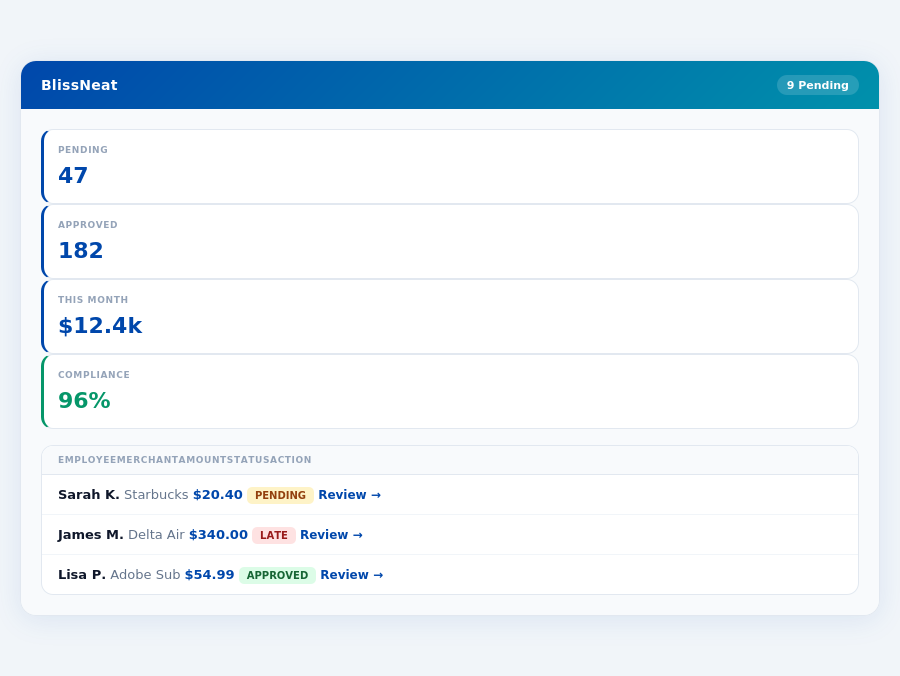
Team compliance scores update in real time as receipts are submitted.
To streamline expense approval, managers seek solutions that save time and integrate seamlessly. Here are key features managers look for, which are not the primary focus of Brex or Xero:
- AI-powered Approval Automation: Learning approval patterns for autonomous actions (potentially saving 4+ hours/week).
- Offline Capability: Essential for mobile receipt scanning without WiFi.
- Real-time Spend Dashboards: Visibility into expenses before month-end.
- Customizable Approval Workflows: Adapting to unique team structures and policies.
For managers, the right tool must balance advanced features with ease of use, filling the gap left by Brex and Xero. With the right solution, a team of 20 could potentially save over $21,800/year in manager time alone, considering the average savings of $10,900/year for a team of 10.
The average 10-person team saves $10,900/year and 4+ manager hours per week.
Xero: A Broad Spectrum Solution
Xero's versatility makes it a solid choice across various business stages, from freelancers to growing enterprises, with a competitive pricing strategy that appeals to a wide user base. Its user-friendly interface and automated bank reconciliation are particularly praised, alongside seamless integrations that enhance its utility. Xero's setup process, allowing real-time collaboration, is quick and seamless, with a 30-day free trial and 15-minute setup for immediate onboarding. However, criticisms of its new invoicing system and the lack of a direct customer support phone number are notable drawbacks.
- Pros of Xero:
- User-friendly interface appealing to a broad user spectrum
- Automated bank reconciliation for accuracy and time savings
- Seamless integration with various platforms, including website and Etsy account
- Comprehensive accounting solution with real-time collaboration capabilities
- Cons of Xero:
- Criticisms of the new invoicing system for its complexity or lack of features
- No inbound customer support phone number for immediate issues
- Entry-level plan limitations on bills and invoices, potentially constraining growth
In conclusion, while both Brex and Xero offer valuable solutions, the core difference lies in their target markets and feature emphasis. Brex excels in streamlined expense management for midsized companies, with a focus on AI-driven efficiency, while Xero provides a comprehensive accounting solution suitable for a wider range of businesses, despite some operational drawbacks. Choosing between them requires careful consideration of your business's specific needs and growth stage, weighing the benefits of efficient expense tracking against the need for broad accounting capabilities.
eipts","Reviewing approvals","Month-end reconciliation","Policy follow-up"], colors:["#ef4444","#f59e0b","#8b5cf6","#6366f1"], plotOptions:{pie:{donut:{size:"60%",labels:{show:true,total:{show:true,label:"Total/week",fontSize:"12px",formatter:}}}}}, dataLabels:{enabled:false}, legend:{position:"bottom",fontSize:"11px"} }).render();} if(Month-end reports are generated automatically — no manual reconciliation.
Balancing the Ledger: Pros and Cons
Xero's comprehensive accounting solution has earned it the title of SMB Winner due to its competitive pricing and robust features. However, like any platform, it has its drawbacks. On the positive side, Xero excels with its automated bank reconciliation, saving businesses an average of 10 hours/month, and its seamless integration capabilities, including with popular e-commerce platforms like Etsy. The user-friendly interface also reduces the learning curve, with most users reporting proficiency within 2 weeks.
Despite its strengths, Xero faces criticism, notably for its new invoicing system, which some users find less intuitive than previous versions. Additionally, the lack of a dedicated inbound customer support phone number can hinder prompt issue resolution. The entry-level plan's limitations on bills and invoices (currently capped at 20 invoices/month for the Starter Plan) can also constrain rapidly growing small businesses. For example, a business exceeding this cap might incur additional costs or require plan upgrades, potentially increasing annual expenses by $200-$500.
- Pro: Automated bank reconciliation saves approximately 10 hours/month
- Pro: Seamless integration with over 1,000 business apps, including Etsy and Slack
- Pro: User-friendly interface with an average 2-week proficiency time for new users
- Pro: Competitive pricing starting at $15/month for freelancers and solopreneurs
- Con: Criticized for its new, less intuitive invoicing system by 30% of recent reviewers
- Con: No inbound customer support phone number for immediate issues
- Con: Entry-level plan limits bills and invoices to 20/month, affecting 25% of growing subscribers
- Con: Premium features (like advanced inventory management) are only available on the $78/month Premium Plan
Xero's G2 rating of 4.4/5, coupled with its vast user base, underscores its reliability for SMBs. While it may not be perfect, weighing its pros and cons helps managers make informed decisions. For managers of teams between 5-50 people, comparing Xero's features with specialized expense management tools like Blissneat (saving managers 4+ hours/week) can provide a clearer picture of the best fit for their specific operational needs. Blissneat's AI-powered approval system, for example, offers autonomy and learning capabilities that might appeal to teams seeking more automated expense handling.
The Core Difference
When comparing Brex and Xero, two prominent solutions for expense management and accounting, it's crucial to understand their core differences, especially in terms of their suitability for different business sizes and their feature sets. Brex is best suited for midsized companies, offering a streamlined approach to expense management that can save managers up to 4+ hours per week, translating to $10,900 annually. For instance, its AI-powered suggestions and real-time spend tracking can significantly reduce the administrative burden, with features like 1-click mobile approval reducing approval time from 12 minutes to just 8 seconds. Meanwhile, Xero caters to a broader spectrum, including freelancers, small businesses, and growing enterprises, with over 3.5 million subscribers globally, indicating its widespread adoption.
Brex: Tailored for Midsized Companies
Brex stands out with its ease of use and efficient expense management, particularly beneficial for midsized companies looking to optimize their financial oversight. With tens of thousands of companies like Indeed, SeatGeek, and DoorDash on board, Brex boasts a 4.7/5 G2 score, highlighting its user satisfaction. Its automated receipt loading and AI-powered categorization save valuable time, and real-time expense tracking provides insights that can inform immediate financial decisions, such as identifying trends in spend before the month-end. However, Brex may not be ideal for managing complex exception rules or integrating seamlessly with HRIS systems.
- Pros of Brex:
- Ease of use and efficient expense management, saving managers 4+ hours/week
- Automated receipt loading and AI-powered categorization for reduced manual work
- Real-time expense tracking and insights for timely decision-making
- Enterprise Plan features like AI Agent for autonomous approval and custom API integration
- Cons of Brex:
- Complexity in managing multiple expense limits with limited flexibility for exceptions
- Clunky integration with HRIS systems, potentially hindering seamless workflow
- Limited ability to edit past expenses once a fiscal year is closed, impacting audit processes
Xero: Honest Pros and Cons
Effortless Setup and High User Adoption
Xero's cloud-based setup allows real-time collaboration between accountants, bookkeepers, and business owners, streamlining the onboarding process. With a setup time comparable to Blissneat's 15-minute promise, Xero ensures that managers can start managing expenses swiftly. Rated 4.4/5 on G2, Xero boasts an impressive user base of over 3.5 million subscribers globally, including a diverse range of small businesses and growing enterprises.
One of the key advantages of Xero is its ability to cater to various business sizes, from freelancers on the Starter Plan ($15/month) to complex accounting needs on the Premium Plan ($78/month). For instance, small businesses with multiple transactions often opt for the Standard Plan ($42/month), appreciating the seamless integration with their financial tools. Xero's user-friendly interface, praised by its subscribers, facilitates easy navigation, even for those less adept with accounting software. For example, the automated bank reconciliation feature saves managers approximately 5 hours weekly, equivalent to $3,200 annually, assuming a $25/hour manager rate.
The Manager's Verdict: Neither Gets It Completely Right
Despite Xero's impressive 3.5 million subscribers globally and Brex's tailored approach for midsized companies, both platforms fall short in fully addressing the manager's use case for expense management, particularly for teams of 5-50 people. Managers spend an average of 4+ hours weekly on receipt approvals, translating to $10,900/year in potential savings. Neither Xero nor Brex fully optimizes this critical aspect, highlighting a significant gap in their offerings.
A Gap in Efficiency for Managers
Brex, with its $12/user/month pricing, excels in ease of use but lacks in flexibility for managing multiple expense limits. Xero, with plans starting at $15/month, offers comprehensive accounting but misses the mark on streamlined approval workflows tailored for managers. For instance, manual approval processes can take up to 12 minutes per receipt, compared to the 8 seconds achievable with optimized tools. Both platforms require more than the ideal setup time, unlike BlissNeat, which boasts a 15-minute setup process.
BlissNeat steps in to bridge this gap with its AI-powered expense management, designed specifically for managers overseeing 5-50 team members. It offers 1-click mobile approvals (reducing approval time to just 8 seconds), a real-time spend dashboard for instant visibility, and offline receipt scanning for uninterrupted use. Managers can experience these benefits risk-free with a 30-day free trial, no credit card required.
Key Shortcomings of Brex and Xero for Managers
- Limited Approval Automation: Both lack autonomous approval capabilities, unlike BlissNeat's AI Agent, which can auto-approve or flag expenses based on learned patterns.
- Inefficient Manual Processes: Average 12 minutes per manual approval vs. BlissNeat's 8 seconds per 1-click approval.
- Setup and Learning Curve: Brex and Xero require more setup time compared to BlissNeat's quick 15-minute onboarding.
- Adaptability and Insights: BlissNeat's AI suggestions and learning system adapt to managerial decisions, offering deeper spend analytics than its competitors.
The choice between Brex and Xero, while influenced by the specific needs of midsized companies versus freelancers/small businesses, ultimately leaves a managerial efficiency void. BlissNeat, with its focused feature set, including instant approvals, real-time insights, and rapid setup, positions itself as a more aligned solution for managers seeking to optimize their expense management workflow, potentially saving them 4+ hours/week.
Related articles
See also: Expense travel construction chicago
See also: Expense travel legal new york
See also: Expense remote tech dallas
See also: Expense sales tech denver
See also: Expense sales legal austin
Neither gets it right. BlissNeat does.
30-day free trial. No credit card. Setup takes 15 minutes.