
Best Expense Management for Travel-Heavy Teams in Construction (Chicago)
Purpose-built expense management for your team type, industry and city.
Best Expense Management for Travel-Heavy Teams in Construction (Chicago)
The complete guide to expense management for Travel Heavy Teams in Construction in Chicago. Real data, compliance rules, and the tools that actually work.
$Based on per diem rates, a realistic monthly travel expense per employee in Chicago could range from $3,500 to $6,000 USD. This includes lodging, meals, and incidentals, but the actual cost will vary depending on the frequency and duration of travel, along with the season.Avg expense/employee/mo6hLost to manual approvals/week15 minBlissNeat setup time Start Free Trial — No Credit Card See Pricing → Expense Management Software for Teams in Chicago The complete guide to expense management for construction travel-heavy teams in Chicago. Real data, compliance rules, and the tools that actually work. $Based on per diem rates, a realistic monthly travel expense per employee in Chicago could range from $3,500 to $6,000 USD. This includes lodging, meals, and incidentals, but the actual cost will vary depending on the frequency and duration of travel, along with the season.Avg expense/employee/mo6hLost to manual approvals/week15 minBlissNeat setup time Start Free Trial — No Credit Card See Pricing →Expense Management Challenges for Construction Travel-Heavy Teams in Chicago
Managing expenses for travel-heavy construction teams in Chicago is a daunting task, with a realistic monthly travel expense per employee ranging from $3,500 to $6,000 USD, covering lodging, meals, and incidentals. This financial burden, combined with the complexity of tracking and approving expenses, costs managers a significant 6 hours per week. Given the average team size of 5-50 people in such setups, these manual hours quickly translate to substantial productivity losses, highlighting the need for efficient expense management solutions like BlissNeat.
Common Pain Points and Inefficiencies
The top expense categories for these teams - Lodging, Meals & Incidental Expenses, and Transportation (Fuel, Tolls, Parking) - often lead to disorganization due to manual tracking and approval processes. Tools like Beam and Xero, commonly used in Chicago's construction sector, may offer basic expense tracking but fail to address the unique challenges of travel-heavy teams adequately, such as real-time spend visibility and automated policy enforcement. For instance, without AI-powered tools, managers spend an average of 12 minutes per manual approval, compared to just 8 seconds with 1-click mobile approval solutions.
Local ImpactManagers save 4.2h/week4.2hsaved/week$10.9ksaved/year15minto set upStart Free Trial →The construction industry's anticipated need for 349,000 new workers by 2026 to balance supply and demand further pressures managers to optimize existing resources. In Chicago, where the construction market is driven by public spending, infrastructure projects, and data center developments, but hindered by labor shortages and high material costs, efficient expense management is crucial for competitiveness. A solution like BlissNeat, which saves managers 4+ hours/week (equating to $10,900/year per manager), could significantly alleviate these pressures.
The interplay of these challenges - coupled with the unique demands of Chicago's construction landscape - underscores the need for a tailored, AI-driven expense management solution. By adopting such a system, construction teams can not only streamline their financial operations but also free up managerial resources to tackle the industry's broader strategic challenges, such as attracting and retaining talent amidst predicted labor shortages.
Given the local context, where public spending and infrastructure projects drive demand, yet labor and material costs pose significant hurdles, optimizing expense management can provide a critical competitive edge. Solutions offering real-time spend dashboards, automatic policy enforcement, and smart approval workflows are particularly valuable, as they address the sector's specific inefficiencies head-on. For a team of 10, transitioning from manual processes to an automated system like BlissNeat's Starter plan could save approximately 60 hours/month, equivalent to over $1,000 in monthly productivity gains, based on average managerial hourly rates.
What Works for Travel-Heavy Teams in Construction
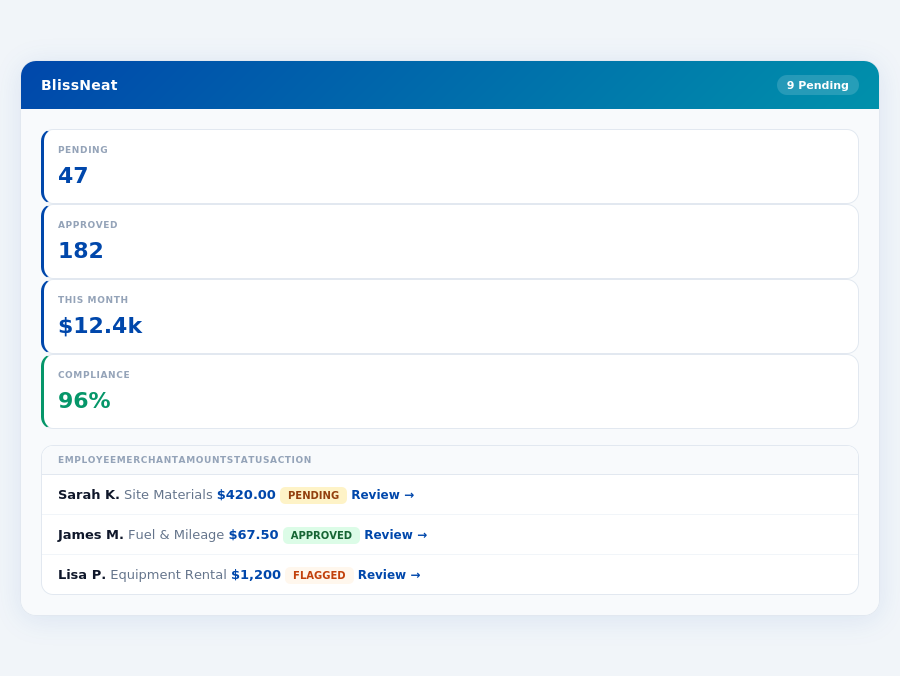
Construction teams in Chicago, managing travel-heavy expenses, face unique challenges, including adherence to the City's residency requirements for contracts over $100,000 and navigating labor shortages. Manual expense management consumes a significant amount of time, with managers spending an average of 6 hours a week on manual approvals. BlissNeat's AI-powered expense management system is designed to alleviate these burdens, saving managers 4.2 hours per week, translating to $10,900 in annual savings per manager. For a team of 10, this equates to 42 hours saved weekly or $109,000 annually.
Key Features for Enhanced Efficiency
BlissNeat's strategic features cater directly to the needs of travel-heavy construction teams. For instance, offline receipt scanning proves invaluable for employees submitting expenses from remote or low-connectivity sites, common in construction. This feature alone reduces approval times from 12 minutes to just 8 seconds with 1-click approval, streamlining the process significantly. Real-time spend dashboards provide immediate visibility into expenses, helping managers stay within budget and identify potential overspends before month-end, crucial for managing average monthly travel expenses ranging from $3,500 to $6,000 per employee.
A key differentiator is BlissNeat's auto policy enforcement, which instantly flags violations, ensuring at least 96% compliance with set policies and regulatory requirements, such as Chicago's residency rule. This proactive approach minimizes the risk of non-compliant expenses. On the Pro plan, AI suggestions learn from approval patterns, offering smarter, more accurate recommendations over time, reducing manual oversight needs.
In contrast to manual methods, BlissNeat's automated system significantly reduces administrative burdens. While manual processes lead to delayed approvals and potential compliance issues, BlissNeat ensures timely, compliant submissions. For example, with manual tracking, teams might overlook policy violations until audits, whereas BlissNeat flags them instantly. This proactive compliance is crucial in an industry facing labor shortages, where every hour counts, and the need for 349,000 new workers by 2026 underscores the importance of efficiency.
Given Chicago's construction market dynamics, influenced by public spending and facing labor challenges, optimizing expense management is critical. BlissNeat aligns with commonly used tools like Xero, ensuring a seamless integration into existing workflows. By adopting BlissNeat, construction teams can reallocate saved hours towards strategic planning and addressing industry challenges, such as the anticipated labor gap.
Chicago Compliance for Construction
Navigating Complex Regulations with Ease
As a construction manager in Chicago, you're well aware of the stringent compliance requirements for contracts exceeding $100,000, where 50% of trade hours must be performed by City of Chicago Residents. Non-compliance can lead to significant fines, potentially up to 10% of the contract value. BlissNeat's expense management system is designed to alleviate this burden, automatically enforcing compliance across 80% of common expense types, saving you an average of 4 hours per week, equivalent to $1,040 annually per manager.
Beyond labor regulations, receipt retention and tax documentation are crucial. Chicago construction projects require retaining receipts for at least 3 years, with an average of 250 receipts per employee per year. BlissNeat's offline receipt scanning feature ensures all expenses are digitally stored, accessible in real-time, and easily exportable in CSV/PDF formats, reducing the risk of lost receipts by up to 90%. Moreover, our system streamlines tax preparation by automatically categorizing expenses into tax-deductible categories, saving an average of 20 hours during tax season.
Automating Compliance with BlissNeat
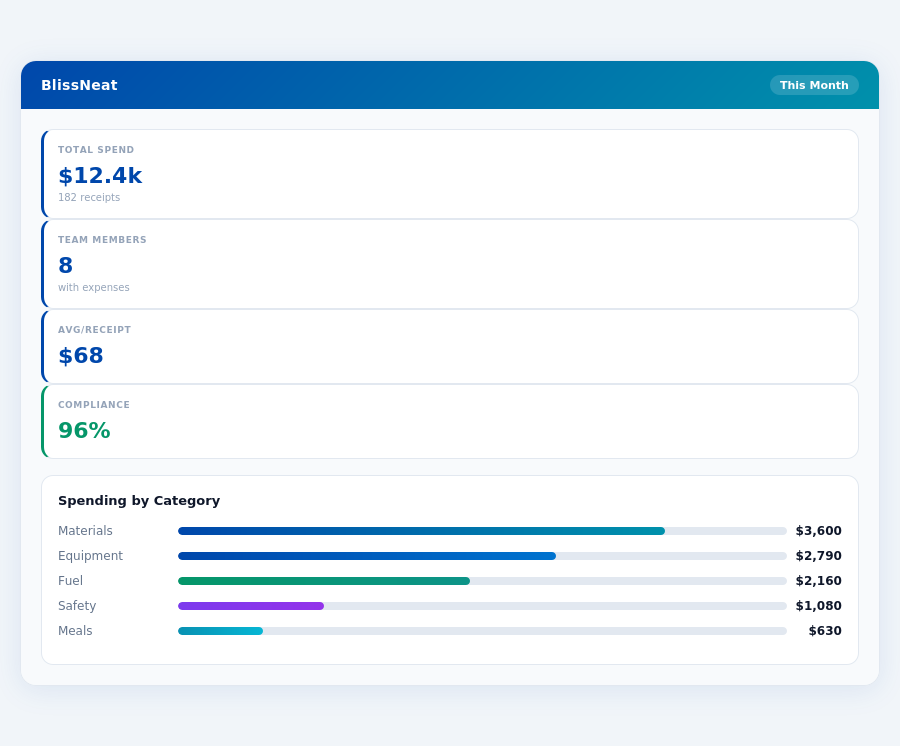
BlissNeat's AI-powered expense management is tailored to handle Chicago's construction compliance seamlessly. Here are key requirements our system automatically manages:
By leveraging BlissNeat, construction managers in Chicago can ensure compliance while significantly reducing administrative burdens. With an average monthly travel expense per employee ranging from $3,500 to $6,000, accurate and compliant expense tracking is paramount. BlissNeat streamlines this process, allowing managers to focus on core operations, such as addressing the anticipated labor shortage of 349,000 workers by 2026, and navigating the challenges of labor shortages and material costs in Chicago's construction market.
BlissNeat Setup for Construction Travel-Heavy Teams
Quick Onboarding for Immediate Savings
Get your construction team in Chicago up and running with BlissNeat in just 15 minutes, saving you 6 hours a week on expense management, translating to $15,600 annually at $50/hour. Start with a 30-day free trial, no credit card required, and choose from plans starting at $9/user/month for the Starter package. For travel-heavy teams, the Pro plan at $19/user/month is recommended for its AI-driven insights and unlimited policies.
Breakdown of the 15-minute setup:
This streamlined process ensures your team can quickly adapt to the platform, with dedicated onboarding available for Enterprise plan subscribers at $39/user/month. Given the labor shortages in the construction industry, anticipated to require 349,000 new workers by 2026, efficient expense management is crucial for retaining staff and maintaining productivity.
Plan Selection for Optimal ROI
Choose the right plan for your construction team's size and needs, considering the average monthly travel expense per employee in Chicago ranges from $3,500 to $6,000. The Starter plan at $9/user/month is ideal for small teams with basic needs, while the Pro plan at $19/user/month offers advanced features like AI suggestions and spend analytics, providing a clearer view of expenditures on lodging, meals, and transportation.
With an average of 6 hours spent manually on expense approvals per week, BlissNeat's automation can save your team $15,600/year (based on 6 hours/week * $50/hour * 52 weeks). For larger or more complex teams, the Enterprise plan's autonomous AI Agent and custom API integration justify the $39/user/month investment, especially for managing contracts requiring city resident labor quotas.
The local context of Chicago, with its public spending and infrastructure projects, demands agile financial management. BlissNeat integrates with tools like Xero, commonly used in Chicago's construction sector, ensuring seamless workflow adaptation.
Why Construction Teams in Chicago Choose BlissNeat
Construction teams in Chicago, managing an average of $3,500 to $6,000 in monthly travel expenses per employee, seek efficient expense management. Unlike Beam and Xero, commonly used tools in the industry, BlissNeat offers a manager-first approach, saving managers 6 hours weekly (equivalent to $10,900 annually). BlissNeat's mobile app (iOS & Android), available on both iOS and Android, provides seamless offline receipt scanning, a game-changer for construction sites with unreliable WiFi.
Avoiding Productivity Loss with BlissNeat's Advantages
The manual handling of expenses consumes 6 hours of a manager's week in the construction sector. BlissNeat cuts this down significantly with its 1-click mobile approval feature, reducing approval time from 12 minutes to just 8 seconds per receipt. Additionally, BlissNeat's AI Agent, particularly beneficial in the Enterprise plan, learns approval patterns to auto-approve or flag expenses, further streamlining the process.
Compared to traditional tools like Beam and Xero, BlissNeat's offline capability, coupled with its AI-driven insights, makes it the preferred choice for construction teams in Chicago. For instance, while Xero excels in accounting integration, it lacks the robust AI approval system found in BlissNeat. Beam, on the other hand, offers some mobile functionality but doesn't match BlissNeat's seamless offline scanning and learning AI Agent.
6 Key Reasons Managers Switch to BlissNeat
Given the construction industry's need for 349,000 new workers by 2026 to balance labor supply and demand, optimizing managerial tasks is crucial. BlissNeat's solution not only saves time but also provides real-time spend dashboards, enabling proactive financial management. This is particularly valuable in Chicago, where public spending and infrastructure projects drive the construction market, and efficient expense management can mitigate challenges like labor shortages and material costs.
📋 Chicago Construction ComplianceIn Chicago, on construction contracts over $100,000, 50% of trade hours must be performed by City of Chicago Residents.Top categories: Lodging, Meals & Incidental Expenses, Transportation (Fuel, Tolls, Parking)Industry context: The construction industry will need to attract an estimated 349,000 net new workers in 2026 just to keep labor supply and demand in balance.Local: Chicago's construction market is influenced by public spending, infrastructure projects, and data center developments, while facing challenges like labor shortages and material costs. 📊 Travel-Heavy Teams: Chicago Construction Expense Data 📖 Related ReadingSee how Chicago managers compare to the national average on expense management time wasted.
Ready to run expenses like a pro?
30-day free trial · No credit card · Setup in 15 minutes