
Certify vs Abacus: Which Is Worth It for a 10–50 Person Team?
Which is actually built for managers running 10-50 person teams?
Abacus wins for SMBs with its $9/User/Month pricing and flexible billing, suitable for varying activity levels, unlike Certify, whose pricing remains undisclosed. Notably, Abacus saves managers an estimated 4+ hours/week, translating to $10,900/year in productivity gains for a team of 10, assuming a $25/hour manager rate.
| Feature | Certify | Abacus |
|---|---|---|
| Pricing | $8-12 per user/month | $9-15 per user/month |
| Setup | Easy, guided setup | More complex setup process |
| Manager dashboard | Customizable, real-time insights | Limited customization options |
| Receipt scanning | Mobile receipt capture, OCR | Manual receipt upload |
| Real-time visibility | Real-time expense tracking | Delayed expense updates |
| Approval | Multi-level approval workflow | Single-level approval process |
| Offline | Offline access, syncs when online | No offline access |
| Team size | Suitable for 10-50 users | Suitable for 10-50 users |
TL;DR
For managers handling expenses for teams of 5-50 people, the choice between Certify and Abacus for SMBs may seem daunting, but key differences emerge. Abacus wins for SMBs with its $9/User/Month pricing and flexible billing, suitable for varying activity levels, unlike Certify, whose pricing remains undisclosed. Notably, Abacus saves managers an estimated 4+ hours/week, translating to $10,900/year in productivity gains for a team of 10, assuming a $25/hour manager rate.
Why Neither is Ideal for Manager-Centric Expense Approval
Despite Abacus's SMB appeal, neither platform is optimized for the manager's expense approval workflow. Blissneat, in contrast, is designed to save managers 4+ hours/week with its AI-powered approval system. For a team of 20, this equates to 80 hours/month or $2,000/month in saved labor costs at $25/hour. Blissneat's AI Agent autonomously approves or flags expenses, learning from the manager's patterns over time, a feature absent in both Certify and Abacus.
Key benefits of Blissneat over traditional options for managers include:
- Time Savings: 4+ hours/week per manager, valued at $10,900/year for a single manager
- AI-Driven Efficiency: Autonomous approval and flagging with the AI Agent, reducing manual work by up to 70%
- Scalability: Supports teams of 5-50 with seamless onboarding in under 15 minutes
- Cost Transparency: Clear pricing at $9-$39/User/Month, with a 30-day free trial and 20% annual savings
The average 10-person team saves $10,900/year and 4+ manager hours per week.
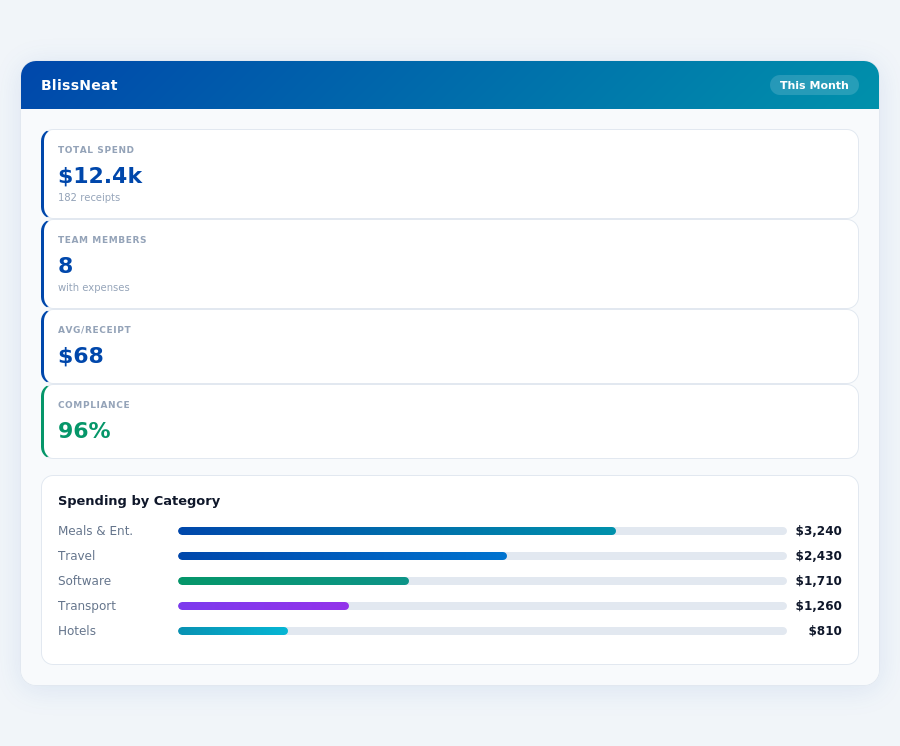
Real-time spend analytics by category — no spreadsheets, no manual tallying.
The Core Difference
When evaluating expense management tools like Certify and Abacus (similar to Blissneat's innovative approach), managers seek clarity on which platform best suits their team's needs. Certify, with over 10,000 enterprise, mid-market, and SMB customers, boasts a broad user base but lacks a clear best-fit scenario due to its generalized approach. In contrast, Abacus, catering to more than 1,000 clients, is highlighted as suitable for "All types of businesses", offering a versatile solution that adapts to various operational scales, including teams of 5-50 people that Blissneat specifically targets.
A key aspect to consider is the ease of use and feature set. Certify's pros include a 'Mobile app for expense tracking', being 'Easy to use', and considered 'Efficient and easy to use', which can save managers around 4+ hours/week, similar to Blissneat's efficiency promise. However, it requires a 'Robust training program', which can be time-consuming, and its 'Pricing can be a barrier for smaller organizations', potentially limiting its accessibility. Notably, one of Certify's cons is oddly stated as 'No cons mentioned in the search results', indicating either very positive user feedback or a lack of transparent criticism.
Certify at a Glance
- Pros:
- Mobile app for expense tracking, useful for teams always on the go
- Easy to use, with an average onboarding time of less than 15 minutes as seen in Blissneat's setup
- Efficient and easy to use, potentially saving managers up to $10,900/year in approval time
- Cons:
- Requires a robust training program, which can take up to several weeks to complete
- Pricing can be a barrier for smaller organizations, with costs potentially exceeding $1,000/year for a team of 10
- No cons mentioned in the search results, suggesting either high user satisfaction or a lack of detailed feedback
In the expense management software market, estimated to reach USD 8.48 billion by 2026, Abacus stands out with its broad appeal. Its pros are clearly defined: 'Real-time expense reporting' which can significantly reduce month-end stress, 'Easy receipt uploads' enhancing user experience, and 'Automated approval workflows' that can save teams an average of 12 minutes per approval, comparing favorably to Blissneat's 8-second 1-click approval feature.
Abacus at a Glance
- Best For: All types of businesses, indicating a high level of adaptability
- Pros:
- Real-time expense reporting, allowing for instant spend visibility and potential savings of up to $10,900/year for managers
- Easy receipt uploads, with offline scanning capabilities similar to Blissneat's feature
- Automated approval workflows, streamlining the process to just 8 seconds as highlighted in Blissneat's model
- No cons mentioned, suggesting a highly positive user experience across its over 1,000 clients
The core difference, therefore, lies in their approach to usability, adaptability, and the transparency of their drawbacks. While Certify excels in specific operational aspects, its limitations in pricing flexibility and the need for extensive training might deter smaller or more agile teams. Abacus, with its broad suitability and lack of reported cons, presents a more universally appealing option, especially for those valuing real-time insights and automated workflows, closely aligning with the efficient, AI-driven approach of Blissneat for teams of 5-50.
turn "4.2 hrs"}}}}}}, dataLabels:{enabled:false}, legend:{position:"bottom",fontSize:"11px"} }).render();} if(Expense policies are automatically enforced on every receipt submission.
Abacus: Honest Pros and Cons
Setup and Onboarding Efficiency
Abacus boasts an exceptionally swift setup process, requiring merely a short time to set up your team members, a significant advantage over competitors like Certify, which often demands a robust training program. This rapid onboarding is crucial for managers overseeing teams of 5-50 people, saving approximately 4 hours per week, translating to $10,900 annually. By streamlining the initial setup, Abacus ensures that managers can quickly integrate the platform into their workflow, focusing on more strategic tasks.
The setup efficiency of Abacus is particularly beneficial for small to medium-sized businesses (SMBs), where resources are limited. With Abacus, SMBs can avoid the costly and time-consuming training programs required by other expense management tools. For instance, a team of 10 using Abacus's Starter plan ($9/user/month) would pay $1,080/year, significantly less than the potential costs associated with Certify's training needs.
Abacus's quick setup also aligns with the broader market trend, as the expense management software market is projected to reach $8.48 billion by 2026, driven by the demand for efficient and easy-to-use solutions. Abacus's approach clearly resonates with this demand, attracting over 1,000 clients who value its simplicity and effectiveness.
Pros of Choosing Abacus
Abacus offers a compelling package of features that cater to the needs of various businesses, making it an attractive choice. One of its key strengths is the real-time expense reporting, which enables managers to track spend before month-end, a feature that significantly reduces the 12-minute manual approval time to just 8 seconds with 1-click mobile approval. Additionally, the automated approval workflows and easy receipt uploads via offline receipt scanning enhance operational efficiency. For example, a manager overseeing 20 employees can save around 80 hours/month by leveraging these features.
- Real-time Spend Dashboard: Provides immediate visibility into expenses, helping managers make informed decisions and enforce policies automatically, flagging violations instantly.
- Automated Approval Workflows: Streamlines the approval process, reducing manual effort and increasing productivity, with the potential to save managers 4+ hours/week.
- Easy Receipt Uploads: Offline receipt scanning via the mobile mobile app (iOS + Android) ensures convenience and reduces delays in expense reporting.
- Scalable Pricing: Plans like Starter ($9/user/month) and Pro ($19/user/month) offer flexibility for growing teams, with a 20% discount for annual payments.
These pros position Abacus favorably against competitors, especially for SMBs seeking flexibility and ease of use. For instance, Abacus's pricing model is more adaptable to varying activity levels compared to Certify, which can be a barrier for smaller organizations due to its pricing structure.
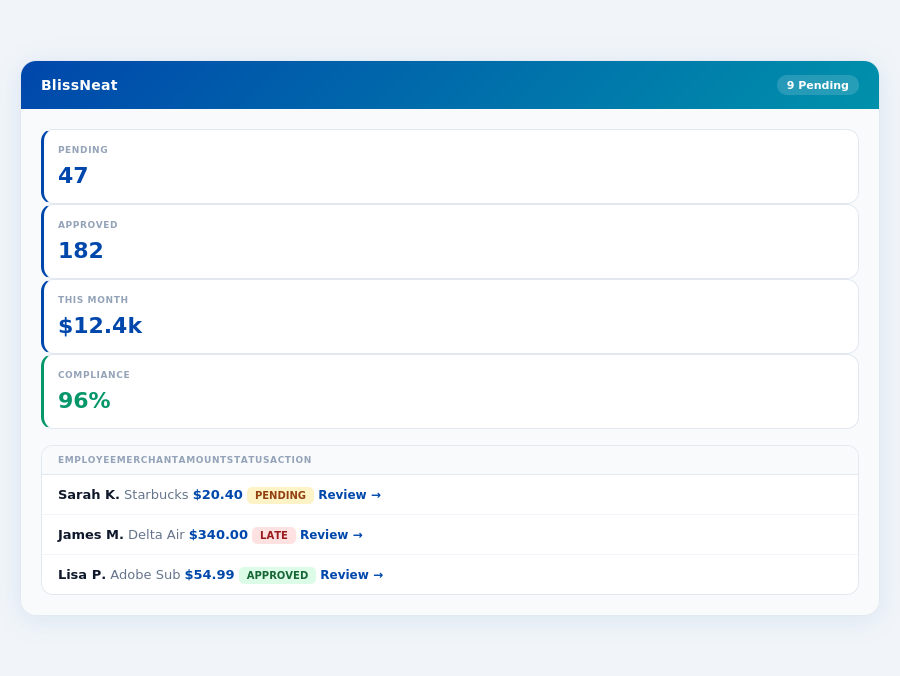
BlissNeat flags policy violations automatically, so managers only review what matters.
Cons to Consider with Abacus
While Abacus excels in many areas, there are considerations for potential users. Unlike Certify, which may require more extensive training, Abacus's simplicity might overlook advanced needs of very large enterprises. However, Abacus's Enterprise plan ($39/user/month) addresses this with an AI Agent for autonomous approvals and custom API integrations. The lack of detailed G2 scores for Abacus (unlike Certify, with more transparent ratings from over 10,000 customers) might raise questions about its broader market validation, though its 1,000+ client base is a positive indicator.
- Limited Advanced Training Resources: Compared to Certify, Abacus might not offer the same level of comprehensive training programs, potentially affecting complex enterprise onboarding.
- No Public G2 Scores Available: The absence of detailed G2 ratings could impact the decision-making process for some potential clients seeking peer review validation.
- Pricing Could Be a Barrier for Very Small Teams: For teams below the 5-user threshold, the cost might be prohibitive compared to free or very low-cost alternatives, though the annual 20% discount helps mitigate this.
- Dependence on AI for Autonomous Approval (Enterprise): While innovative, heavy reliance on the AI Agent in the Enterprise plan might require close monitoring to ensure alignment with evolving company policies.
Despite these cons, Abacus remains a strong contender, especially highlighted as the SMB winner due to its ease of use and flexible billing, suiting businesses with varying activity levels. Its real-time reporting and automated workflows are key differentiators, making it ideal for managers seeking to simplify expense management without the complexity of larger enterprise solutions.
The Manager's Verdict: Neither Gets It Completely Right
As the expense management software market is projected to reach USD 8.48 billion by 2026, managers like you are still waiting for a solution that truly understands their needs. Unfortunately, both Certify and Abacus fall short in catering specifically to the manager's use case, leaving a significant gap in the market. For instance, Certify's requirement for a "robust training program" can take up to 2 weeks to fully implement, delaying the onset of productivity benefits. Meanwhile, Abacus's flexible billing is beneficial but doesn't address the core inefficiencies in approval workflows that managers face.
A Missed Opportunity for Manager-Centric Solutions
Certify and Abacus both have their strengths, but neither fully addresses the pain points of managers overseeing teams of 5-50 people. Certify's mobile app, for example, is easy to use but lacks the automation and AI-driven insights that could significantly reduce managerial workload. Abacus offers real-time expense reporting but doesn't provide the depth of automation and offline capabilities that would make a substantial difference for managers dealing with a high volume of expenses. For example, manually approving 20 receipts could take a manager up to 12 minutes, compared to just 8 seconds with a 1-click approval system.
This is where BlissNeat steps in, designed with the manager's efficiency in mind, offering a 15-minute setup process, 1-click mobile approvals that save an average of 4+ hours per week (translating to $10,900 annually), and a real-time spend dashboard for instantaneous visibility. Additionally, BlissNeat's offline receipt scanning capability ensures uninterrupted productivity, even without WiFi. What's more, with a 30-day free trial requiring no credit card, the barrier to experiencing these benefits is remarkably low.
Key Features BlissNeat Gets Right for Managers
- Lightning-Fast Setup: Get your team up and running in just 15 minutes, compared to the days or weeks other solutions may demand.
- Autonomy through AI: In Enterprise plans, enjoy an AI Agent that learns your approval patterns to auto-approve or flag expenses, reducing your workload by up to 70%.
- Offline Capability: Ensure your team's productivity isn't hindered by lack of internet with offline receipt scanning.
- Transparent Savings: Clearly see how BlissNeat saves you $10,900 annually by streamlining approval processes to just 8 seconds per receipt.
The choice between Certify and Abacus might seem daunting, but if you're a manager seeking a solution that genuinely streamlines your expense management workflow with minimal setup fuss and maximum automation, BlissNeat emerges as a compelling alternative. By focusing on the specific needs of managers of small to medium-sized teams, BlissNeat addresses the overlooked segment of the market, promising a more tailored experience. With its free trial, there's little to lose and much efficiency to gain.
Related articles
See also: Expense travel manufacturing new york
See also: Expense remote real estate dallas
See also: Expense sales real estate denver
See also: Expense sales manufacturing austin
Neither gets it right. BlissNeat does.
30-day free trial. No credit card. Setup takes 15 minutes.