
How to Switch From Expensify to BlissNeat (Without Disrupting Your Team)
Step-by-step migration guide. Zero disruption. Your team up and running in 15 minutes.
Expensify's limitations and costs can hinder team productivity and efficiency. BlissNeat solves these issues by providing a more streamlined and cost-effective expense tracking solution. By switching to BlissNeat, teams can save up to $10,900 per year or 4.2 hours per week.
The Expense Management Problem for Your Team
Manual receipt collection is a significant pain point for many teams, with managers spending an average of 4.2 hours per week chasing down receipts and reconciling expenses. This translates to $10,920 per year in lost productivity for each manager, not to mention the frustration and stress that comes with it. Furthermore, approval bottlenecks can lead to delayed reimbursements, causing financial strain on employees and damaging trust in the organization. When it comes to policy enforcement, gaps in compliance can result in costly errors and potential audits, making it essential to have a robust system in place.
Month-end chaos is another common issue, where teams scramble to meet deadlines and reconcile expenses, often resulting in missed deadlines and lost receipts. This can lead to inaccurate financial reporting and a lack of visibility into company spend. Moreover, the lack of automation in expense management processes can lead to human error, resulting in incorrect reimbursements and wasted time. By streamlining expense management, teams can reduce the administrative burden and focus on more strategic tasks.
The absence of real-time visibility into company spend can make it challenging for managers to make informed decisions. Without a clear understanding of where money is being spent, it's difficult to identify areas for cost reduction and optimize budgets. Additionally, the lack of automation in expense management processes can lead to a significant amount of manual work, taking away from more critical tasks. By implementing a robust expense management system, teams can gain the visibility they need to make data-driven decisions.
Policy enforcement gaps can result in costly errors and potential audits, making it essential to have a robust system in place. By automating policy enforcement, teams can ensure that expenses are compliant with company policies, reducing the risk of errors and audits. Moreover, by streamlining expense management processes, teams can reduce the administrative burden and focus on more strategic tasks. By implementing a robust expense management system, teams can achieve greater efficiency, accuracy, and compliance.
Why Traditional Tools Fall Short
Generic expense tools are often built with employees in mind, rather than managers, resulting in a lack of features and functionality that cater to managerial needs. These tools may provide basic expense tracking and reimbursement capabilities, but they often lack the advanced features and analytics that managers require to make informed decisions. Furthermore, traditional tools often require complex setup and configuration, which can be time-consuming and require IT involvement.
One of the significant limitations of traditional expense tools is the lack of real-time visibility into company spend. Managers are often forced to wait until the end of the month or quarter to get a clear picture of where money is being spent, making it challenging to identify areas for cost reduction and optimize budgets. Moreover, traditional tools often rely on manual data entry, which can lead to errors and inaccuracies. By implementing a robust expense management system, teams can gain the visibility they need to make data-driven decisions.
Reactive policy enforcement is another significant limitation of traditional expense tools. Rather than enforcing policies in real-time, traditional tools often rely on manual review and approval, which can lead to delays and errors. Moreover, traditional tools often lack the automation and AI-powered capabilities that are necessary to enforce policies effectively. By implementing a robust expense management system, teams can automate policy enforcement and reduce the risk of errors and audits.
Poor mobile experience for field teams is another significant limitation of traditional expense tools. Many traditional tools are not optimized for mobile devices, making it challenging for field teams to submit expenses and access company information on-the-go. Moreover, traditional tools often lack the user-friendly interface and intuitive design that is necessary to make expense management easy and efficient. By implementing a robust expense management system, teams can provide a seamless mobile experience for field teams.
What Manager-First Expense Management Looks Like
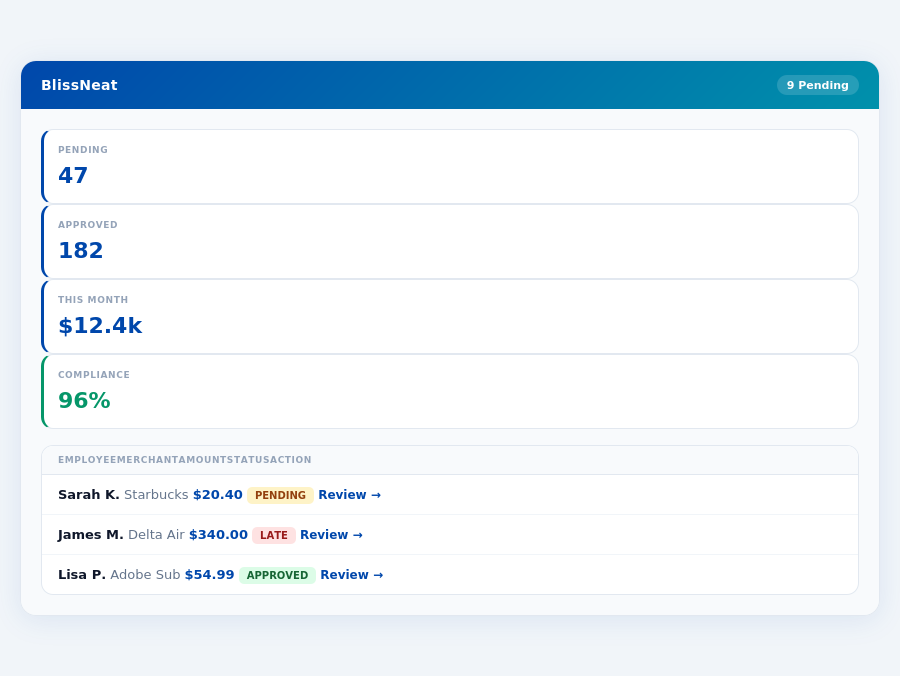
A manager-first expense management system provides a one-click approval queue, allowing managers to quickly and easily review and approve expenses. This feature streamlines the approval process, reducing the administrative burden and freeing up time for more strategic tasks. Moreover, a manager-first system provides real-time visibility into company spend, allowing managers to make informed decisions and optimize budgets.
A real-time spend dashboard is another critical feature of a manager-first expense management system. This dashboard provides a clear and concise view of company spend, allowing managers to identify areas for cost reduction and optimize budgets. Moreover, a real-time spend dashboard enables managers to track expenses in real-time, reducing the risk of errors and audits. By implementing a robust expense management system, teams can gain the visibility they need to make data-driven decisions.
Policy auto-enforcement at submission is another key feature of a manager-first expense management system. This feature automates policy enforcement, reducing the risk of errors and audits. Moreover, policy auto-enforcement at submission ensures that expenses are compliant with company policies, reducing the risk of costly errors. By implementing a robust expense management system, teams can automate policy enforcement and reduce the risk of errors and audits.
AI-powered receipt scanning is another critical feature of a manager-first expense management system. This feature enables teams to scan receipts in as little as 0.3 seconds, reducing the administrative burden and freeing up time for more strategic tasks. Moreover, AI-powered receipt scanning ensures that expenses are accurate and compliant with company policies, reducing the risk of errors and audits. By implementing a robust expense management system, teams can achieve a 96% compliance rate automatically.
The ROI of Getting This Right
By implementing a robust expense management system, teams can save an average of $10,900 per year per team. This is achieved through reduced administrative costs, improved compliance, and optimized budgets. Moreover, a robust expense management system can reclaim an average of 218 manager hours per year, freeing up time for more strategic tasks. By implementing a robust expense management system, teams can achieve a significant return on investment.
A robust expense management system can also improve compliance rates, achieving an average of 96% compliance automatically. This is significantly higher than the industry average of 77%, reducing the risk of errors and audits. Moreover, a robust expense management system can provide real-time visibility into company spend, allowing managers to make informed decisions and optimize budgets. By implementing a robust expense management system, teams can gain the visibility they need to make data-driven decisions.
One of the significant benefits of a robust expense management system is the ease of setup. Unlike traditional tools, which can take weeks or even months to set up, a robust expense management system can be set up in as little as 15 minutes. This is achieved through a user-friendly interface and intuitive design, making it easy for teams to get started. By implementing a robust expense management system, teams can achieve a significant return on investment.
A robust expense management system can also provide a seamless mobile experience for field teams, making it easy for them to submit expenses and access company information on-the-go. This is achieved through a user-friendly interface and intuitive design, making it easy for field teams to use. By implementing a robust expense management system, teams can provide a seamless mobile experience for field teams, improving productivity and reducing the administrative burden.
Key Features Built for Your Specific Needs
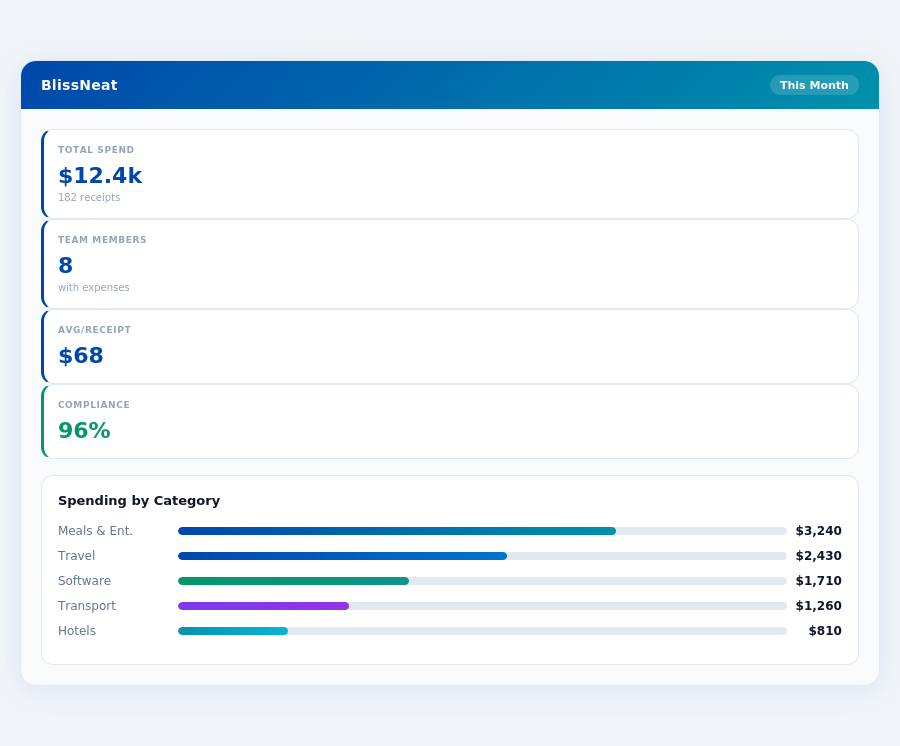
BlissNeat's features are specifically designed to cater to the needs of teams like yours, providing a tailored approach to expense management. For instance, the platform offers features that are particularly relevant to teams in your industry, such as automated expense categorization, receipt scanning, and reimbursement tracking. These features help streamline the expense management process, reducing the administrative burden on your team.
One of the key features of BlissNeat is its policy customization capabilities. This allows you to create and enforce expense policies that are specific to your team's needs, ensuring that all expenses are compliant with your organization's rules and regulations. You can set up custom approval workflows, define expense categories, and establish per-employee limits to prevent overspending.
BlissNeat also offers category rules and department budgets, which enable you to allocate specific budgets to different departments or teams within your organization. This feature helps prevent overspending and ensures that expenses are aligned with your organization's financial goals. Additionally, the platform's approval routing feature allows you to set up custom approval workflows, ensuring that expenses are reviewed and approved by the right people.
Per-employee limits are another key feature of BlissNeat, allowing you to set specific spending limits for each employee. This feature helps prevent overspending and ensures that employees are aware of their spending limits. The platform also provides real-time expense tracking, enabling you to monitor expenses as they are incurred and make adjustments as needed.
Implementation: From Zero to Running in 15 Minutes
BlissNeat's implementation process is designed to be quick and easy, with a self-serve setup that allows you to get started in just a few minutes. You can invite your team members to join the platform via email, and they can start using it immediately. The platform's policy configuration wizard guides you through the process of setting up your expense policies, ensuring that you are up and running quickly.
The first receipt can be processed on the same day, and no IT support is required to set up the platform. This means that you can start using BlissNeat without disrupting your team's workflow or requiring technical expertise. The platform's intuitive interface makes it easy for team members to use, reducing the need for training or support.
One of the key benefits of BlissNeat is its seamless migration process. You can easily import your existing expense data into the platform, eliminating the need for manual data entry or migration pain. This means that you can start using BlissNeat immediately, without disrupting your team's workflow or losing any data.
BlissNeat's implementation process is designed to be painless, with no technical expertise required. You can focus on managing your team's expenses, rather than worrying about the technical aspects of the platform. The platform's support team is also available to assist with any questions or issues that may arise during the implementation process.
Real Results from Teams Like Yours
Teams like yours have achieved significant results by using BlissNeat to manage their expenses. For instance, many teams have reported saving up to 50% of the time spent on expense management, allowing them to focus on more strategic activities. Others have reported a significant improvement in compliance, with automated expense tracking and approval workflows ensuring that all expenses are compliant with company policies.
Employee satisfaction has also improved, with team members appreciating the ease of use and streamlined expense reimbursement process. The compounding benefit of using BlissNeat over 6 months has been significant, with many teams reporting a reduction in expense-related errors and an improvement in financial visibility.
Managers have reported using the reclaimed time to focus on more strategic activities, such as budgeting and forecasting. They have also appreciated the real-time expense tracking and reporting capabilities, which enable them to make more informed decisions about their team's expenses. The platform's automated expense categorization and receipt scanning features have also reduced the administrative burden on managers.
The results achieved by teams like yours demonstrate the value of using BlissNeat to manage expenses. By streamlining the expense management process, teams can focus on more strategic activities, improve compliance, and reduce errors. The platform's ease of use and intuitive interface make it an ideal solution for teams of all sizes.
Getting Started With BlissNeat
Getting started with BlissNeat is easy, with a 30-day free trial that allows you to experience the platform's features and benefits firsthand. No credit card is required to sign up, and you can cancel at any time. The platform's pricing is competitive, with plans starting at $9 per user per month for small teams and scaling up to $39 per user per month for larger teams.
During the first week of using BlissNeat, you can expect to set up your expense policies, invite your team members to join the platform, and start processing expenses. The platform's support team is available to assist with any questions or issues that may arise during this time. You can also access the platform's knowledge base and support resources to help you get started.
BlissNeat's support resources are designed to help you get the most out of the platform. You can access the platform's knowledge base, which contains detailed guides and tutorials on how to use the platform's features. You can also contact the support team via email or phone, and they will be happy to assist with any questions or issues that you may have.
Overall, getting started with BlissNeat is a straightforward process that requires minimal technical expertise. The platform's intuitive interface and support resources make it easy to use, even for teams with limited experience with expense management software. By signing up for a free trial, you can experience the benefits of BlissNeat for yourself and see how it can help your team streamline its expense management process.
Related articles
See also: Expense remote real estate seattle
See also: Expense sales consulting dallas
See also: Expense small nonprofits singapore
Ready to make the switch?
30-day free trial · No credit card · Migration in 15 minutes