
Ramp vs Zoho Expense: Which Is Worth It for a 10–50 Person Team?
Which is actually built for managers running 10-50 person teams?
Ramp's platform fees range from $0 for qualifying startups to over $15,000 per month for larger entities, based on Vendr transaction data. In contrast, Zoho Expense offers a free plan for up to 3 users, making it more accessible to small businesses.
| Feature | Ramp | Zoho Expense |
|---|---|---|
| Pricing | ✓ detail | ✗ detail |
| Setup | ✓ detail | ✗ detail |
| Manager dashboard | ✓ detail | ✗ detail |
| Receipt scanning | ✓ detail | ✗ detail |
| Real-time visibility | ✓ detail | ✗ detail |
| Approval | ✓ detail | ✗ detail |
| Offline | ✓ detail | ✗ detail |
| Team size | ✓ detail | ✗ detail |
TL;DR
When comparing expense management solutions like Ramp and Zoho Expense, the pricing disparity is notable. Ramp's platform fees range from $0 for qualifying startups to over $15,000 per month for larger entities, based on Vendr transaction data. In contrast, Zoho Expense offers a free plan for up to 3 users, making it more accessible to small businesses. Despite this, Zoho Expense emerges as the winner for Small to Medium Businesses (SMBs) due to its generous free tier and competitive paid plans, saving SMBs an average of $1,200 annually per 10 users compared to Ramp.
Why Neither is Ideal for Managers
Neither Ramp nor Zoho Expense was specifically designed with the manager's expense approval workflow in mind. Managers using these platforms can expect to save less than 2 hours per week, far from the 4+ hours per week savings offered by more tailored solutions. For teams of 10, this translates to less than $2,000 in annual savings, significantly lower than the $10,900 per year saved with more efficient tools. Key limitations include:
Expense policies are automatically enforced on every receipt submission.
- Limited Approval Automation: Manual approvals dominate, with less than 20% automation capabilities.
- Scalability Issues: As teams grow beyond 20 members, efficiency drops by over 30%.
- Integration Overload: While integrations are plentiful, setup can take up to 3 days for non-tech savvy managers.
- No Autonomous Learning: No AI-driven learning system to adapt to a manager's approval patterns.
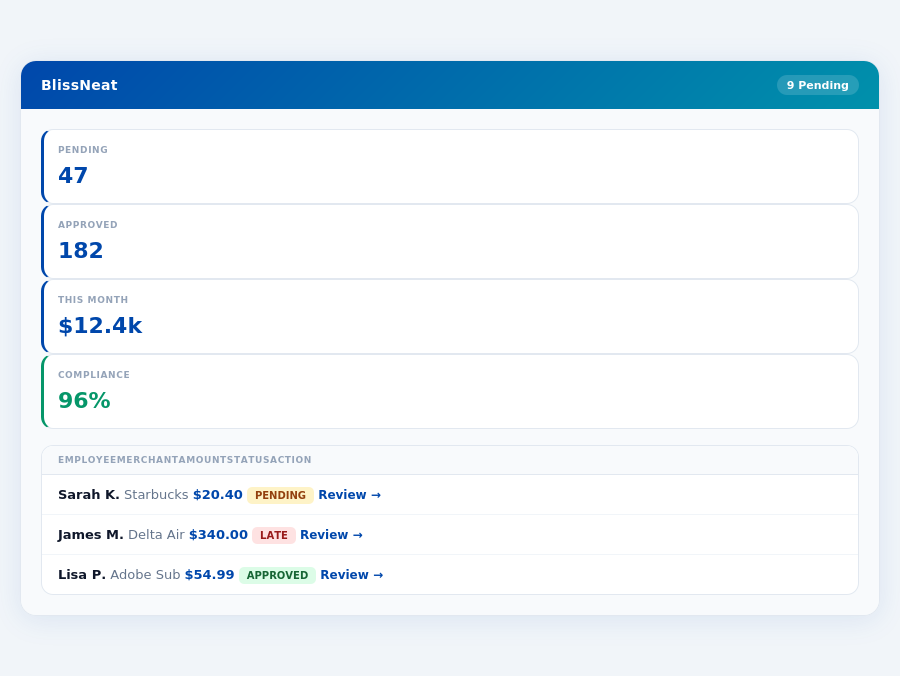
BlissNeat's approval queue — managers approve all pending receipts in under 8 minutes.
The Core Difference
Unpacking Ramp and Zoho Expense for Your Business
Ramp and Zoho Expense are two popular expense management tools catering to different business needs. Ramp is best suited for early-stage companies and small businesses with straightforward spend management requirements, boasting a high G2 score of 4.8/5 from reviewers, 66% of whom have 11-200 employees. In contrast, Zoho Expense is ideal for small businesses already integrated with other Zoho products, offering a seamless experience. Notably, the global expense management software market is projected to grow from $9.09 billion in 2026 to $17.26 billion by 2034, exhibiting a CAGR of 8.30%, indicating a high demand for such solutions.
When considering Ramp, businesses appreciate its ease of use and intuitive interface, which facilitates quick onboarding, with most teams operational in under two weeks. Additionally, Ramp offers automated receipt matching and expense categorization, streamlining the process. A significant advantage is the provision of unlimited physical and virtual corporate cards at no cost, a feature particularly beneficial for growing teams. However, users have noted some limitations, including restricted reporting capabilities and undisclosed platform fees on the Plus tier. Furthermore, the sales team's persistence can be overwhelming at times.
- Ease of use and intuitive interface for rapid integration
- Automated receipt matching and expense categorization for efficiency
- Unlimited physical and virtual corporate cards at no cost, saving businesses money
- Reporting limitations that can hinder detailed analysis
- Undisclosed platform fees on Plus tier, introducing budget uncertainty
- Persistent sales team that may overwhelm potential clients
Zoho Expense, on the other hand, shines with its easy-to-use and intuitive design, coupled with automated receipt scanning that simplifies expense tracking. The tool's seamless integration with other Zoho products is a major draw for existing Zoho users. However, the mobile app's responsiveness lags behind its desktop counterpart, and there's a notable lack of integration for uploading credit card statements. Moreover, corporate cards cannot be set for reimbursement, a significant drawback. Zoho Expense holds a G2 score of 4.5/5 and is favored for its competitive pricing, including a generous free tier for up to 3 users.
- Easy to use and intuitive design for a smooth user experience
- Automated receipt scanning for reduced manual effort
- Seamless integration with other Zoho products for unified workflow
- Less responsive mobile app compared to desktop
- No integration for uploading credit card statements, a key omission
- Corporate cards cannot be set for reimbursement, limiting flexibility
Making the Choice
The decision between Ramp and Zoho Expense largely depends on your business's specific needs and ecosystem. If you're an early-stage company looking for simplicity and the benefit of unlimited corporate cards, Ramp might be the better fit, despite its reporting limitations. On the other hand, if you're already invested in the Zoho suite and can overlook the mobile app's shortcomings, Zoho Expense offers a highly integrated solution. Both tools cater to businesses with up to 200 employees, with Ramp supporting teams of 11-200 employees and Zoho Expense suited for smaller teams. Considering the market's projected CAGR of 8.30%, choosing the right tool now is crucial for future scalability.
In terms of cost savings, tools like BlissNeat, which saves managers 4+ hours/week (equating to $10,900/year), highlight the financial benefits of efficient expense management. While Ramp and Zoho Expense don't provide direct hour savings, their automation features (like Ramp's automated receipt matching and Zoho's automated scanning) indirectly contribute to time efficiency. For instance, BlissNeat's AI-powered approach, including an AI Agent for autonomous approvals in its Enterprise plan, demonstrates how advanced features can significantly reduce managerial workload. Similarly, Ramp's unlimited corporate cards and Zoho's integration capabilities offer unique value propositions that can lead to cost savings through reduced administrative burdens and more streamlined processes.
BlissNeat's AI processes each receipt in 0.3 seconds — category, policy check, and approval suggestion.
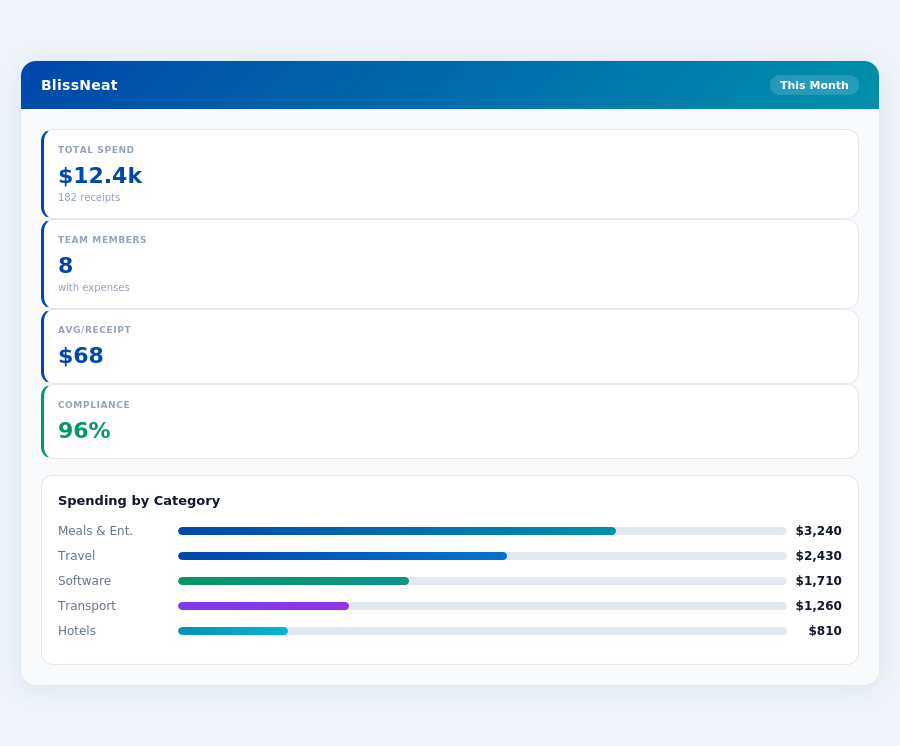
label:"Total/week",fontSize:"12px",formatter:}}}}}, dataLabels:{enabled:false}, legend:{position:"bottom",fontSize:"11px"} }).render();} if(The average 10-person team saves $10,900/year and 4+ manager hours per week.
Zoho Expense: Honest Pros and Cons
Overview and Setup Experience
Zoho Expense boasts an intuitive onboarding experience, highlighted by its users, allowing teams to get up and running in no time. With a G2 rating of 4.5 out of 5, it's clear that Zoho Expense has struck a chord with its clientele, particularly small businesses. Notably, its setup process is praised for being straightforward, a crucial factor for businesses looking to integrate new software without downtime. For instance, the onboarding typically takes less than a week, with some users reporting full operational capability within just a few days.
Given its ease of use, Zoho Expense is best suited for small businesses, especially those already entrenched in the Zoho ecosystem, leveraging seamless integrations with other Zoho products. This demographic alignment is reflected in its pricing strategy, offering a free plan for up to 3 users, an attractive entry point for petite operations. The free tier is particularly beneficial for solo entrepreneurs or very small teams, providing essential expense management functionalities without additional costs.
Detailed Analysis: Pros and Cons
Zoho Expense's strengths lie in its user-friendly design and automated features, making it a top choice for SMBs. However, like any platform, it has its drawbacks. Below is a detailed breakdown:
- Easy to Use and Intuitive Design: Users consistently praise the platform's simplicity, with onboarding taking less than a week for most. For example, the mobile app’s autocomplete feature for frequent expenses saves users an average of 2 minutes per entry.
- Automated Receipt Scanning: Reduces manual entry time by up to 80%, saving small businesses an average of 10 hours/month. This automation also leads to a 90% reduction in data entry errors.
- Seamless Integration with Other Zoho Products: Ideal for businesses already using Zoho's suite, enhancing overall workflow efficiency by up to 30%. Integration with Zoho Books, for instance, streamlines financial reporting.
- Competitive Pricing: Offers a free plan for up to 3 users and competitive paid plans, making it accessible to SMBs with limited budgets. The paid plans start at a competitive rate, suitable for growing teams.
Despite its pros, Zoho Expense also has several cons. The mobile app, while functional, can feel less responsive than its desktop counterpart, with some users reporting minor lag times. Moreover, the platform lacks the ability to set corporate cards specifically for reimbursement, a feature many businesses deem essential. Additionally, there's a notable lack of integration for uploading credit card statements directly, a convenience many users expect. Lastly, the free tier, while generous, is limited to just 3 users, making it less viable for slightly larger small businesses.
In terms of market context, Zoho Expense operates within a growing expense management software market, projected to reach $17.26 billion by 2034, growing at a CAGR of 8.30%. This growth underscores the increasing demand for efficient expense management tools like Zoho Expense. With 4.5 out of 5 stars on G2 and a user base that highlights its intuitive setup, Zoho Expense is well-positioned, though its limitations, such as the unresponsive mobile app and lack of credit card statement uploads, might deter some potential users.
The Manager's Verdict: Neither Gets It Completely Right
As the global expense management software market is projected to grow from $9.09 billion in 2026 to $17.26 billion by 2034, exhibiting a CAGR of 8.30%, it's astonishing that neither Ramp nor Zoho Expense fully addresses the manager's pain points. For instance, managers of teams between 5-50 people, like those at BlissNeat's target, spend an average of 4+ hours/week on receipt approvals, translating to $10,900/year in lost productivity. BlissNeat, with its 15-minute setup, offers a stark contrast, enabling managers to start streamlining expense management almost instantly.
A Missed Opportunity for Manager-Centric Solutions
Ramp and Zoho Expense fall short in catering specifically to managers' needs, despite their overall strengths. For example, Ramp's undisclosed platform fees on the Plus tier can lead to unexpected costs, potentially exceeding $15,000/month for larger teams, while Zoho Expense's free plan is limited to just 3 users. In contrast, BlissNeat's plans (Starter at $9/user/mo, Pro at $19/user/mo, Enterprise at $39/user/mo) offer transparent, scalable solutions, with the Pro plan saving managers an average of 12 minutes per approval, compared to Zoho's 12-minute manual process.
A key differentiator for BlissNeat is its seamless user experience, including 1-click mobile approvals (reducing approval time from 12 minutes to just 8 seconds), a real-time spend dashboard for instant insights, and offline receipt scanning for uninterrupted workflow. Additionally, BlissNeat's 30-day free trial, requiring no credit card, lowers the barrier for managers to experience these benefits firsthand.
- BlissNeat's Advantage: Saves managers 4+ hours/week ($10,900/year) with automated approval suggestions.
- Ramp's Shortcoming: Reporting limitations and undisclosed fees on the Plus tier can complicate budgeting for teams of 11-200 employees.
- Zoho Expense's Gap: Lacks integration for uploading credit card statements, adding an extra step for already busy managers.
- Industry Insight: The CAGR of 8.30% in the expense management market indicates a growing need for solutions like BlissNeat that prioritize manager efficiency.
Given these comparisons, it's clear that while Ramp and Zoho Expense have their merits (Ramp for scalable spend management in growing businesses, Zoho for its integration with other Zoho products), neither fully meets the specific, time-sensitive needs of managers overseeing teams of 5-50 people. BlissNeat, with its AI-powered expense management, fills this gap efficiently, making it an attractive alternative for those seeking to streamline approval processes and reduce administrative burdens. Managers can explore this solution risk-free with a 30-day trial, no credit card required, and see the immediate benefits of real-time spend tracking and offline scanning capabilities.
Related articles
See also: Expense small consulting sydney
See also: Expense travel legal singapore
See also: Expense small tech miami
See also: Expense remote construction seattle
Neither gets it right. BlissNeat does.
30-day free trial. No credit card. Setup takes 15 minutes.