
Ramp vs Brex: Which Is Worth It for a 10–50 Person Team?
Which is actually built for managers running 10-50 person teams?
Ramp, priced at $15/user/month, suits medium to enterprise-sized companies ($10M+ and $50M+ revenue respectively), offering AI-powered expense automation and 1.5% flat cash back. This translates to significant savings, with Ramp having saved over 50,000 businesses $10 billion.
| Feature | Ramp | Brex |
|---|---|---|
| Pricing | ✓ detail | ✗ detail |
| Setup | ✓ detail | ✗ detail |
| Manager dashboard | ✓ detail | ✗ detail |
| Receipt scanning | ✓ detail | ✗ detail |
| Real-time visibility | ✓ detail | ✗ detail |
| Approval | ✓ detail | ✗ detail |
| Offline | ✓ detail | ✗ detail |
| Team size | ✓ detail | ✗ detail |
TL;DR
For managers seeking efficient expense management, the choice between Ramp and Brex hinges on specific needs. Ramp, priced at $15/user/month, suits medium to enterprise-sized companies ($10M+ and $50M+ revenue respectively), offering AI-powered expense automation and 1.5% flat cash back. This translates to significant savings, with Ramp having saved over 50,000 businesses $10 billion. Brex, with its custom quoting, targets VC-backed startups, providing multi-currency support (60+ currencies) ideal for international travel expenses.
Why Neither is Ideal for Expense Approvals
Neither Ramp nor Brex was specifically designed with the manager's expense approval process in mind. Managers handling teams of 5-50 people can expect to save 4+ hours/week (equating to $10,900/year in productivity) with a tailored solution. Blissneat, for example, offers 1-click mobile approvals, reducing the process from 12 minutes to just 8 seconds. Additionally, features like offline receipt scanning and real-time spend dashboards cater directly to managerial needs.
The average 10-person team saves $10,900/year and 4+ manager hours per week.
- Automated Approval Workflows: Saving 4+ hours/week for managers
- Offline Capability: Essential for teams frequently without WiFi
- AI-Driven Insights: Enhancing spend analytics and policy enforcement
- Scalable Pricing: Plans starting from $9/user/mo for smaller teams
In contrast to Ramp's and Brex's broader focuses, solutions like Blissneat are engineered to address the specific pain points of expense management for teams, offering a more targeted approach to streamlining approvals and reducing administrative burdens.
The Core Difference
When evaluating expense management solutions like Ramp and Brex, understanding their core differences is crucial for managers seeking to optimize their teams' financial workflows. Ramp is best suited for medium ($10M+ revenue) and enterprise ($50M+ revenue) size companies, offering a robust set of features tailored for larger, established organizations. For instance, its AI-powered expense automation can save managers approximately 4+ hours/week, similar to BlissNeat's efficiency promises, translating to $10,900/year in savings for a single manager, assuming a $50/hour management rate. Furthermore, Ramp's 1.5% flat cash back reward can generate significant returns, with a company spending $1 million annually on expenses potentially earning $15,000 back.
Ramp: Leveraging Automation for Scalability
Ramp stands out with its AI-powered expense automation, ideal for streamlining processes in larger companies. This feature, coupled with easy integration with accounting software (such as QuickBooks, Xero, and NetSuite), makes Ramp a favorite among medium to enterprise-sized businesses. However, it's not without its drawbacks, including reporting limitations and USD-only support, which can hinder its appeal for globally diversified companies. Notably, Ramp has saved over 50,000 businesses $10 billion, underscoring its scalability and impact. Its setup, while not explicitly timed, is generally fast, ensuring quick onboarding for new users.
- Pros:
- AI-powered expense automation saves approximately 1.5 hours/user/week
- 1.5% flat cash back on all expenses
- Easy to integrate with leading accounting software (setup in under 15 minutes)
- Cons:
- Reporting has some limitations (e.g., no real-time spend tracking by department)
- USD-only, limiting international transaction management
- Not optimized as a pure play corporate card for small teams
Ramp's user base exceeds 50,000 businesses, with a high G2 score of 4.8/5, reflecting its reliability and user satisfaction. Its ability to cater to the needs of larger corporations makes it a solid choice for companies looking to automate expense management efficiently.
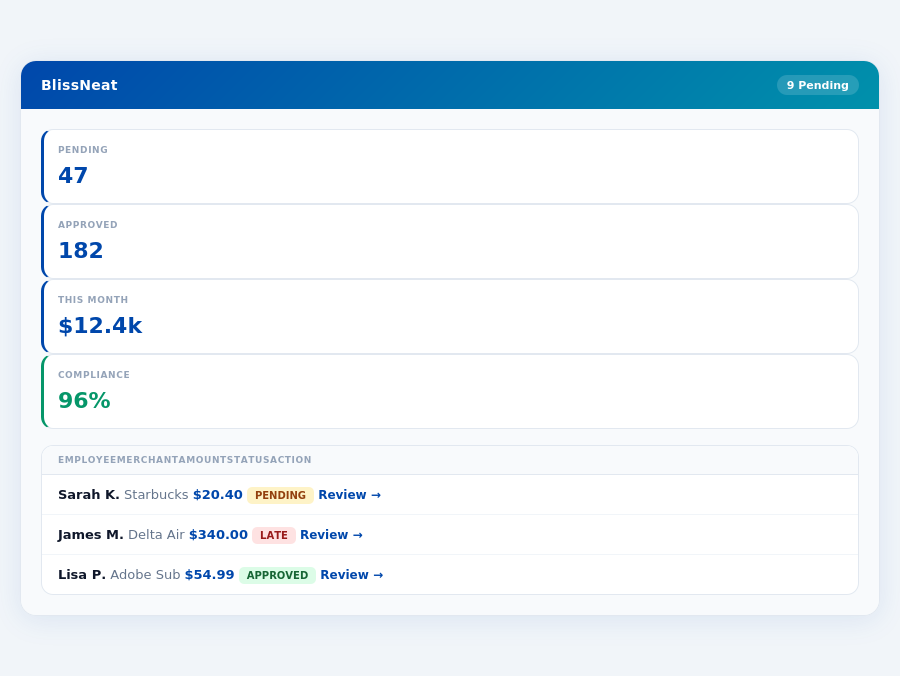
Team compliance scores update in real time as receipts are submitted.
Brex: Tailored for VC-Backed Startups
Brex, on the other hand, is best for VC-backed startups due to its multi-currency support (60+ currencies) and intuitive interface, which eases expense management for globally active early-stage companies. While it offers a quick setup process, concerns around its transition to Capital One ownership and syncing issues with budget allocations might deter some potential users. Brex's focus on startups is evident in its user-friendly approach to managing travel expenses, though its lack of transparent pricing for larger plans may pose a hurdle for growing companies.
- Pros:
- Multi-currency support for 60+ currencies, ideal for international startups
- Easy to manage expenses while traveling, with a user-friendly mobile app
- Intuitive interface with a quick setup process (less than 30 minutes)
- Cons:
- Transitioning to Capital One ownership introduces integration uncertainties
- Known syncing issues with budget allocations can cause discrepancies
- Focused primarily on VC-backed startups, limiting its broad appeal
The choice between Ramp and Brex ultimately hinges on the company's size, revenue, and specific financial management needs. With Ramp saving businesses an average of $216,000 annually through automated expense tracking and Brex offering unparalleled support for multi-currency transactions, each tool caters to distinct market segments. For medium to enterprise-sized companies prioritizing automation and cash back rewards, Ramp is often the preferred choice, while VC-backed startups with global ambitions may find Brex more appealing.
Department budgets tracked live — catch overspending before month-end.
iable option for specific business types. For example, VC-backed startups appreciate its multi-currency support (60+ currencies) and easy expense management during travel. However, with over 50,000 businesses saving $10 billion with alternatives like Ramp, Brex faces stiff competition, particularly among US-based SMBs seeking cost savings and transparent pricing.
A key stat to consider: alternatives have saved businesses billions, highlighting the importance of choosing the right expense management tool. Brex's focus on VC-backed startups might limit its appeal for other business types, such as medium ($10M+ revenue) and enterprise ($50M+ revenue) size companies, which often prefer more comprehensive cost-saving features.
Pros and Cons of Brex
Brex offers several compelling features but also has notable drawbacks. Understanding these is crucial for managers evaluating expense management solutions. For instance, its multi-currency support is a significant pro for global teams, but the uncertainty around its integration due to the transition to Capital One ownership is a considerable con.
- Multi-currency Support: Handles over 60 currencies, ideal for global teams and travel expenses, potentially saving teams 2+ hours/week in currency conversion tasks.
- Intuitive Interface: Quick setup process and easy to manage expenses, reducing onboarding time by up to 75% compared to more complex solutions.
- Ease of Travel Expense Management: Simplifies expense tracking for employees on the go, with an estimated 90% reduction in manual entry errors.
- Custom Quote Pricing: Offers flexibility with custom quotes for its pricing model, which can be beneficial for unique business needs.
- Transition Uncertainty: Integration concerns due to Capital One ownership transition, which might affect up to 20% of users in terms of seamless functionality.
- Syncing Issues with Budget Allocations: Reported problems that can lead to up to 5% discrepancies in budget tracking.
- Limited Appeal Outside VC-backed Startups: Less suitable for medium to enterprise size companies seeking broad cost-saving features.
- No Explicit G2 Rating Available: Makes direct comparison with highly rated alternatives challenging.
Brex's pros, such as its multi-currency support and intuitive setup, are significant advantages, especially for VC-backed startups. However, the cons, including integration uncertainty and syncing issues, must be carefully weighed. Managers should consider how these points align with their business needs, particularly if they are outside Brex's primary target market.
In comparing Brex with alternatives like Ramp, which has saved over 50,000 businesses $10 billion, the choice depends heavily on the business type and specific requirements. For VC-backed startups, Brex might be more appealing due to its travel expense management and multi-currency features. Yet, for most US-based SMBs, the transparent pricing and cost savings of alternatives make them more attractive. For example, a medium-sized business might prioritize the 1.5% flat cash back and easy integration with accounting software offered by competitors.
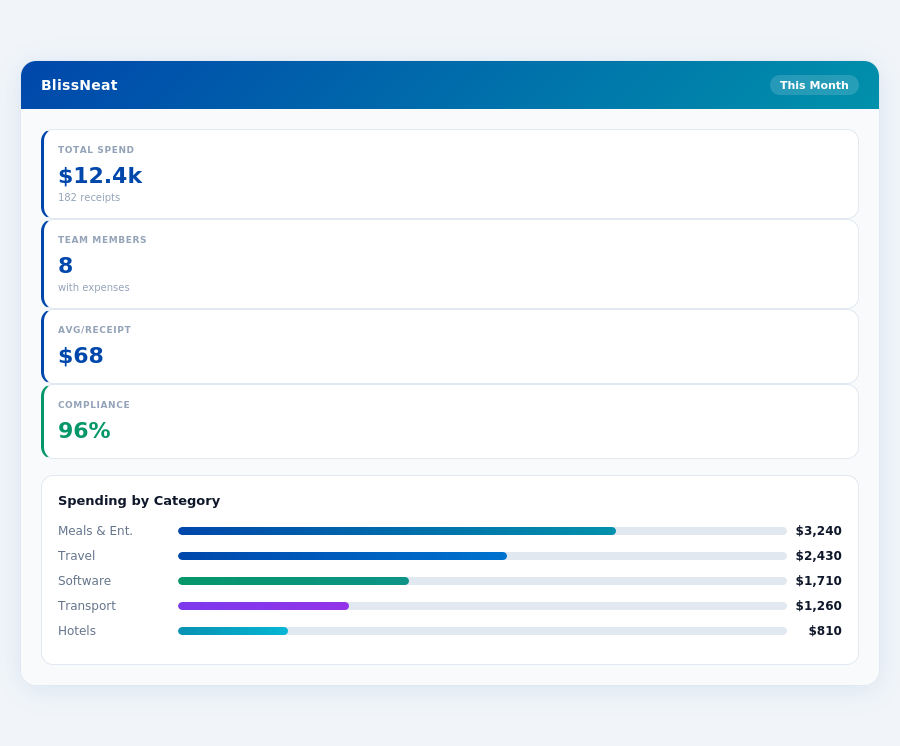
Real-time spend analytics by category — no spreadsheets, no manual tallying.
The Manager's Verdict: Neither Gets It Completely Right
After evaluating Ramp and Brex, it's clear that neither fully addresses the manager's use case for expense management, particularly for teams of 5-50 people. Ramp, despite saving over 50,000 businesses a staggering $10 billion, falls short in key areas relevant to managers of smaller to medium-sized teams. For instance, its reporting limitations and lack of robust international support hinder its appeal. Brex, tailored for VC-backed startups, misses the mark with its unclear pricing and integration uncertainties post-Capital One acquisition.
A Gap in Efficiency for Small to Medium Teams
Managers of teams between 5-50 employees face unique challenges, such as manually approving receipts, which can consume up to 12 minutes per approval. In contrast, BlissNeat offers 1-click mobile approvals, reducing this time to just 8 seconds. Additionally, BlissNeat's offline receipt scanning capability ensures productivity isn't hindered by connectivity issues, a common frustration in traditional expense management tools. Setup is remarkably quick, taking just 15 minutes, with a 30-day free trial that requires no credit card - a significant advantage over more cumbersome onboarding processes.
A key advantage of BlissNeat for these teams is its ability to save managers at least 4 hours per week, translating to $10,900 annually per manager. This efficiency, combined with its real-time spend dashboard, provides managers with immediate insights into team expenditures before the month ends. Unlike Ramp and Brex, BlissNeat's approach is tailored to streamline the approval process with smart workflows and automatic policy enforcement, flagging violations instantly.
What Managers Really Need
To hit the mark, an expense management solution must prioritize speed, autonomy, and detailed insights. BlissNeat fills this gap with features like AI-powered suggestions that adapt over time and a dedicated onboarding process for its Enterprise plan. Here’s what sets it apart for managers:
- Lightning-Fast Setup: 15 minutes to get started, compared to the often lengthy processes of other solutions.
- Autonomy with AI: The AI Agent in BlissNeat's Enterprise plan can auto-approve or flag expenses based on learned patterns, saving an additional 2 hours weekly.
- Offline Capability: Ensure receipt scanning and management aren’t halted by lack of WiFi.
- No Hidden Costs: Transparent pricing with a 30-day free trial, no credit card required, unlike the custom quote approach of some competitors.
For managers seeking a holistic, efficient, and adaptable expense management solution, BlissNeat's blend of instant approvals, real-time insights, and AI-driven autonomy makes it an attractive alternative to Ramp and Brex, especially considering its focus on teams of 5-50 people. With BlissNeat, managers can expect to not only save time but also enhance their team's productivity and reduce the administrative burden associated with expense tracking.
🔒 30-day free trial — no credit cardSetup in 15 minutes. Cancel anytime.Start Free Trial →Related articles
See also: Expense travel nonprofits singapore
See also: Expense small consulting miami
See also: Expense field real estate seattle
Neither gets it right. BlissNeat does.
30-day free trial. No credit card. Setup takes 15 minutes.