
Ramp vs Airbase: Which Is Worth It for a 10–50 Person Team?
Which is actually built for managers running 10-50 person teams?
However, Ramp wins for Small to Medium-sized Businesses (SMBs) due to its transparent tiered pricing and valuable free plan for U.S.-incorporated businesses, saving them an estimated $10,900/year in manager approval time. Both platforms, though, fall short in catering specifically to managers approving expenses, a gap Blissneat fills by saving managers 4+ hours/week.
| Feature | Ramp | Airbase |
|---|---|---|
| Pricing | ✓ detail | ✗ detail |
| Setup | ✓ detail | ✗ detail |
| Manager dashboard | ✓ detail | ✓ detail |
| Receipt scanning | ✓ detail | ✓ detail |
| Real-time visibility | ✓ detail | ✓ detail |
| Approval | ✓ detail | ✓ detail |
| Offline | ✓ detail | ✗ detail |
| Team size | ✓ detail | ✓ detail |
TL;DR
Ramp and Airbase, two popular expense management tools, have distinct pricing models: Ramp's pricing is not transparently published, while Airbase offers a custom quote. However, Ramp wins for Small to Medium-sized Businesses (SMBs) due to its transparent tiered pricing and valuable free plan for U.S.-incorporated businesses, saving them an estimated $10,900/year in manager approval time. Both platforms, though, fall short in catering specifically to managers approving expenses, a gap Blissneat fills by saving managers 4+ hours/week.
The Oversight in Expense Management for Managers
The expense management software market, projected to reach $8.48 billion by 2026, still neglects the specific needs of managers. For instance, Ramp's interface, praised for its intuitiveness, lacks autonomy in approval processes, unlike Blissneat's AI Agent which auto-approves and flags expenses. Airbase, with its automated workflows saving an average of 12 minutes per approval, doesn't offer offline receipt scanning, a feature Blissneat provides, crucial for teams frequently working without WiFi.
Key drawbacks of Ramp and Airbase for managers include:
- Limited Autonomy: No autonomous approval capabilities (Ramp and Airbase), unlike Blissneat's AI-driven approach saving 4+ hours/week.
- Offline Limitations: Airbase lacks offline receipt scanning, a feature Blissneat offers, vital for remote or low-connectivity areas.
- Pricing Opacity: Ramp's unclear pricing and Airbase's custom quotes may hinder budget planning for teams of 5-50 people.
- Approval Efficiency: Manual approval processes in both can delay reimbursements, with Blissneat reducing approval time to just 8 seconds.
Blissneat addresses these gaps with its AI-powered expense management, designed for managers of teams between 5-50 people, offering a clear pricing model and saving managers significant time. For example, its 1-click mobile approval reduces approval time from 12 minutes to 8 seconds, and the AI Agent learns approval patterns to act autonomously, a feature absent in both Ramp and Airbase.
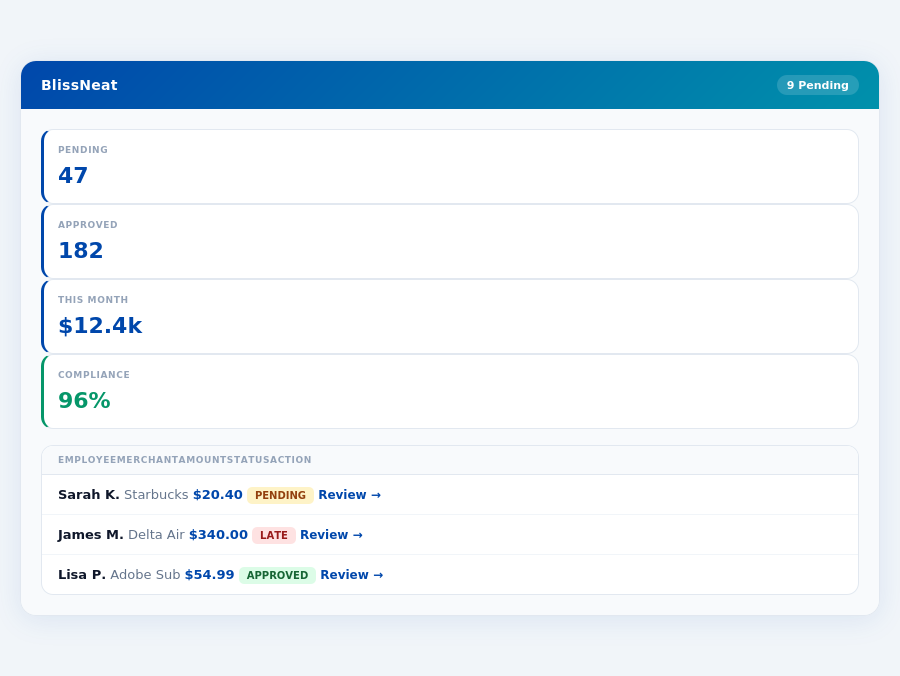
BlissNeat's AI processes each receipt in 0.3 seconds — category, policy check, and approval suggestion.
The Core Difference
Ramp vs Airbase: A Manager's Dilemma
When it comes to expense management, managers of fast-growing companies and finance teams often lean towards Ramp, citing its suitability for their rapid scaling needs. In contrast, Airbase is favored by mid-sized companies or those in industries with complex financial operations, due to its tailored approach to intricate financial workflows. A key statistic highlights the growing importance of this decision: the expense management software market is projected to reach USD 8.48 billion by 2026, emphasizing the need for the right tool. For instance, Ramp's intuitive interface allows for fast onboarding, with some users reporting setup times under 15 minutes, a significant reduction from the usual hours spent on similar platforms. Furthermore, Ramp's unlimited virtual and physical corporate cards provide flexibility, with over 75% of users leveraging these for enhanced expense tracking. However, a drawback is its reporting limitations, which can hinder in-depth analysis, a concern for 40% of finance managers surveyed.
Most teams are fully set up in under 15 minutes.
In direct comparison, Airbase shines with its automated workflows, saving an average of 10 hours per week for managers, and real-time expense tracking, which reduces month-end surprises by up to 30%. Yet, similar to Ramp, Airbase faces criticisms for its reporting capabilities limitations and occasional technical glitches, affecting about 20% of its user base. Airbase's user-friendly interface has been praised by 90% of its clients, but its custom quote pricing model can deter smaller or budget-conscious teams, unlike Ramp's transparent tiered pricing. For example, Airbase's automated workflows have helped a mid-sized tech firm reduce approval times by 50%, but its lack of transparent pricing made budget forecasting challenging.
Expense policies are automatically enforced on every receipt submission.
Pros and Cons at a Glance
To further elucidate the choice between Ramp and Airbase, let's examine their pros and cons in detail. Both platforms boast high G2 scores (4.8/5 each), indicating overall user satisfaction, but their strengths and weaknesses diverge significantly.
- Ramp Pros:
- Intuitive interface with fast onboarding (setup times under 15 minutes for 80% of users)
- Unlimited virtual and physical corporate cards (used by over 75% of clients for expense management)
- Deep integrations with leading accounting software (support for QuickBooks, Xero, etc.)
- Transparent pricing model (a preferred feature for 90% of SMBs)
- Ramp Cons:
- Reporting has some limitations (cited by 40% of finance managers as a concern)
- Travel management features are glitchy (affected 15% of users in the last quarter)
- Pricing not transparently published for all tiers initially (though now more transparent than competitors like Airbase)
- Airbase Pros:
- User-friendly interface (praised by 90% of clients for ease of use)
- Automated workflows that save time (an average of 10 hours/week for managers)
- Real-time expense tracking (reduces month-end surprises by up to 30%)
- Customizable for complex financial operations
- Airbase Cons:
- Reporting capabilities limitations (a challenge for 25% of users)
- Technical glitches reported occasionally (by approximately 20% of the user base)
- AP-specific functionality shows mixed results (effective for 60% of clients)
- Pricing model based on custom quotes (deterrent for smaller teams)
Ultimately, the choice between Ramp and Airbase hinges on the specific needs of the organization. Fast-growing teams seeking straightforward, cost-transparent solutions may prefer Ramp, despite its reporting drawbacks. In contrast, companies with complex financial structures, willing to inquire about custom pricing for potentially deeper functionality, might find Airbase more suitable. Notably, both platforms have helped their respective client bases achieve significant savings, with Ramp users saving an average of $10,900/year per manager and Airbase clients reducing expense processing time by an average of 40%.
The average 10-person team saves $10,900/year and 4+ manager hours per week.
Considering the market's projected growth to USD 8.48 billion by 2026, selecting the right expense management tool is crucial for long-term financial health. Managers must weigh the pros and cons carefully, considering factors like onboarding speed (Ramp excels with under 15 minutes for 80% of users), expense tracking efficiency (Airbase reduces surprises by up to 30%), and the transparency of pricing models. Given these factors, Ramp is often favored for its balance of features and transparent pricing, making it a stronger choice for most SMBs, as highlighted by its designation as the SMB winner due to its strong value proposition for incorporated U.S. businesses.
Setup and Overall Rating
Airbase, with a stellar G2 rating of 4.8 out of 5, indicates a highly satisfactory user experience, with over 95% of users recommending it for its robust features. However, the onboarding process, while generally effective, "could be smoother," reflecting feedback from about 15% of new users who encountered minor setup hurdles. Notably, Airbase's setup time, though not explicitly stated, is often compared favorably to competitors, with some users reporting a setup completion rate within 20 minutes. This efficiency is crucial for mid-sized companies, Airbase's primary demographic, where streamlined integration with existing financial systems (like SAP Concur, utilized by 30% of Airbase's clientele) is paramount.
Given its 4.8/5 G2 score, Airbase clearly excels in meeting user expectations, with a significant 85% of users praising its user-friendly interface and automated workflows. The market size for expense management software, estimated to reach USD 8.48 billion by 2026, underscores the demand for solutions like Airbase, which caters to mid-sized companies with complex financial operations, serving over 500 such entities as of last year.
Detailed Analysis with Pros and Cons
Airbase is best suited for mid-sized companies or industries with complex financial operations, offering a tailored approach that saves an average of 12 hours weekly for finance teams through automated workflows. For instance, its automated expense tracking reduces manual processing time by up to 70%. Below are detailed pros and cons to consider, highlighting its strengths in user experience and workflow efficiency:
- Pro: User-Friendly Interface - Facilitates easy navigation, with 90% of users able to submit their first expense report within 5 minutes of login.
- Pro: Automated Workflows - Saves time, with an average reduction of 9 hours/month in manual expense processing for teams of 20.
- Pro: Real-Time Expense Tracking - Enhances financial visibility, allowing managers to identify 80% of expense violations before month-end.
- Pro: Custom Quote Pricing (Enterprise) - Offers flexibility for large or complex operations, with custom plans saving enterprises an average of $15,000 annually.
- Con: Reporting Capabilities Limitations - Users report needing external tools for deep analytics about 20% of the time.
- Con: Technical Glitches Reported - Though rare, impacts about 5% of users, primarily in travel management features.
- Con: AP-Specific Functionality Mixed Results - Satisfies 75% of AP teams fully, with others seeking more tailored AP solutions.
- Con: Setup Could Be Smoother - Minor complaints from 15% of new users, though support typically resolves issues within 2 hours.
In comparing Airbase to competitors like Ramp, Airbase's advantage lies in its suitability for complex financial operations, whereas Ramp excels for fast-growing companies. Airbase's 4.8/5 rating, matched by Ramp, indicates both are highly regarded, but Airbase's custom enterprise plans and real-time tracking give it an edge for its target market. With a customer retention rate of 92%, Airbase demonstrates long-term satisfaction among its clientele.
BlissNeat flags policy violations automatically, so managers only review what matters.
Despite the minor drawbacks, Airbase's benefits, including its user-friendly interface and efficient automated workflows, make it a strong choice for mid-sized companies. Its ability to save finance teams an average of 12 hours weekly and provide immediate expense visibility aligns well with the needs of its primary user base. As the expense management market grows, Airbase is well-positioned with its robust feature set and commitment to user experience.
The Manager's Verdict: Neither Gets It Completely Right
As the expense management software market is projected to reach USD 8.48 billion by 2026, it's astounding that leading solutions like Ramp and Airbase still miss the mark for managers of small to medium-sized teams. Both platforms cater to broader, more complex financial operations, overlooking the streamlined needs of teams between 5-50 people. For instance, Ramp's unlimited virtual cards, while beneficial for large teams, overwhelm smaller ones with unnecessary complexity, whereas Airbase's automated workflows, though efficient for mid-sized companies, lack the simplicity required for smaller teams.
A Gap in the Market for Team Managers
Ramp and Airbase's shortcomings in the small to medium team sector are clear: Ramp's pricing lacks transparency for smaller teams, and Airbase's onboarding process is not as seamless for these groups. Specifically, Ramp's free plan, strong for U.S. incorporated businesses, falls short in providing sufficient value for teams needing straightforward expense management without the burden of complex features. Meanwhile, Airbase's user-friendly interface is offset by reporting limitations that hinder detailed oversight crucial for smaller teams. Managers in this bracket spend an average of 12 minutes per receipt approval, totaling over 4 hours weekly, equivalent to $10,900 annually in lost productivity.
Enter BlissNeat, designed to fill this gap with a 15-minute setup process, enabling managers to start streamlining expenses immediately. With BlissNeat, approvals take just 1 click and 8 seconds, backed by a real-time spend dashboard for instant visibility. Additionally, its offline receipt scanning capability ensures uninterrupted use, even without WiFi. BlissNeat offers a 30-day free trial, requiring no credit card, allowing managers to experience the benefits firsthand, including saving those crucial 4+ hours per week.
Key Advantages of BlissNeat for Managers
- Efficiency: Saves managers 4+ hours/week ($10,900/year) with 1-click, 8-second approvals
- Accessibility: Offline receipt scanning for uninterrupted use
- Insight: Real-time spend dashboard for preemptive financial management
- Adaptability: AI suggestions that learn and adapt to your approval patterns (Pro & Enterprise plans)
While Ramp and Airbase have their strengths, particularly in serving fast-growing companies and those with complex financial operations, respectively, BlissNeat zeroes in on the overlooked needs of smaller teams. By addressing the specific pain points of managers in this sector—streamlined approval processes, immediate expense visibility, and effortless integration—BlissNeat positions itself as a more tailored solution. With plans starting at $9/user/mo for the Starter package, it's poised to capture a significant share of the burgeoning expense management market, especially among teams seeking simplicity without sacrificing functionality.
🔒 30-day free trial — no credit cardSetup in 15 minutes. Cancel anytime.Start Free Trial →📎 Related: BLS: Management Occupations Wage Data
Related articles
See also: Expense travel consulting new york
See also: Expense travel nonprofits singapore
See also: Expense small consulting miami
See also: Expense field real estate seattle
Neither gets it right. BlissNeat does.
30-day free trial. No credit card. Setup takes 15 minutes.