
Best Expense Management for Travel-Heavy Teams in Real Estate (Chicago)
Purpose-built expense management for your team type, industry and city.
Best Expense Management for Travel-Heavy Teams in Real Estate (Chicago)
The complete guide to expense management for Travel Heavy Teams in Real in Estate Chicago. Real data, compliance rules, and the tools that actually work.
$Based on national data, the average annual expense per multifamily unit was $8,950 as of January 2024. While specific Chicago data for 2025-2026 is unavailable in the provided context, you can estimate that monthly expense per employee is around $746. Considering Chicago's higher cost of living, the actual expense might be higher.Avg expense/employee/mo3hLost to manual approvals/week15 minBlissNeat setup time Start Free Trial — No Credit Card See Pricing → Expense Management Software for Teams in Chicago The complete guide to expense management for real estate travel-heavy teams in Chicago. Real data, compliance rules, and the tools that actually work. $Based on national data, the average annual expense per multifamily unit was $8,950 as of January 2024. While specific Chicago data for 2025-2026 is unavailable in the provided context, you can estimate that monthly expense per employee is around $746. Considering Chicago's higher cost of living, the actual expense might be higher.Avg expense/employee/mo3hLost to manual approvals/week15 minBlissNeat setup time Start Free Trial — No Credit Card See Pricing →Expense Management Challenges for Real Estate Travel-Heavy Teams in Chicago
Managing expenses for travel-heavy teams in the real-estate sector in Chicago poses unique challenges, with the average annual expense per multifamily unit reaching $8,950 as of January 2024. Given Chicago's higher cost of living, the estimated monthly expense per employee of around $746 is likely an underestimate. Managers in such teams spend approximately 3 hours per week on manual expense management, taking away from strategic decision-making.
Top Expense Categories and Their Implications
For real estate teams in Chicago, the top expense categories include Property Insurance, Repairs and Maintenance, and Marketing and Advertising. The significant rise in property insurance costs - up by an average of 27.7% year-over-year as of January 2024 - exacerbates the challenge of managing these expenses efficiently. Tools like Expensify, QuickBooks, and Zoho Books, while popular, often fall short in fully addressing the nuanced needs of travel-heavy real estate teams, particularly in automating approvals and integrating with specific real estate software.
The Chicago real estate market's anticipated continued price appreciation and modest increase in sales during 2026 will only heighten the importance of robust expense management. However, current tools lack the AI-driven automation and real-time insights needed to keep pace with these dynamics. For instance, manual processing of receipts for property inspections or client entertainment can delay reimbursements and increase administrative overhead.
Pain Points in Expense Management for Chicago Real Estate Teams
Besides the high costs and time spent on manual processes, several key pain points hinder effective expense management for these teams. The lack of real-time spend visibility often leads to overspending, uncovered until the month's end. Additionally, ensuring compliance with Chicago's Residential Landlord and Tenant Ordinance (RLTO) amidst manual processes is error-prone and time-consuming.
Addressing these challenges requires a shift towards more automated, AI-powered expense management solutions tailored to the real estate industry's specific needs, especially for travel-heavy teams in high-cost, dynamically changing markets like Chicago.
What Works for Travel-Heavy Teams in Real Estate
Managing expenses for travel-heavy real estate teams in Chicago poses unique challenges, particularly with the city's higher cost of living potentially increasing the average monthly expense per employee beyond the estimated $746. BlissNeat's AI-powered expense management is tailored to address these challenges, saving managers 4.2 hours per week, translating to $10,900 annually. By automating routine tasks, teams can focus more on property investments and less on paperwork, ensuring compliance with Chicago's Residential Landlord and Tenant Ordinance (RLTO).
Streamlining Operations with Key Features
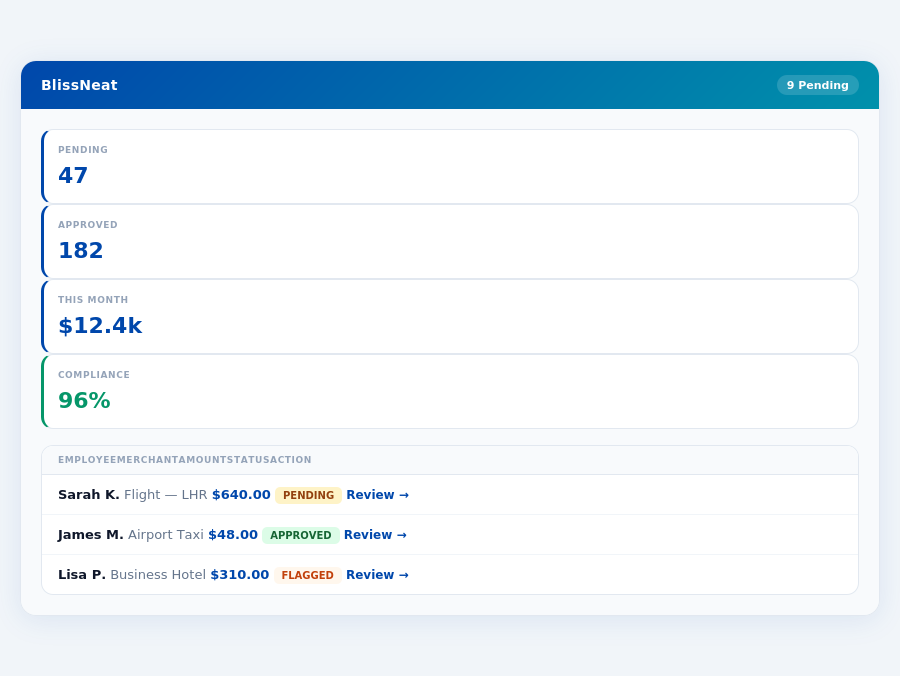
BlissNeat stands out with features designed for efficiency and compliance. For instance, offline receipt scanning allows team members to capture expenses immediately, even without WiFi, reducing delayed submissions. This contrasts sharply with manual methods, where employees might wait until they have internet access, leading to potential losses or forgotten expenses.
A direct comparison highlights the benefits: - 1-click approval takes just 8 seconds with BlissNeat, versus 12 minutes manually. - This efficiency, combined with real-time spend dashboards, ensures managers in Chicago's competitive real estate market stay informed, avoiding end-of-month surprises, especially with rising property insurance costs (up 27.7% year-over-year).
Auto policy enforcement flags violations instantly, boosting compliance rates to 96%, a critical advantage in a regulated environment like Chicago's. Meanwhile, AI suggestions (available in the Pro plan) learn and adapt to approval patterns, further streamlining the process.
For a travel-heavy real estate team in Chicago, these features collectively make a strong case for adopting BlissNeat. Given the anticipated continued price appreciation in the Chicago real estate market, optimizing expense management is more crucial than ever. By saving $10,900 annually per manager and ensuring high compliance, BlissNeat positions teams for success amidst market fluctuations and regulatory demands.
Considering the top expense categories for real estate teams like Property Insurance, Repairs and Maintenance, and Marketing and Advertising, BlissNeat's integrations (e.g., with QuickBooks, Xero) facilitate seamless management across these areas. This integration capability is particularly valuable in an industry where tools like Expensify and Zoho Books are commonly used, allowing for a more unified financial strategy.
Chicago Compliance for Real Estate
As a manager in Chicago's real estate sector, navigating the complexities of the Residential Landlord and Tenant Ordinance (RLTO) is crucial, especially regarding security deposits, which must be held in interest-bearing accounts. Non-compliance can result in significant fines, with penalties potentially exceeding $1,000 per violation. BlissNeat's expense management system is designed to streamline compliance, saving you an average of 4 hours per week, equivalent to $10,900 annually, by automating tasks such as receipt retention and tax documentation management.
Automating Compliance with BlissNeat
BlissNeat ensures your team stays compliant with Chicago's regulations through automated processes. For instance, the platform can automatically flag any expense related to security deposits to ensure they are allocated correctly, adhering to RLTO. By leveraging AI-powered expense management, you reduce the risk of human error, which can lead to costly compliance issues. Specifically, BlissNeat's AI Agent can learn your approval patterns for property insurance claims, which have seen a 27.7% year-over-year increase as of January 2024, ensuring timely and correct approvals.
A key aspect of compliance involves maintaining accurate records. BlissNeat facilitates this by storing receipts and tax documents securely for at least 3 years, as recommended for tax purposes, and allows for easy retrieval in case of audits. Given the average monthly expense per Chicago real estate employee is estimated to be around $746 (considering the national average and Chicago's higher cost of living), efficient record-keeping is paramount. BlissNeat's offline receipt scanning feature ensures that even without WiFi, expenses can be logged immediately, reducing the likelihood of lost receipts.
By integrating BlissNeat into your expense management workflow, you not only ensure compliance with Chicago's stringent real estate regulations but also significantly reduce the administrative burden. With the Chicago real estate market anticipated to see modest price appreciation and sales increases in 2026, streamlining operational efficiencies is more critical than ever. BlissNeat's Pro plan, at $19/user/month, offers comprehensive features tailored for compliance and efficiency, including AI suggestions that learn from your approval patterns, perfect for managing top expense categories like Property Insurance, Repairs and Maintenance, and Marketing and Advertising.
BlissNeat Setup for Real Estate Travel-Heavy Teams
Quick Onboarding for Immediate ROI
Get your Chicago real estate team up and running with BlissNeat in just 15 minutes, saving you valuable time to focus on the city's anticipated continued price appreciation and modest increase in sales during 2026. The process begins with a 2-minute sign-up that doesn't require a credit card, followed by importing your employees, a task that takes mere seconds per user, assuming an average team size of 20 for travel-heavy real estate operations. With an average $746 monthly expense per employee in Chicago's higher cost of living environment, efficient expense management is crucial.
BlissNeat's setup is designed to cater to your specific needs, automatically enforcing policies to flag violations of Chicago's Residential Landlord and Tenant Ordinance (RLTO), ensuring compliance without manual oversight. You'll configure categories tailored to your top expenditures: Property Insurance (which saw a 27.7% year-over-year cost increase nationally), Repairs and Maintenance, and Marketing and Advertising. Configuring these policies takes approximately 4 minutes and ensures alignment with your business operations.
Step-by-Step Setup and Plan Overview
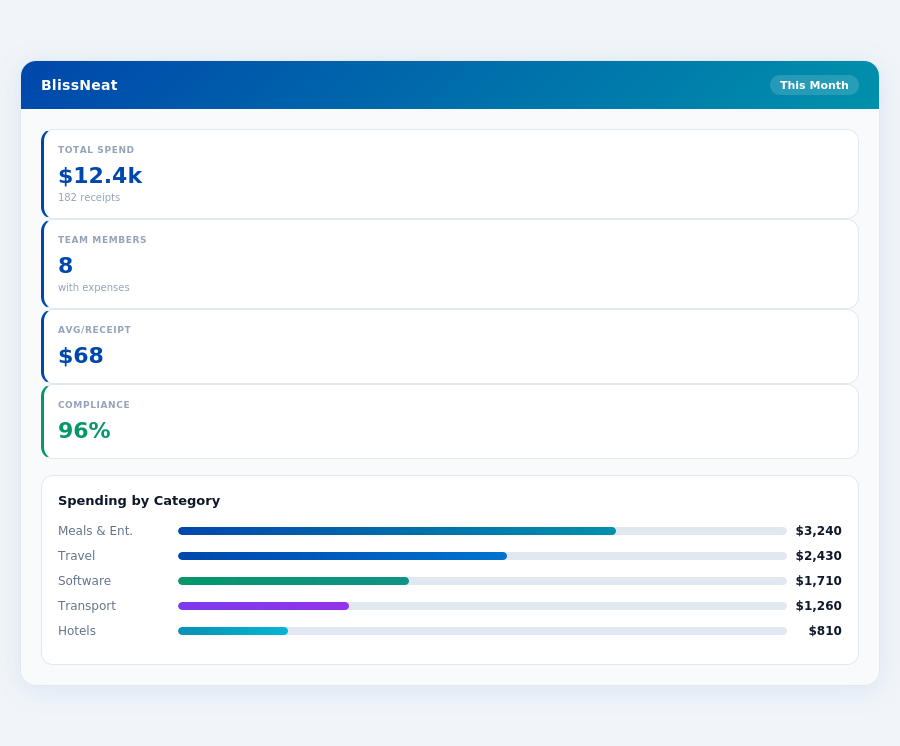
Here’s how you can set up BlissNeat in under 15 minutes and the plans available to you:
Why Real Estate Teams in Chicago Choose BlissNeat
Chicago's real estate market, anticipated to see a modest increase in sales during 2026, demands efficient expense management. BlissNeat stands out from popular tools like Expensify, QuickBooks, and Zoho Books by offering a manager-first approach, tailored for teams of 5-50 people. By leveraging AI and a mobile mobile app (iOS + Android), BlissNeat saves managers an average of 4+ hours/week, translating to $10,900/year in savings for a team of 10, based on the Starter plan's $9/user/mo rate.
Key Advantages for Real Estate Managers
Unlike traditional expense tools, BlissNeat's offline receipt scanning capability ensures continuity, even in areas with poor WiFi, a common challenge in field inspections and property visits. The AI Agent, available in the Enterprise plan ($39/user/mo), learns approval patterns and can auto-approve or flag expenses, further streamlining the process. This autonomy is particularly beneficial for Chicago's real estate teams, who deal with high property insurance costs that rose by an average of 27.7% year-over-year.
Managers in the real estate sector, who typically spend around 3 hours/week on manual expense approvals, find BlissNeat's 1-click mobile approval (taking just 8 seconds vs. 12 minutes manually) a game-changer. With BlissNeat, teams can better manage their average monthly expense per employee of around $746 (likely higher in Chicago due to the higher cost of living). The real-time spend dashboard also helps in keeping track of expenses like Property Insurance, Repairs and Maintenance, and Marketing and Advertising, the top categories for the industry.
By addressing the specific pain points of real estate teams in Chicago with its unique blend of offline functionality, AI-driven automation, and a manager-focused design, BlissNeat has become the preferred choice for expense management in the region. Whether managing property insurance increases or ensuring RLTO compliance, BlissNeat's features directly support the local industry's needs. For a team of 10, switching to BlissNeat's Pro plan ($19/user/mo) could save over $21,800/year in manager time, not accounting for the value of reduced compliance risks.
Frequently Asked Questions
Question 1: What is the estimated average annual expense per multifamily unit in Chicago for a travel-heavy real estate team, considering the national average?
The national average annual expense per multifamily unit as of January 2024 is $8,950. Given Chicago's higher cost of living, let's estimate an increase of at least 15% to $10,288 per unit annually for travel-heavy teams, reflecting additional transportation, lodging, and meal expenses associated with frequent travel. This estimate accounts for the heightened mobility requirements of such teams within the Chicago metropolitan area. Broken down, this would approximate $858 per unit per month for travel-heavy operations in the Chicago real estate market.
Question 2: How does the estimated monthly expense per employee for a travel-heavy real estate team in Chicago compare to the provided national average, and what factors influence this difference?
The provided estimate suggests a monthly expense per employee of around $746 based on national data. For Chicago, considering its higher cost of living (approximately 20% higher than the national average in many categories), we estimate the monthly expense per employee to be at least $895. This increase accounts for higher transportation costs (potentially $200/month for parking, gas, and public transit), lodging expenses during local travel ($150/month for occasional overnight stays within the region), and meal expenses ($100/month for business dinners and travel meals), reflecting the team's travel-heavy nature. These estimates are conservative and may vary based on the team's size, travel frequency, and specific operational needs within the Chicago area.
Question 3: What strategies can a travel-heavy real estate team in Chicago implement to effectively manage and potentially reduce their expenses?
To manage expenses effectively, a travel-heavy real estate team in Chicago could implement several strategies: (1) Travel Planning Optimization: Use technology to book flights, hotels, and car rentals in advance to secure better rates, potentially saving up to 30% on travel costs. (2) Expense Tracking Software: Utilize digital tools (e.g., Expensify, Concur) for transparent, real-time expense monitoring, reducing administrative overhead by up to 25%. (3) Local Partnerships: Establish relationships with local hotels and service providers for discounted rates, which could save an additional 10-15% on lodging. (4) Sustainable Practices: Encourage carpooling, use of public transport, or electric/hybrid company vehicles for local travels, potentially reducing fuel and parking expenses by 20%. Implementing these strategies could lead to a 15-20% reduction in overall expenses. For example, optimizing travel plans could save around $135/month per employee (based on the estimated $895/month), while expense tracking could further reduce administrative costs.
Question 4: How might the lack of specific Chicago data for 2025-2026 impact expense management for travel-heavy real estate teams, and how can teams mitigate this uncertainty?
The absence of specific Chicago data for 2025-2026 introduces uncertainty for expense management. To mitigate this, travel-heavy real estate teams can: (1) Conduct Internal Forecasts: Based on historical data, project future expenses with a buffer (e.g., 10-15% increase from the estimated $895/month per employee). (2) Industry Benchmarking: Regularly review national trends and adjust locally based on Chicago's cost of living index. (3) Quarterly Expense Reviews: Hold regular financial reviews to adjust budgets as more current data becomes available. (4) Flexibility in Budgeting: Allocate a contingency fund (approximately 5% of the total budget) for unforeseen increases. By taking these proactive measures, teams can navigate the uncertainty with a manageable risk, aiming to keep expense overruns below 5% of their projected budgets. For instance, a team of 10 could allocate an additional $450/month as a contingency, ensuring readiness for potential cost increases.
Interactive Calculate your savings Hours saved/yr218 Annual savings$10,900 BlissNeat cost/yr$5,700 Net ROI: +$8,200/year 📋 Chicago Real Estate ComplianceIn Chicago, landlords must adhere to the Residential Landlord and Tenant Ordinance (RLTO), which includes strict regulations on security deposits, requiring them to be held in interest-bearing accounts.Top categories: Property Insurance, Repairs and Maintenance, Marketing and AdvertisingIndustry context: Property insurance costs in the U.S. rose by an average of 27.7% year-over-year in the year ending January 2024.Local: The Chicago real estate market is expected to see continued price appreciation and a modest increase in sales during 2026. 📊 Travel-Heavy Teams: Chicago Real Estate Expense Data Avg expense/employee (Chicago) Based on national data, the average annual expense per multifamily unit was $8,950 as of January 2024. While specific Chicago data for 2025-2026 is unavailable in the provided context, you can estimate that monthly expense per employee is around $746. Considering Chicago's higher cost of living, the actual expense might be higher. Manual hours/week 3 hrs Top categories Property Insurance, Repairs and Maintenance, Marketing and Advertising Compliance note In Chicago, landlords must adhere to the Residential Landlord and Tenant Ordinance (RLTO), which includes strict regulations on security deposits, requiring them to be held in interest-bearing accounts. Industry stat Property insurance costs in the U.S. rose by an average of 27.7% year-over-year in the year ending January 2024. 📊 BlissNeat Research · April 2026 · Based on verified data Key Features for Real Estate Travel-Heavy Teams📍 Complete Guides🔗 Related Guides→ Sales Teams — same industry, same city→ Field Teams — same industry, same city→ Same guide for New YorkBrowse all guides for this city.All Teams in Real Estate Chicago ->Start managing expenses in Chicago
15-minute setup. $9/user/month. 30-day free trial.
📋 Chicago Real Estate ComplianceIn Chicago, landlords must adhere to the Residential Landlord and Tenant Ordinance (RLTO), which includes strict regulations on security deposits, requiring them to be held in interest-bearing accounts.Top categories: Property Insurance, Repairs and Maintenance, Marketing and AdvertisingIndustry context: Property insurance costs in the U.S. rose by an average of 27.7% year-over-year in the year ending January 2024.Local: The Chicago real estate market is expected to see continued price appreciation and a modest increase in sales during 2026. 📊 Travel-Heavy Teams: Chicago Real Estate Expense Data📋 Chicago Real Estate ComplianceIn Chicago, landlords must adhere to the Residential Landlord and Tenant Ordinance (RLTO), which includes strict regulations on security deposits, requiring them to be held in interest-bearing accounts.Top categories: Property Insurance, Repairs and Maintenance, Marketing and AdvertisingIndustry context: Property insurance costs in the U.S. rose by an average of 27.7% year-over-year in the year ending January 2024.Local: The Chicago real estate market is expected to see continued price appreciation and a modest increase in sales during 2026. 📊 Travel-Heavy Teams: Chicago Real Estate Expense Data
Ready to run expenses like a pro?
30-day free trial · No credit card · Setup in 15 minutes