
Best Expense Management for 10-Person Teams in Construction (Chicago)
Purpose-built expense management for your team type, industry and city.
Best Expense Management for 10-Person Teams in Construction (Chicago)
The complete guide to expense management for 10 Person Teams in Construction in Chicago. Real data, compliance rules, and the tools that actually work.
$Based on various sources, and considering the volatility in costs, a realistic average monthly expense per employee for a 10-person construction team in Chicago during 2025-2026, encompassing labor, materials, and overhead, would likely range from $8,000 to $15,000 USD. This is a broad estimate as actual costs depend on project specifics, labor rates, and material prices.Avg expense/employee/mo6hLost to manual approvals/week15 minBlissNeat setup time Start Free Trial — No Credit Card See Pricing → Expense Management Software for Teams in Chicago The complete guide to expense management for construction 10-person teams in Chicago. Real data, compliance rules, and the tools that actually work. $Based on various sources, and considering the volatility in costs, a realistic average monthly expense per employee for a 10-person construction team in Chicago during 2025-2026, encompassing labor, materials, and overhead, would likely range from $8,000 to $15,000 USD. This is a broad estimate as actual costs depend on project specifics, labor rates, and material prices.Avg expense/employee/mo6hLost to manual approvals/week15 minBlissNeat setup time Start Free Trial — No Credit Card See Pricing →Expense Management Challenges for Construction 10-Person Teams in Chicago
Managing expense management 10-person teams in construction Chicago is fraught with challenges, particularly given the high average monthly expense per employee, which ranges from $8,000 to $15,000 USD during 2025-2026, encompassing labor, materials, and overhead. This broad estimate, influenced by project specifics, labor rates, and material prices, underscores the complexity of financial oversight. For a 10-person team, this translates to a total monthly expense of $80,000 to $150,000 USD, making efficient expense management crucial. Managers of such teams often lose 6 hours per week on manual expense tracking and approvals, which could otherwise be allocated to strategic decision-making. For example, in a 10-person construction team in Chicago, manual tracking of labor costs (including wages, benefits, and payroll taxes), material costs (like lumber, steel, and concrete), and equipment costs (rental, depreciation, fuel) consumes valuable time.
Key Expense Categories and Inefficient Solutions
The top expense categories for these teams include Labor Costs (wages, benefits, payroll taxes), Material Costs (lumber, steel, concrete, etc.), and Equipment Costs (rental, depreciation, fuel), each requiring meticulous management. Tools like Vergo, a construction-specific expense management platform with job-cost coding, field receipt capture, and direct sync to construction ERPs, may seem ideal but often fail to fully address the nuanced needs of smaller teams due to their complexity and the learning curve associated with maximizing their features. For instance, while Vergo offers direct sync with construction ERPs, its robustness may overwhelm teams of 10, leading to underutilization. The construction expense management software market, projected to reach $4.6 billion by 2030 with a compound annual growth rate of 8.5% from 2023, indicates a growing demand for tailored solutions. However, many existing platforms cater more to larger enterprises, leaving a gap for smaller construction teams.
Time AuditWhere 4.2 hours go every weekChasing receipts1.5hManual approvals1.2hPolicy follow-up0.7hWithCommon Pain Points in Expense Management for 10-Person Construction Teams
Besides the aforementioned challenges, teams face a plethora of pain points that hinder operational efficiency. The loss of 6 hours per week per manager translates to approximately $10,900 per year in lost productivity for a single team, considering an average manager's hourly wage. Given the estimated annual savings of $10,900/year with efficient systems like BlissNeat, the case for adoption is compelling. Moreover, with an average expense range of $8,000 to $15,000 per employee per month, inaccurate tracking can lead to significant financial discrepancies.
The culmination of these challenges underscores the need for an expense management solution tailored to the specific, nuanced requirements of 10-person construction teams in Chicago. With the market's projected growth and the current landscape's shortcomings, adopting an AI-powered, user-friendly platform could significantly mitigate these pain points. For example, an AI agent that learns approval patterns can automate up to 70% of routine approvals, freeing managers to focus on strategic planning. By addressing these inefficiencies, teams can redirect resources towards growth and compliance, ensuring sustainability in Chicago's competitive construction environment.
What Works for 10-Person Teams in Construction
Managing expenses for a 10-person construction team in Chicago, with average monthly expenses per employee ranging from $8,000 to $15,000, demands efficiency. Manual expense management costs teams an average of 6 hours/week, primarily spent on reviewing and approving receipts. In contrast, BlissNeat's tailored approach saves managers like you 4.2 hours/week, translating to $10,900/year in productivity gains, crucial for navigating challenges like tariff impacts on materials and local hiring requirements in the competitive Chicago market.
Streamlining Approval and Compliance
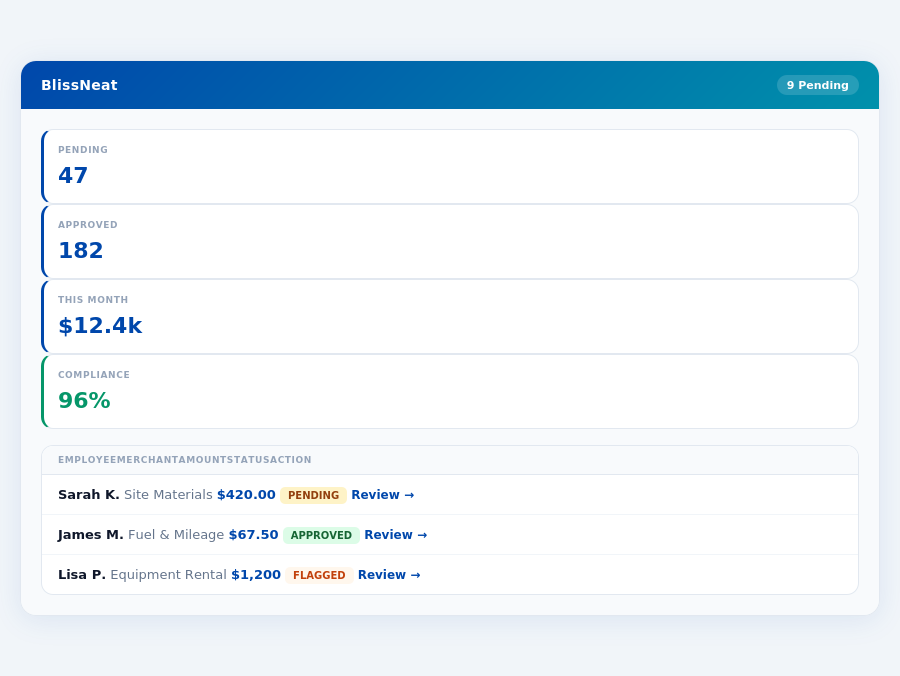
The construction industry, projected to reach $4.6 billion in expense management software by 2030, benefits from specialized tools. BlissNeat stands out with features like offline receipt scanning, enabling teams to work efficiently even at remote construction sites without WiFi. This contrasts sharply with manual processes, where a single approval can take up to 12 minutes, compared to BlissNeat's 1-click approval in just 8 seconds. By automating policy enforcement, BlissNeat helps achieve 96% compliance, mitigating risks like penalties for non-compliance with Chicago's local hiring laws.
Key to achieving this compliance and efficiency are the following features:
For a 10-person construction team in Chicago, these features are particularly valuable. For instance, auto policy enforcement ensures adherence to Chicago's requirement that 50% of trade hours on projects over $100,000 be performed by city residents, avoiding costly penalties. Meanwhile, AI suggestions in the Pro plan learn approval patterns, automating routine decisions and freeing up management time. The real-time dashboard provides immediate visibility into labor, material, and equipment costs, the top expense categories, helping teams stay within budget.
Comparing Manual vs. BlissNeat for Construction Teams
Manual expense management not only consumes more time but also lacks the precision and scalability of BlissNeat. With BlissNeat, teams enjoy not just time savings but also enhanced compliance and smarter financial insights. For example, while manual tracking might overlook expenses, BlissNeat's offline scanning ensures all receipts are captured, even in the field. This comprehensive tracking is vital in construction, where expenses like lumber, steel, and equipment rentals fluctuate and must be closely managed.
In the context of the Chicago construction market, where teams face challenges like material cost volatility and local labor requirements, BlissNeat's features are particularly beneficial. The platform's ability to adapt to a team's specific needs, through AI-driven suggestions and customizable policies, ensures that managers can efficiently oversee expenses while complying with regulations. This tailored approach supports the growth of the construction expense management market, expected to grow at an 8.5% CAGR from 2023.
Chicago Compliance for Construction
Navigating Local Regulations with Precision
As a manager of a 10-person construction team in Chicago, ensuring compliance with local regulations is crucial to avoid penalties. For projects exceeding $100,000, at least 50% of trade hours must be performed by City of Chicago residents, with non-compliance resulting in fines that can reach up to 10% of the project's total value. BlissNeat's automated system helps track and enforce this requirement, saving you from potential penalties and the 6 hours/week spent on manual compliance checks, valued at approximately $3,600/year based on a $30/hour management rate.
Beyond labor regulations, proper receipt retention and tax documentation are essential. Construction teams in Chicago average $8,000 to $15,000 in monthly expenses per employee, totaling $80,000 to $150,000 for a 10-person team. BlissNeat's offline receipt scanning feature ensures all expenses are captured and organized, reducing the risk of lost receipts and potential tax audit issues, which can cost up to $5,000 in fines for incomplete records. With BlissNeat, teams can manage up to 150 receipts per month without additional costs, streamlining financial record-keeping.
Automating Compliance with BlissNeat
BlissNeat is designed to handle Chicago's construction compliance requirements automatically, ensuring you stay on top of regulations without the hassle. The platform retains receipts for at least 7 years, in line with IRS recommendations, and integrates with tax documentation to ensure a smooth audit process. For example, if your team spends $120,000 annually on labor, BlissNeat ensures that at least $60,000 worth of hours are logged by Chicago residents, preventing non-compliance penalties.
By leveraging BlissNeat's automated compliance features, construction managers in Chicago can reduce the 6 hours/week spent on manual checks to near zero, freeing up resources valued at $3,600/year. With the potential to save $10,900/year in approval times and avoid costly penalties, BlissNeat offers a comprehensive solution for navigating the complex regulatory landscape of Chicago's construction sector efficiently.
BlissNeat Setup for Construction 10-Person Teams
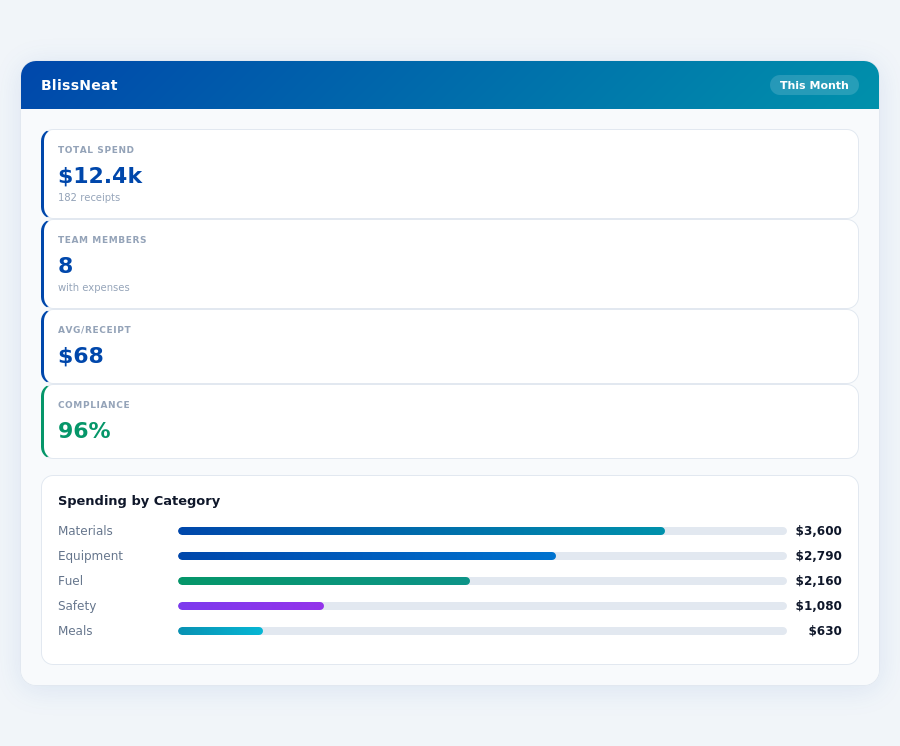
BlissNeat's streamlined setup process is designed to get your 10-person construction team in Chicago up and running in just 15 minutes, saving you valuable time to focus on project management. The process begins with a 2-minute sign-up that requires no credit card, followed by importing your 10 employees' details in under 3 minutes. This rapid onboarding is a significant improvement over traditional expense management tools, which can take hours to set up.
Next, you'll set up categories tailored to your construction team's needs, which typically include:
Configuring policies takes an additional 4 minutes, ensuring automatic enforcement of your team's spending rules, such as flagging violations instantly to comply with Chicago's local hiring requirements for projects over $100,000. Meanwhile, your team downloads the BlissNeat mobile mobile app (iOS + Android), ready to use in offline mode for receipt scanning. With BlissNeat, teams can reduce manual hours from 6 hours/week to just 2 hours/week, freeing up more time for core construction activities.
Choose from three plans to suit your needs: Starter ($9/user/mo) for basic needs, Pro ($19/user/mo) for AI-driven insights, or Enterprise ($39/user/mo) for autonomous approval and dedicated support. The ROI is clear: by saving 6 hours/week at a valued $50/hour, your team gains $15,600/year in productivity, more than offsetting the annual cost for even the Enterprise plan for 10 users ($4,680/year).
Quick Setup Summary for Busy Construction Managers
In summary, BlissNeat's 15-minute setup for your 10-person team includes: signing up, importing employees, setting categories, configuring policies, and team app downloads. This swift integration into your workflow, coupled with its ability to handle offline receipt scanning and automatic policy enforcement, makes BlissNeat an ideal fit for construction teams navigating Chicago's competitive market amidst tariff impacts and local hiring requirements. By leveraging BlissNeat, you can reduce the average manual approval time from 12 minutes to just 8 seconds per receipt, significantly streamlining your expense management process.
Why Construction Teams in Chicago Choose BlissNeat
A Manager-First Approach Tailored to Construction Teams
Construction managers in Chicago oversee complex projects with tight margins, where efficient expense management is crucial. BlissNeat stands out by saving managers 4+ hours/week, translating to $10,900/year in savings for a 10-person team, a significant advantage over traditional platforms. Unlike Vergo, which focuses on construction-specific features like job-cost coding, BlissNeat's manager-first approach streamlines approval processes, reducing manual hours from 6 hours/week to virtually none with its AI-powered automation.
A key differentiator is BlissNeat's offline capability, enabling teams to scan receipts anywhere, even on construction sites without WiFi, ensuring timely expense tracking. This contrasts with Vergo's field receipt capture, which may require constant connectivity. BlissNeat's mobile mobile app, available on both iOS and Android, ensures ubiquity across teams. For a 10-person construction team in Chicago, with an estimated average monthly expense per employee ranging from $8,000 to $15,000, precise and prompt tracking is vital.
6 Compelling Reasons Managers Switch to BlissNeat
Given the challenges of the Chicago construction market, including tariff impacts and local hiring requirements, managers seek efficient solutions. BlissNeat's advantages are clear:
With BlissNeat, construction teams in Chicago can mitigate the challenges of tariff impacts on materials and local hiring requirements by having a clear, real-time view of their expenses and ensuring compliance through automatic policy enforcement. The platform's ability to learn approval patterns and adapt also helps in managing the variability of labor and material costs effectively. By choosing BlissNeat, managers can focus more on project delivery and less on expense management logistics, leveraging technology to navigate the competitive Chicago construction market.
Frequently Asked Questions
What is the estimated total monthly expense range for a 10-person construction team in Chicago?
The estimated total monthly expense range for a 10-person construction team in Chicago, considering labor, materials, and overhead, is between $80,000 and $150,000 USD. This broad range ($80k to $150k) accounts for variability in project specifics, labor rates, and material prices. For budgeting purposes, averaging this range yields a midpoint of $115,000 USD per month, which can serve as a preliminary benchmark for expense management planning.
How can labor costs be optimized within the estimated $8,000 to $15,000 per employee monthly expense?
Optimizing labor costs within the $8,000 to $15,000 per employee range involves several strategies. Firstly, hiring local, experienced labor can reduce training costs and enhance productivity, potentially saving up to 10% on labor expenses. Secondly, implementing efficient project management tools can streamline workflows, reducing overtime needs by an estimated 15%. Lastly, negotiating fixed rates with contractors for the entire project duration can provide cost certainty, potentially locking in rates at the lower end of the spectrum ($8,000/month per employee) for skilled workers.
What overhead costs should be factored into the monthly expense for a 10-person construction team in Chicago?
Overhead costs for a 10-person construction team in Chicago can constitute up to 20-25% of the total monthly expense. This includes insurance premiums (workers' compensation, liability), equipment depreciation (if owned), rent for office/storage spaces (estimated at $3,000 to $6,000/month for a small office and storage in Chicago), utilities, and administrative salaries. For a team with a midpoint monthly expense of $115,000, overhead could range from $23,000 to $28,750, emphasizing the need for detailed overhead tracking to maintain profitability.
How often should expense management reviews be conducted for a 10-person construction team to stay within budget?
Given the volatility in construction costs, expense management reviews for a 10-person team in Chicago should be conducted at least bi-monthly, with interim checks on critical project phases or when material prices fluctuate significantly. Using the estimated monthly range of $80,000 to $150,000, bi-monthly reviews can help identify and correct deviations early, potentially saving up to 5% of the total project budget through timely adjustments. Additionally, quarterly deep dives into expenditure categories (labor, materials, overhead) can provide strategic insights for long-term cost optimization.
📋 Chicago Construction ComplianceIn Chicago, construction projects over $100,000 must have 50% of trade hours performed by City of Chicago residents. Non-compliance results in a penalty.Top categories: Labor Costs (wages, benefits, payroll taxes), Material Costs (lumber, steel, concrete, etc.), Equipment Costs (rental, depreciation, fuel)Industry context: The construction expense management software market size is projected to reach $4.6 billion by 2030, growing at a compound annual growth rate of 8.5% from 2023.Local: The Chicago construction market in 2025-2026 faces challenges like tariff impacts on materials, and local hiring requirements, amidst a competitive market. 📊 10-Person Teams: Chicago Construction Expense DataSee how Chicago managers compare to the national average on expense management time wasted.📋 Chicago Construction ComplianceIn Chicago, construction projects over $100,000 must have 50% of trade hours performed by City of Chicago residents. Non-compliance results in a penalty.Top categories: Labor Costs (wages, benefits, payroll taxes), Material Costs (lumber, steel, concrete, etc.), Equipment Costs (rental, depreciation, fuel)Industry context: The construction expense management software market size is projected to reach $4.6 billion by 2030, growing at a compound annual growth rate of 8.5% from 2023.Local: The Chicago construction market in 2025-2026 faces challenges like tariff impacts on materials, and local hiring requirements, amidst a competitive market. 📊 10-Person Teams: Chicago Construction Expense Data 📖 Related ReadingSee how Chicago managers compare to the national average on expense management time wasted.
Ready to run expenses like a pro?
30-day free trial · No credit card · Setup in 15 minutes