
BlissNeat vs Doing Nothing: The Real Cost Comparison
The real cost of doing nothing — for managers running 10-50 person teams.
On average, a manager like you loses approximately 4.2 hours every week on expense-related tasks. This might seem negligible, but it translates to a substantial $10,920 per year, assuming a modest hourly value of $50.
The Hidden Cost Nobody Tracks
Managers often underestimate the time spent on expense tasks, but the reality is that it's a significant drain on productivity. According to a recent study, managers lose an average of 4.2 hours per week on expense tasks. This may seem like a small amount, but when you break it down, it's a substantial cost to the company.
Let's do the math. Assuming a manager's hourly wage is $50, the weekly cost of expense tasks is $210 (4.2 hours x $50 per hour). This may not seem like a lot, but when you multiply it by the number of weeks in a year (52), the annual cost is $10,920 per manager.
Here's a weekly breakdown of the time spent on expense tasks and the associated cost:
Weekly time spent on expense tasks: 4.2 hours
Weekly cost: $210 (4.2 hours x $50 per hour)
Annual cost: $10,920 (52 weeks x $210 per week)
How the Cost Compounds With Team Size
The cost of expense tasks can quickly add up as the team size grows. Let's consider a few examples. If a company has three managers, each spending 4.2 hours per week on expense tasks, the total weekly cost is $630 (3 x $210). Annually, this translates to $32,760 (52 weeks x $630 per week).
As the team size grows, so does the cost. For a company with 10 managers, the weekly cost is $2,100 (10 x $210), and the annual cost is $109,200 (52 weeks x $2,100 per week). This is a significant expense that could be better spent on other areas of the business.
The math is clear: the cost of expense tasks compounds quickly as the team size grows. It's essential for companies to consider this cost and explore ways to reduce it.
Here's a summary of the cost of expense tasks for different team sizes:
3 managers: $32,760 per year (3 x $10,920)
10 managers: $109,200 per year (10 x $10,920)
The Receipt Chase That Never Ends
One of the most frustrating aspects of expense tasks is the receipt chase. This is the daily friction that occurs when employees fail to submit receipts, or when receipts are blurry, incorrect, or missing. Managers must then spend time chasing employees to obtain the necessary documentation, which can be a significant time drain.
The receipt chase can be a never-ending cycle. Employees may forget to submit receipts, or they may not understand the company's expense policy. Managers must then spend time educating employees and following up on missing receipts. This can lead to delays in reimbursement and a lack of transparency in the company's finances.
The receipt chase can also lead to errors and discrepancies in the company's financial records. When receipts are missing or incorrect, it can be challenging to accurately track expenses and ensure compliance with company policies.
What Policy Violations Actually Cost
When out-of-policy expenses slip through, they can have a significant impact on a company's bottom line. Not only do these expenses eat into profits, but they also create a culture of non-compliance that can be difficult to reverse. Moreover, when employees know that they can get away with submitting non-compliant expenses, they may be more likely to push the boundaries even further, leading to a slippery slope of expense abuse.
Another significant risk associated with policy violations is the risk of expense fraud. According to the Association of Certified Fraud Examiners, the average company loses 5% of its revenue to expense fraud each year. This can add up to tens of thousands of dollars, or even more, depending on the size of the company. By not having a robust expense management system in place, companies are leaving themselves vulnerable to this type of abuse.
The costs of policy violations can also extend beyond just the financial impact. When employees are submitting non-compliant expenses, it can create a sense of mistrust and undermine the company's values and culture. This can lead to decreased morale and productivity, as well as increased turnover rates. By implementing a robust expense management system, companies can help to prevent these types of issues and create a more positive and productive work environment.
Month-End Reconciliation Hell
Month-end reconciliation is a critical process that ensures the company's financial records are accurate and up-to-date. However, this process can be a nightmare when it comes to expense tasks. Managers must spend hours matching receipts to statements, identifying errors, and making corrections.
The process can be time-consuming and labor-intensive, requiring managers to pour over financial statements and receipts to ensure accuracy. This can lead to late nights and weekends spent working on expense tasks, rather than focusing on more strategic activities.
Month-end reconciliation can also be a source of stress and anxiety for managers. The pressure to meet deadlines and ensure accuracy can be overwhelming, and the consequences of errors or discrepancies can be severe. In some cases, errors may even trigger audits or other regulatory issues.
The process of month-end reconciliation can be improved with the right tools and processes. However, without these, it can be a significant source of frustration and stress for managers.
The Opportunity Cost of Doing Nothing
When managers are spending a significant amount of time reviewing and approving expenses, it can take away from more strategic and important work. According to a recent study, managers spend an average of 218 hours per year reviewing and approving expenses. This is time that could be better spent on high-level tasks such as business development, talent management, and strategic planning.
By not implementing an automated expense management system, companies are essentially choosing to allocate their managers' time to low-level tasks rather than high-level tasks. This can have a significant opportunity cost, as managers are not able to focus on the tasks that will drive the most value for the company. By automating the expense management process, companies can free up their managers to focus on more strategic and important work.
The opportunity cost of doing nothing can also extend beyond just the time spent by managers. When employees are submitting expenses, they may be waiting for reimbursement for an extended period of time. This can create cash flow problems for employees, as well as decreased morale and productivity. By implementing an automated expense management system, companies can help to reduce the time it takes for employees to get reimbursed, which can lead to increased morale and productivity.
Furthermore, the opportunity cost of doing nothing can also be seen in the lack of visibility and control that companies have over their expenses. Without a robust expense management system, companies may not have a clear understanding of where their money is being spent, which can make it difficult to make informed business decisions. By implementing an automated expense management system, companies can gain greater visibility and control over their expenses, which can lead to better decision-making and more effective cost management.
Why Most Managers Keep Delaying
One of the main reasons that managers keep delaying the implementation of an automated expense management system is the perceived switching cost. Many managers believe that implementing a new system will be too time-consuming and costly, and that it will disrupt the current workflow. However, this is often a myth. In reality, implementing an automated expense management system can be relatively quick and easy, and can often be done in a matter of minutes.
Another reason that managers keep delaying is the fear of disruption. Many managers are hesitant to implement a new system because they are afraid that it will disrupt the current workflow and cause problems for employees. However, this is often not the case. In reality, an automated expense management system can often be implemented without disrupting the current workflow, and can often lead to increased efficiency and productivity.
The delay itself is often the most expensive decision. By not implementing an automated expense management system, companies are essentially choosing to continue with a manual and inefficient process that can lead to wasted time and money. In reality, the cost of implementing an automated expense management system is often far less than the cost of continuing with a manual process. By delaying the implementation of an automated expense management system, companies are essentially choosing to throw money away.
What BlissNeat Changes in 15 Minutes
BlissNeat is an automated expense management system that can be set up in just 15 minutes. With BlissNeat, employees can scan receipts in just 0.3 seconds, and managers can approve expenses with just one click. This can lead to a significant reduction in the time spent on expense management, as well as increased efficiency and productivity.
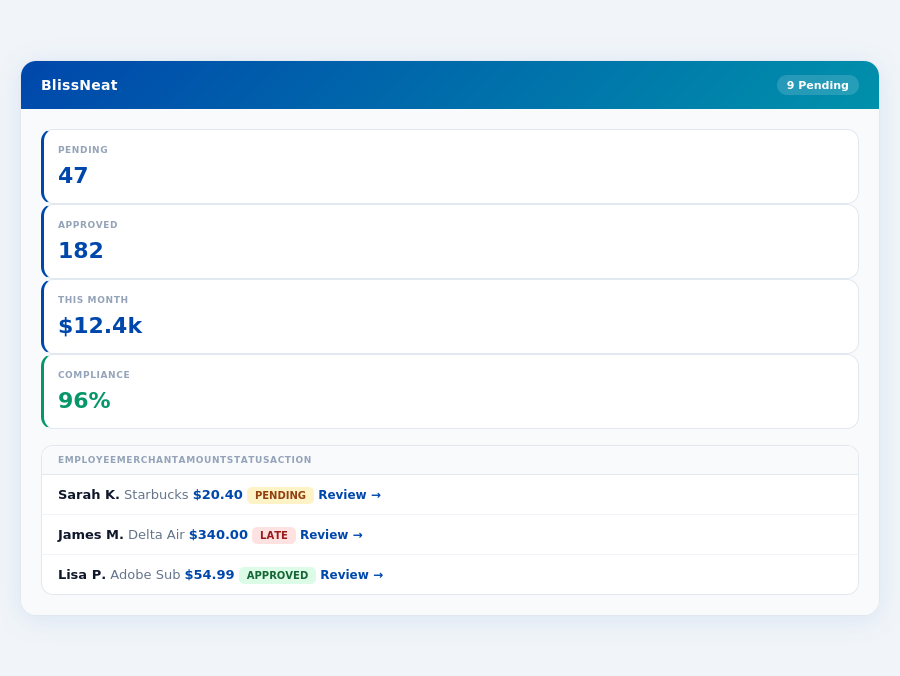
BlissNeat also has a 96% compliance rate, which means that companies can be confident that their expenses are being managed in accordance with company policy. This can help to reduce the risk of expense fraud and abuse, and can lead to increased visibility and control over company expenses.
By implementing BlissNeat, companies can also reduce the opportunity cost of doing nothing. With BlissNeat, managers can focus on more strategic and important work, rather than spending time reviewing and approving expenses. This can lead to increased morale and productivity, as well as better decision-making and more effective cost management.
See also: Expense sales construction austin
See also: Expense small legal seattle
See also: Expense field legal dallas
See also: Expense remote tech new york
See also: Expense travel nonprofits sydney
See also: Expense sales real estate austin
Stop losing $10,900/year to manual processes
30-day free trial. No credit card. Setup takes 15 minutes.